The Heckler & Koch HK433 gives shooters two familiar operating systems in one rifle
The Heckler & Koch HK433 was built around a simple idea with big consequences for modern rifle users: combine the operating concepts of the G36 and the HK416 in a single, modular 5.56 mm platform. Rather than forcing units to pick a side in the long-running debate over controls and handling, the HK433 lets shooters configure the rifle to feel like the system they already know. That hybrid approach turns a technical design exercise into a practical answer to training time, logistics and battlefield stress.
From concept to “revolutionary hybrid” rifle

Heckler & Koch describes the HK433 as a revolutionary hybrid weapon platform that merges two of its established assault rifle families into one new type of weapon platform. In official material, the company calls it a scalable and modular all-round talent meant to bridge the worlds of the G36 and the HK416 for military and law enforcement customers who want familiar ergonomics with updated engineering. The rifle is chambered in 5.56 mm x 45 NATO and is positioned squarely in the same role as those predecessors, but with a design that tries to capture their best traits in a single package.
At the core of the HK433 is a short-stroke gas piston operating system that places it in the same mechanical family as the HK416 and the G36. That choice reflects Heckler & Koch’s long-standing commitment to piston-driven rifles instead of direct impingement designs. The HK433 uses a rotating bolt and a gas block that siphons off propellant gas to cycle the action, a setup intended to keep heat and fouling away from the bolt carrier group and extend reliability under sustained fire.
Externally, the HK433 presents a clean, modern profile with a monolithic-style upper and extensive rail space for optics and accessories. The lower receiver is designed for flexibility, with control layouts that can be configured to mimic either the G36 or the HK416 operating philosophies. That decision turns what could have been a simple incremental update into a platform that directly targets the institutional habits of units that have spent years on one system or the other.
Two operating systems in one rifle
The headline feature of the HK433 is its dual operating concept that draws directly from the G36 and the HK416. Heckler & Koch’s own description highlights the merging of two HK assault rifle worlds into one, and user-oriented material emphasizes that the rifle’s controls can be set up to match the manual of arms that shooters already know. The selector, magazine release and charging handle arrangements can be configured so that a G36-trained soldier or an HK416-trained soldier can pick up the HK433 and find familiar motions.
Technical overviews note that the HK433 was designed to be familiar to operators with experience using the Heckler & Koch G36 and HK416. That familiarity extends beyond simple control placement to the overall feel of the rifle in the shoulder, the way the folding and adjustable stock locks in place, and the ambidextrous nature of the controls. The goal is to reduce cognitive load during high-stress use so that muscle memory built on earlier HK platforms still applies.
Forum discussions among early observers have described this as a customizable operating philosophy. Enthusiasts who examined the rifle highlighted that an outstanding feature of the HK433 is the adaptable operating philosophy, which results from the ability to tailor the control scheme. This is a different approach from many modular rifles that focus solely on barrel swaps or caliber changes. In the HK433, modularity extends to how the human being behind the trigger interacts with the machine.
Technical architecture and core specifications
Mechanically, the HK433 uses a short-stroke gas piston system with a rotating bolt, a layout that places it alongside modern 5.56 mm service rifles that prioritize reliability in adverse conditions. The gas system is adjustable, allowing tuning for suppressor use or different ammunition loads. The upper receiver is made from aluminum, while the lower receiver is made of polymer to reduce weight and simplify manufacturing. This combination follows a pattern seen in other Heckler & Koch designs that mix metal and high-strength polymer components.
The rifle is chambered in 5.56 mm x 45 NATO, and official product data lists this caliber as the standard configuration. The HK433 is offered with multiple barrel lengths to suit roles from close quarters to standard infantry use. At trade shows, Heckler & Koch representatives have displayed barrels that can accept a front sight interface and bayonet holder as optional equipment, and they have emphasized that all barrels can be swapped within the same platform. That approach allows a single lower and upper receiver set to serve as a compact carbine or a longer rifle simply by changing the barrel assembly.
Heckler & Koch marketing material describes the HK433 as a scalable and modular all-round talent. The scaling refers not only to barrel length but also to features such as different fore ends, stock types and accessory configurations. The rifle includes a mechanical sight system as standard and a full-length rail for optics. The folding stock can also be adjusted for length of pull and cheek height, which supports shooters wearing body armor or using various sighting systems.
Ergonomics under stress
Heckler & Koch has framed the HK433’s operating concept around performance in stressful situations. Company descriptions emphasize that the revolutionary operating concept is intended to help users operate the rifle safely and effectively when adrenaline is high and fine motor skills are compromised. Large, ambidextrous controls and clear tactile feedback on selectors and charging handles are part of that design philosophy.
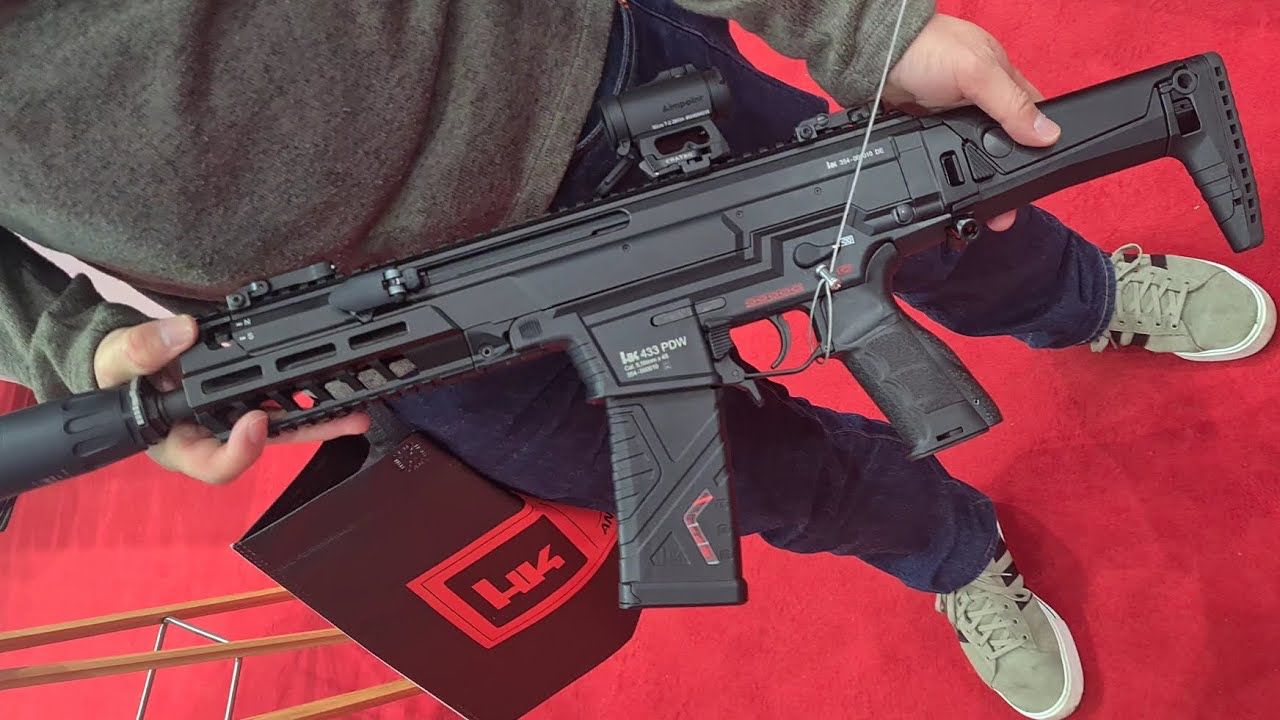
Video demonstrations at events such as Shot Show have shown company representatives walking viewers through the control layout of the HK433. In one presentation, a representative identified as Yorn from HK highlighted how quickly shooters can adapt to the rifle because the manual of arms can be set to match either a G36-style or HK416-style configuration. The presentation also underscored the rifle’s balance and the ease with which the stock can be folded and adjusted without tools.
Other video tours of Heckler & Koch’s facilities have treated the HK433 as a target of opportunity, with hosts taking time to shoulder the rifle and comment on its handling. In one such segment filmed in the company’s grey room in Columbus, Georgia, an interviewer discussed the rifle’s feel and the way its controls fall under the hand. Those impressions align with Heckler & Koch’s own emphasis on intuitive handling and suggest that the company is confident enough in the HK433’s ergonomics to showcase it alongside long-established models.
Modularity and “all round talent” in practice
The HK433’s claim to be a scalable and modular all-round talent rests on more than marketing language. Official product descriptions spell out a platform that can accept different barrel lengths, fore ends and stocks, and that can be configured with various sighting systems. The rifle’s upper features an uninterrupted top rail for optics, while the handguard provides mounting points for lights, lasers and grips. This layout makes the HK433 suitable for roles ranging from standard infantry rifle to designated marksman support when configured with appropriate barrels and optics.
At trade events such as EnforceTac, observers have noted that a front sight interface and bayonet holder can be mounted on the barrels as an option. The fact that all barrels can be equipped this way reinforces the idea that the HK433 is meant to serve traditional infantry roles that still require bayonet compatibility, while also supporting modern accessory setups. The ability to switch barrels within the same receiver set allows units to adapt to mission requirements without issuing entirely different weapon systems.
Heckler & Koch’s own description of the HK433 as a new type of weapon platform underscores the company’s intent to create a system rather than a single fixed configuration. By merging the G36 and HK416 operating concepts into a modular chassis, the HK433 positions itself as a long-term solution that can evolve with changing doctrine. The rifle’s design supports both right- and left-handed shooters through fully ambidextrous controls, which simplifies training and logistics in mixed-handed units.
Gas system pedigree and reliability focus
The HK433’s short-stroke gas piston system draws directly from Heckler & Koch’s experience with the HK416 and the G36. Technical analyses of the rifle emphasize that, like the HK416 and the G36, the HK433 uses a gas piston operating mechanism that siphons off a portion of the propellant gas during firing. This gas drives a piston that in turn cycles the bolt carrier group, helping keep combustion gases out of the receiver and reducing fouling compared to direct impingement designs.
This operating choice reflects Heckler & Koch’s broader philosophy for service rifles, which prioritizes reliability under adverse conditions. The company has long argued that piston-driven systems maintain performance over longer firing schedules and in harsh environments. By aligning the HK433’s gas system with the HK416 and G36, Heckler & Koch can leverage existing testing data and user experience while offering an updated platform that integrates lessons learned from those rifles.
Technical write-ups also highlight that the HK433’s receiver set is designed for durability. The aluminum upper provides a rigid base for optics, while the polymer lower reduces weight and can be shaped for ergonomic comfort. The combination of a proven gas system and a modern receiver architecture positions the HK433 as a rifle that aims to deliver consistent performance over an extended service life.
What hybrid ergonomics mean for training and adoption
The decision to give the HK433 two familiar operating systems in one rifle has clear implications for training and adoption. Units that have invested heavily in G36 training can configure the HK433 so that selectors, magazine releases and charging procedures match what soldiers already know. Likewise, units that have standardized on the HK416 can set up the HK433 in a way that preserves their existing manual of arms. This reduces retraining time and lowers the risk of user error during transition periods.
By offering a customizable operating philosophy, Heckler & Koch is also addressing the reality that modern forces often mix personnel from different backgrounds. A rifle that can be tailored to different control schemes within the same platform allows armorers and trainers to support diverse user groups without maintaining multiple weapon families. That flexibility can simplify logistics and spare parts management, since the core mechanical components remain the same even as controls shift.
The HK433’s hybrid approach also signals a broader trend in rifle design where ergonomics and human factors receive as much attention as ballistics and materials. In stressful situations, shooters rely on deeply ingrained habits. A rifle that can adapt to those habits rather than forcing users to adopt entirely new ones may offer real advantages in terms of safety and effectiveness. Heckler & Koch’s decision to highlight stressful-situation performance in its marketing suggests that the company sees this as a key selling point.

Leo’s been tracking game and tuning gear since he could stand upright. He’s sharp, driven, and knows how to keep things running when conditions turn.