During WWII, Bruce W. Carr was shot down behind enemy lines — and escaped by flying a captured aircraft
In the final year of WWII, a young American fighter pilot was shot down behind enemy lines, spent days hiding in hostile territory, then slipped into a German airfield and escaped by flying off in a captured fighter. The pilot was Bruce W. Carr, a future triple ace whose improbable getaway in a German Focke‑Wulf became one of the war’s most retold stories. His escape was not a stunt, it was a desperate calculation by a man who believed he had run out of other options.
What makes Carr’s story endure is not only the audacity of stealing an enemy aircraft but the way it encapsulates the chaos, improvisation, and personal risk that defined air combat in Europe. His journey from rookie flier to seasoned ace, and finally to the pilot who taxied out of a German forest in a stolen machine, reveals how individual decisions could bend the course of a war day, and how thin the line was between legend and oblivion.
The making of Bruce W. Carr, combat pilot
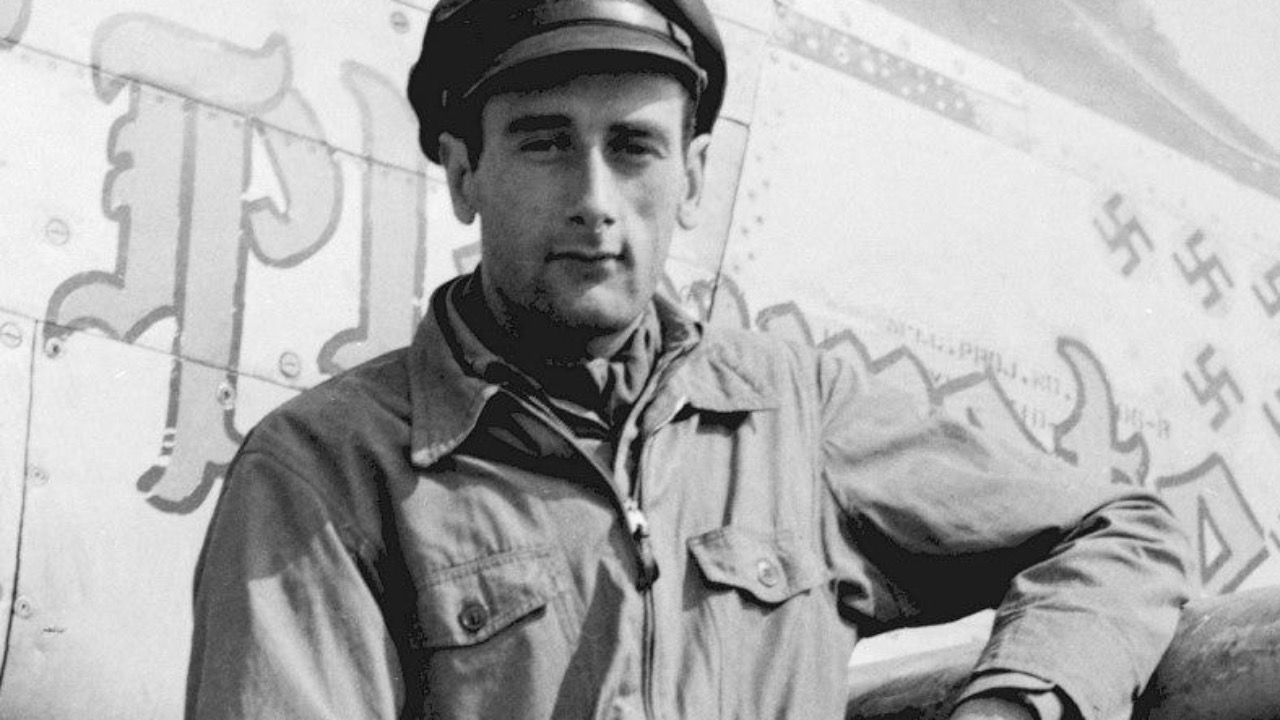
Before he ever set eyes on a German airfield from the ground, Bruce Carr had already built a reputation as an aggressive young fighter pilot. As After records of his combat service show, Bruce Ward Carr led formations of P‑51 type aircraft in repeated attacks on enemy positions, pressing home strikes even when outnumbered. Those missions demanded precision flying at low altitude, split‑second gunnery decisions, and a willingness to stay on target while anti‑aircraft fire clawed at the sky around him. That combination of nerve and technical skill would later prove essential when he found himself alone behind enemy lines.
By the time he was shot down, Carr was no novice. He had already flown deep escort and ground‑attack sorties with the 354th Fighter Group, operating the P‑51D Mustang that gave Allied pilots the range to escort bombers into the heart of occupied Europe. Those long missions over hostile territory meant that every pilot had to think constantly about what would happen if his engine failed or he took a hit far from friendly lines. Carr’s later decision to risk everything on a captured aircraft grew out of that hard‑earned understanding that survival often depended on improvisation rather than a scripted escape plan.
Shot down over Austria and alone behind enemy lines
The turning point came when Bruce Carr, flying yet another mission into enemy territory, was shot down over Austria. According to official accounts of Bruce Carr, the pilot parachuted into hostile countryside and immediately began evading capture. For several days he moved cautiously through fields and woods, avoiding roads, farms, and any sign of German patrols. He had no guarantee that local civilians would help him, and every decision about where to sleep or search for food carried the risk of betrayal or discovery.
Those days of evasion were a test of endurance as much as tactics. The same record that identifies him as Bruce Ward Carr notes that he survived for an extended period with limited supplies, relying on concealment and constant movement rather than contact with organized resistance. While evading after being shot down over Austria, Capt Bruce Carr eventually came across something few downed pilots would ever see up close: a German Fw 190 fighter sitting on an airfield that appeared, at least for a moment, vulnerable.
Discovering the German Fw 190 on a quiet airfield
It was during this period of hiding that Carr’s story took its extraordinary turn. Moving cautiously near a German installation, he observed an enemy airfield and noticed an air‑ready FW‑190 parked with minimal visible security. The aircraft was a German Focke‑Wulf, a frontline fighter that Allied pilots usually saw only as a fast‑moving adversary in the air. On the ground, with its propeller still and its cockpit closed, it represented both a lethal machine and a potential lifeline.
Accounts preserved in escape and evasion narratives describe how, although he was exhausted and deep in enemy territory, Capt Bruce Carr recognized that the German Fw 190 might be his only realistic way out. Although he could have tried to continue on foot toward Allied lines, the distance, the density of German forces, and the lack of organized help made that option increasingly unlikely to succeed. The sight of a fueled and armed fighter, sitting almost invitingly on the tarmac, forced him to consider an option that would have sounded absurd in any briefing room.
Deciding to steal the enemy fighter
At some point, hunger, fatigue, and cold intersected with calculation, and Deciding to act, Bruce Ward Carr chose to risk everything on the German aircraft. The official citation notes that he slipped into the enemy camp and prepared to use the FW‑190 as his escape vehicle, a choice that combined his intimate knowledge of fighter operations with a gambler’s willingness to stake his life on unfamiliar controls. For a pilot trained on American cockpits, the German layout, labeling, and engine systems were not just foreign, they were potentially fatal if misread under pressure.
Later retellings have sometimes framed his decision as a spur‑of‑the‑moment act of bravado, but the surviving records suggest a more deliberate process. Carr had already weighed the odds of continuing to evade on foot and judged them worse than the odds of mastering a captured fighter long enough to get airborne. In that sense, his choice to steal the German Focke Stealing the Wulf 190 was less a daredevil stunt than a calculated escape plan built on the only asset he truly trusted: his own skill as a pilot.
Figuring out how to start and fly a Focke‑Wulf 190
Getting into the cockpit was only the beginning. Near dawn he, identified in records as Bruce Ward Carr, sneaked out and jumped into the German fighter, then faced the problem of starting an unfamiliar engine without any checklist or instructor. Through experimentation, Carr was able to start the plane, working his way through switches, fuel controls, and ignition systems labeled in German. Every wrong move risked drawing attention from ground crews or guards, yet he persisted until the engine finally came to life.
Once the Focke‑Wulf was running, Carr still had to taxi and take off from a hostile airfield without attracting fire. The same account notes that Carr threaded the fighter between two hangars before he was airborne, using the limited space available to build enough speed for takeoff. In that moment, his training on the Mustang and his experience handling high‑performance fighters translated into instinctive control inputs that kept the German Fw 190 stable as it clawed into the air. It was a test of airmanship under conditions no training syllabus had ever contemplated.
Crossing the front lines in an enemy aircraft
Once airborne, Carr faced a new danger: every Allied gunner and fighter pilot who saw his silhouette would assume he was the enemy. The Focke‑Wulf’s distinctive shape and the number 190 associated with its designation made it a prime target for anti‑aircraft batteries and patrols. He had to navigate back toward friendly territory in a machine that screamed “German” from every angle, hoping that speed, altitude, and perhaps a bit of luck would keep him out of Allied crosshairs long enough to reach his home field.
Contemporary descriptions of the episode emphasize how improbable it was for any pilot to cross the front in a German Focke German Focke Wulf and survive. Carr had no radio contact with Allied controllers, no way to identify himself as friendly, and no parachute if something went wrong. Every mile he flew toward France increased the chance that someone on his own side would finally spot the intruder and open fire. Yet he pressed on, relying on his knowledge of the terrain and the approximate location of his squadron’s base.
Landing a German fighter at an American base in France
When he finally approached his unit’s airfield in France, Bruce Carr had to solve one last problem: how to arrive in a German fighter without being shot down by his own side. One detailed narrative notes that When he got close to his When squadron’s base in France, Bruce Carr decided not to circle or signal but to line up directly for landing. By that stage of the war there was almost no threat of German attack in that sector, which may have helped him avoid immediate defensive fire as he descended.
Another account describes how Taxiing through the woods with no parachute, helmet, or radio, he, identified simply as Taxiing Carr, could see a green field ahead and no signs of unfriendly pursuit as he headed for home. At dusk he, recorded again as Bruce Carr, slipped into the enemy camp, entered the FW‑190, and flew it back to his base in France, avoiding ground fire from Allied forces who might have mistaken him for an attacker. The landing itself, in an unfamiliar aircraft with no prior checkout, was a final demonstration of his ability to adapt under extreme pressure.
Separating legend from the “greatest escape that never happened”
Over the years, Carr’s escape in the Focke‑Wulf has been retold so often that it sometimes sounds more like folklore than history. Some commentators have even questioned whether the most dramatic details occurred exactly as later stories describe. One critical analysis refers to the popular version as the greatest escape that never happened, arguing that certain embellishments crept in as the tale was passed from pilot to pilot and later to aviation enthusiasts. That skepticism does not erase the core facts but it does remind me to distinguish between documented events and narrative flourishes.
Even within those more skeptical accounts, however, key elements remain consistent. They still identify Bruce, named as Carr, as an American ace who was shot down, evaded capture, and ultimately used a Ger‑built fighter to return to his unit. One detailed reconstruction notes that Bruce Carr chopped the throttle, pitched up to bleed off speed, then rolled to pull the nose back down toward the runway, reaching to deploy the landing gear and ultimately bringing it in with the wheels still up. Whether every maneuver unfolded exactly as described or not, the convergence of official citations and escape narratives supports the central claim that he flew a captured German fighter back to Allied territory.
From escape artist to triple ace and postwar pioneer
Carr’s escape did not define his career so much as punctuate it. By April, according to one combat summary, Bruce Carr was credited with 7.5 m more victories, five on one mission, putting him among the top scorers in his group. Another record notes that he also became a flying ace credited with 14 or 15 aerial victories, including five in a single day, for which he, identified as Bruce Ward Carr, was awarded the Distinguished Service Cross. Those numbers place him in the top tier of American fighter pilots in the European theater.
Official tallies conclude that he finished the war as a TRIPLE ACE and was credited with 15 aerial victories, a status confirmed in records that also describe how At dusk he slipped into the enemy camp and flew the FW‑190 back to his base in France. After the war he helped form the “Acrojets”, a pioneering jet aerobatic team that served as a precursor to later demonstration units, and he remained in uniform through the transition from the Army Air Forces to the independent U.S. Air Force. He finished his career in 1970 as a U.S. Air Force Colonel, a trajectory summarized in a citation that notes he finished the war as a TRIPLE, ACE and that After the Acrojets he continued to serve at high levels of responsibility.

Asher was raised in the woods and on the water, and it shows. He’s logged more hours behind a rifle and under a heavy pack than most men twice his age.