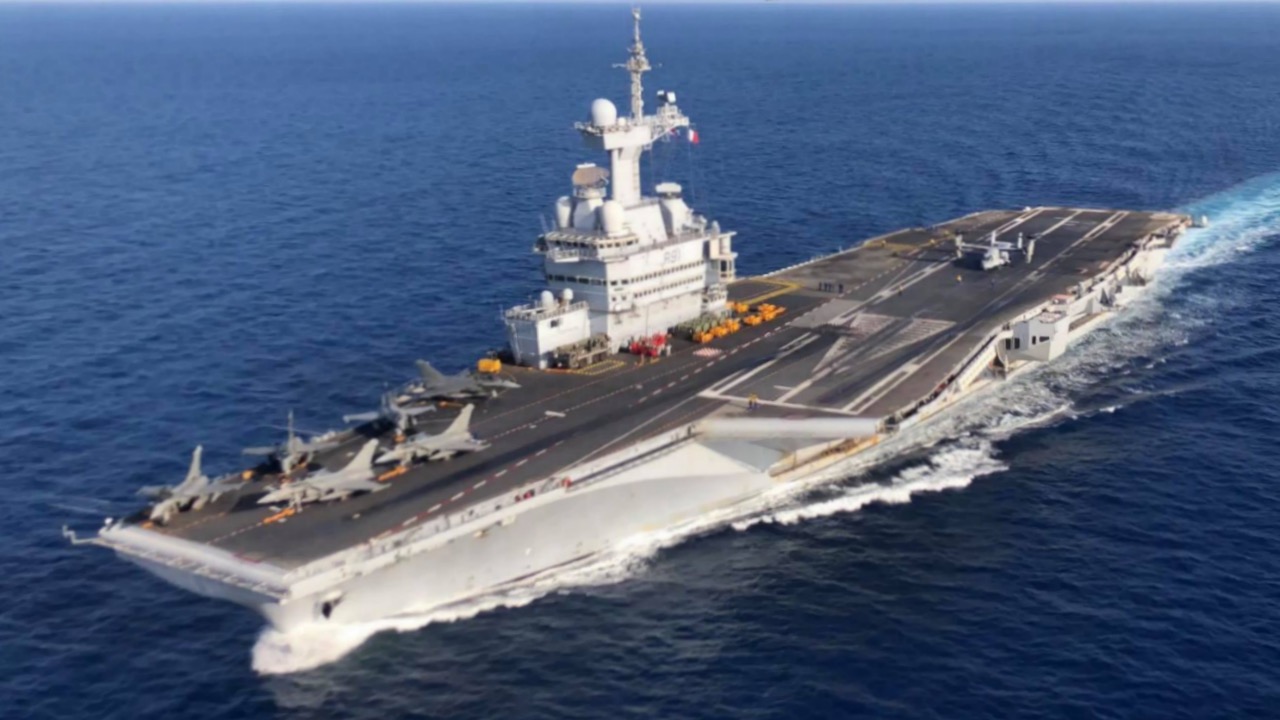
France deploys its most powerful warship through Suez Canal toward Strait of Hormuz with 20 Rafale jets aboard
As you track the shifting dynamics in the Middle East, France has moved its flagship aircraft carrier through the Suez Canal and toward the southern Red Sea. The Charles de Gaulle, Europe’s most powerful warship, carries around 20 Rafale fighter jets and a full escort group. This repositioning comes at a tense moment, with the Strait of Hormuz effectively blocked amid ongoing conflict. French officials describe it as preparation for a possible multinational effort to reopen safe passage for commercial shipping. The move underscores Paris’s determination to protect global trade routes without rushing into direct confrontation.
France Sends Its Flagship Carrier Closer to the Action
The nuclear-powered Charles de Gaulle left its earlier station in the eastern Mediterranean and passed through the Suez Canal on May 6. Escorted by several frigates and support vessels, the carrier group now sits in the Red Sea, ready to head farther east if conditions improve. French President Emmanuel Macron framed the step as a practical measure to support a proposed coalition mission. That effort, backed by Britain and more than 50 other nations, aims to restore confidence for shipowners once threats subside.
You see the logic in the timing. The carrier had already been at sea since January, completing exercises in the North Atlantic and Baltic before being retasked. Its presence near the Red Sea puts French air and naval assets within striking distance of the Gulf of Aden and beyond. No one expects immediate action, but the positioning sends a clear signal that France stands prepared to contribute when the moment arrives.
The Carrier’s Route Through the Suez Canal
Transiting the Suez Canal marked a visible milestone in the deployment. Timelapse footage released by the French military shows the carrier and its escorts moving steadily southward under clear skies. The narrow waterway, always a logistical challenge for large vessels, required careful coordination with Egyptian authorities. Once through, the group continued into the Red Sea, shortening the distance to potential operating areas.
This passage reflects years of French naval planning for rapid response in distant waters. The Charles de Gaulle, at over 260 meters long, handles the canal’s constraints with practiced efficiency. Its arrival in the southern Red Sea places it closer to the Bab el-Mandeb Strait, another chokepoint that has seen heightened activity. Officials emphasize that the transit itself was routine, yet its destination makes the journey noteworthy.
Rafale Jets Bring Air Power to the Carrier Group
The flight deck of the Charles de Gaulle currently supports around 20 Rafale multirole fighters. These aircraft give the task force the ability to conduct patrols, reconnaissance, and, if needed, strikes over wide stretches of ocean. Pilots train regularly for maritime scenarios, making the jets a versatile asset in any security operation around Hormuz.
You appreciate how the Rafales complement the carrier’s other capabilities. The ship also carries helicopters for search-and-rescue and anti-submarine work. Together, they form a self-sustaining unit that can operate far from home bases. French commanders have highlighted the group’s flexibility, noting it can adapt to whatever tasks the coalition ultimately assigns once the green light comes.
Why the Strait of Hormuz Matters Right Now
The Strait of Hormuz handles roughly one-fifth of the world’s traded oil under normal conditions. Its closure has stranded hundreds of vessels and triggered the largest supply disruption the International Energy Agency has ever recorded. Tankers sit idle while energy prices swing and supply chains strain across continents.
France sees the waterway’s security as essential to global stability. The proposed mission would not favor any single side in the broader conflict. Instead, it focuses on reopening safe lanes for commercial traffic. Paris has urged both Washington and Tehran to consider the plan as a way to ease immediate economic pain while talks continue on longer-term issues.
France and Britain Lead a Wider Coalition Effort
The repositioning ties directly into a joint French-British initiative for maritime security. London has also moved assets, including the destroyer HMS Dragon, to support the same goals. More than 50 countries have expressed interest in the coalition, though actual operations remain on hold until two key conditions are met: reduced threats to shipping and renewed confidence from the maritime industry.
You notice the careful language from officials in Paris. The mission would remain defensive and distinct from other operations in the region. Col. Guillaume Vernet, spokesperson for the French armed forces, stressed that the coalition would activate only when circumstances allow. This measured approach reflects France’s preference for diplomacy backed by credible presence rather than premature engagement.
The Charles de Gaulle’s Capabilities at a Glance
As a nuclear-powered vessel, the Charles de Gaulle can remain at sea for months without refueling. Its reactors provide steady power for propulsion and onboard systems, giving the carrier endurance that diesel ships cannot match. The flight deck handles simultaneous launches and recoveries, while below decks crews maintain a full suite of radars, command systems, and defensive weapons.
This technical edge matters in a region where distances are vast and threats can appear suddenly. The carrier group includes FREMM-class frigates for air defense and anti-surface warfare, plus a fleet oiler for sustained operations. French naval doctrine has long emphasized such integrated task forces, honed through exercises and real-world deployments in the Mediterranean and beyond.
What the Move Reveals About French Strategy
Paris has shown a pattern of using naval power to project influence without overcommitting ground forces. The Charles de Gaulle’s earlier retasking from the Baltic to the Mediterranean earlier this year followed the same logic: respond to emerging needs while preserving flexibility. The current shift to the Red Sea continues that approach.
You see continuity in Macron’s decisions. The president described the mobilization as unprecedented in scope, involving the carrier plus additional frigates and amphibious ships. Yet the emphasis remains on preparation rather than provocation. France wants to keep options open, contributing to stability while avoiding escalation that could draw it deeper into the conflict.
Looking Ahead to Possible Next Steps
The carrier group will likely hold position in the Red Sea or Gulf of Aden for now, conducting training and monitoring developments. French diplomats continue discussions with partners to refine the coalition’s rules of engagement. If threats ease and industry signals readiness, the mission could transition from planning to execution within weeks.
For now, the deployment keeps French capabilities forward-deployed and visible. It reassures allies and reminds all parties that Europe retains the means to protect vital sea lanes. The coming days will show whether conditions allow the next phase or whether the carrier simply remains a potent symbol of readiness on the horizon.

Asher was raised in the woods and on the water, and it shows. He’s logged more hours behind a rifle and under a heavy pack than most men twice his age.