
16 Deer cartridges that outperform their reputation
Some deer cartridges get tagged as marginal, old-fashioned, or too specialized, then quietly stack up clean kills every season. The 16 rounds here have reputations that lag behind what they actually do on deer-sized game, whether that is flat trajectories, deep penetration, or forgiving recoil. If you judge them by field results and hard numbers instead of chatter at the gun counter, they punch well above their billing.
1. .243 Winchester
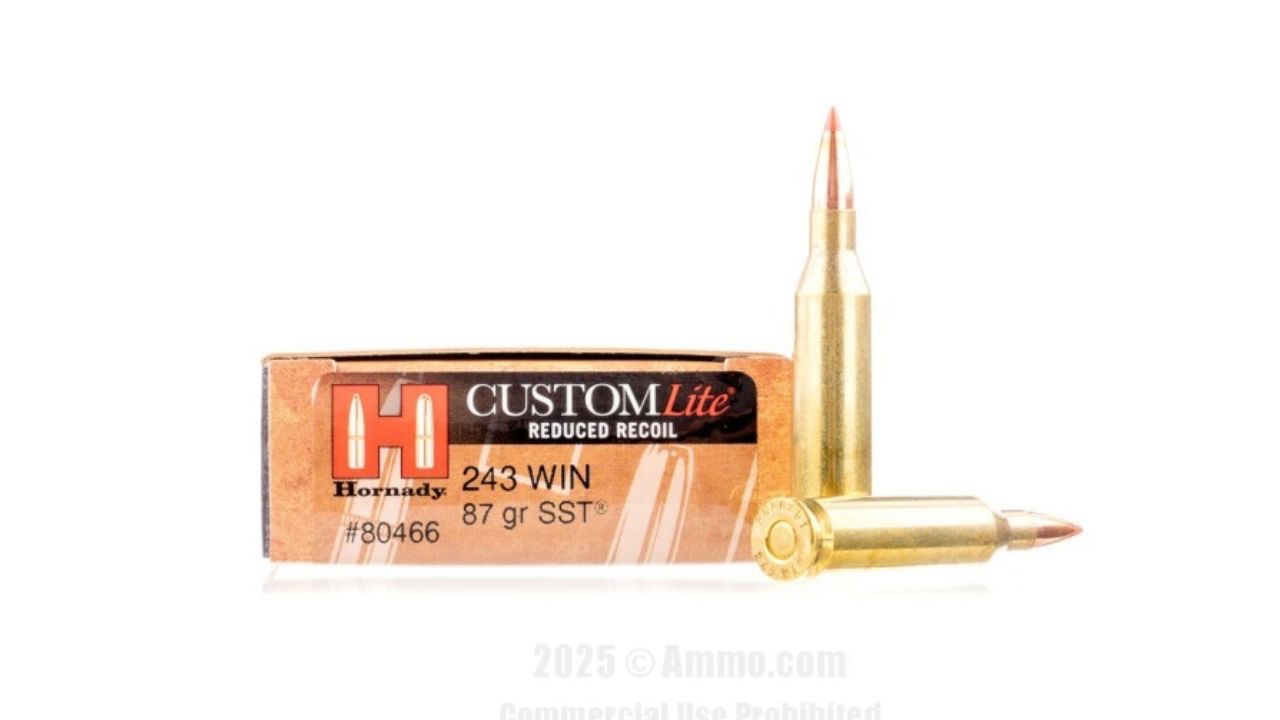
The .243 Winchester showed up in 1955 with a reputation as a dual-purpose round, and the numbers back that up. Factory loads can hit 3,000 fps with 80-grain bullets and still carry 1,000 ft-lbs of energy at 300 yards, which is squarely in deer territory. Early design goals were to push an 80-grain bullet to about 3,200 fps and also run 100- and 105-grain bullets for bigger game.
Plenty of hunters still dismiss the 243 as a “kid’s gun,” but worldwide it has become one of the most popular 6mm options for both varmints and smaller big game. As 243 data show, no other 6mm has matched its reach in the field. With modern controlled-expansion bullets and careful shot placement, it hits far harder than its mild recoil suggests.
2. 6mm Creedmoor
The 6mm Creedmoor came out in 2019 from Hornady and was quickly pigeonholed as a paper-punching round. In reality, it drives 108-grain ELD-M bullets at about 3,100 fps and routinely prints sub-MOA groups at 400 yards in well-set-up rifles. That kind of precision, paired with efficient bullets, gives it more than enough authority for deer where shots stretch across open country.
Because it grew out of the precision-rifle crowd, some hunters assume it is too specialized or fragile for real-world hunting. Field reports show the opposite, with clean kills on whitetails and mule deer when bullets are matched to the job. For shooters who like light recoil but want more reach than older 6mm rounds, it quietly outperforms its “benchrest only” label.
3. .250 Savage
The .250-3000 Savage, often shortened to .250 Savage, hit the market in 1915 and was one of the first commercial rounds to break the 3,000 fps mark. Modern loads commonly push 100-grain bullets to about 2,800 fps, which gives it a flat enough trajectory and solid energy for whitetails. Recoil is mild, especially in trim bolt guns, so many shooters run it better than harder-kicking cartridges.
Because it started life with lighter bullets and early marketing leaned on speed, the .250 Savage picked up a “varmint round” reputation. Historical field reports show it has always been more than that, especially with 100-grain soft points. In thick timber or farm-country stands where shots stay moderate, it hits well above what its age and case size might suggest.
4. 6.5×55 Swedish
The 6.5×55 Swedish Mauser dates back to 1894 as a military round, yet its ballistics still look modern. Typical 140-grain hunting loads hold around 2,200 fps and 1,200 ft-lbs of energy at 300 yards, which is plenty for deer-sized game. Long, high-sectional-density bullets help it penetrate straight and deep, even at lower impact speeds.
Some hunters see the old military designation and assume it is outdated, but Scandinavian moose hunters have leaned on it for generations. In North America, it quietly takes whitetails and mule deer with very manageable recoil. For shooters who like classic rifles and want performance similar to newer 6.5s, it outperforms the “too old” label that sometimes follows it.
5. 7×57 Mauser
The 7x57mm Mauser was developed in 1892 by Paul Mauser and has been underestimated ever since. Typical hunting loads send a 140-grain bullet at about 2,600 fps, giving a flat enough trajectory for normal deer ranges. In many factory rifles, it feeds smoothly and shoots accurately with minimal fuss, which matters more in the field than raw speed.
Despite a reputation in some circles as underpowered, the 7×57 has a long record of clean kills on deer and larger game in both Europe and North America. Modern bullets only improve that track record. For hunters who appreciate mild recoil and classic chamberings, it delivers performance that belies its age and conservative pressure limits.
6. .280 Remington
The .280 Remington arrived in 1957 and has lived in the shadow of the .270 ever since, even though its numbers are strong. With a 140-grain Core-Lokt, it can reach about 2,900 fps and still carry roughly 1,500 ft-lbs of energy at 200 yards. That puts it squarely in the all-around deer and elk class, with room for heavier bullets when needed.
Marketing missteps and timing hurt its popularity, not its performance. In practical terms, it offers a useful balance of trajectory, energy, and recoil that many hunters overlook. For those willing to look past the .270’s fame, the .280 Remington gives a bit more bullet weight and flexibility without adding much kick, which shows up on longer shots at big-bodied deer.
7. 7mm-08 Remington
The 7mm-08 Remington, introduced in 1980 by necking down the .308 case, has quietly become one of the best-balanced deer rounds around. Typical loads push a 120-grain bullet at about 2,800 fps, and one widely cited figure lists a 120-grain at 2,930 fps with 2,459 ft-lbs of energy and roughly 13 pounds of recoil in a 7.5 pound rifle. That is serious performance with very manageable kick.
Some early chatter painted it as a crossover varmint round, but real-world use shows it handles whitetails and mule deer with ease. One detailed look at the 120-grain loads highlights how well it fits new hunters and veterans who want efficiency. High-BC bullets and factory support from companies that tell you to Check their 7mm-08 Rem offerings underline how far it has come from its niche reputation.
8. .300 Savage
The .300 Savage came out in 1920 to give lever guns more reach, and it still does that job well. Standard loads send a 150-grain bullet at about 2,630 fps, which is not far behind early .308 Winchester figures. In compact rifles, especially classic lever actions, it offers a handy package that hits harder than its age suggests.
Critics sometimes call it obsolete, but field reports show it has taken plenty of deer and even elk with proper bullets. Its moderate pressures and shorter case make it a natural fit in older rifles that many hunters still carry every fall. For those who like traditional actions and want performance close to modern .30 calibers, the .300 Savage is far from done.
9. .307 Winchester
The .307 Winchester was launched in 1982 to bring near-.308 performance to lever guns that needed a rimmed case. Typical factory loads push a 150-grain Power Point at about 2,650 fps, giving it plenty of punch for deer in timber or on field edges. It also fits neatly into regulations that favor straight-walled or lever-friendly cartridges in some Midwestern states.
Because it never became mainstream, many hunters assume it is a dead-end option. In reality, where straight-wall rules apply, it can outperform more limited rounds by offering better reach and energy. For lever-gun fans who want to stay legal and still have real .30-caliber authority, the .307 Winchester is a sleeper choice that works harder than its sales numbers suggest.
10. .325 WSM
The .325 WSM, introduced in 2005 as a Winchester Short Magnum, has been labeled overkill for deer, but the ballistics tell a different story. It can drive a 180-grain AccuBond at about 3,000 fps, delivering high retained energy downrange. In short-action rifles, that performance comes in a compact package that carries well in steep mule deer country.
Critics worry about recoil and meat damage, yet careful bullet selection and shot placement make it a very controlled tool on big-bodied deer. Hunters who split time between elk and mule deer often appreciate having that margin. For those willing to manage the kick, the .325 WSM offers reach and authority that go beyond its “too much gun” reputation.
11. .338 Federal
The .338 Federal, introduced in 2006 by necking up the .308 case, was quickly tagged as a niche round. Typical hunting loads can push a 225-grain bullet to about 2,800 fps, which is impressive for such a compact case. That combination of diameter, weight, and speed gives deep penetration and reliable expansion on deer-sized game in heavy cover.
Because it is not a long-range star, some shooters overlook how effective it is inside 250 yards. In thick timber or brushy river bottoms, the .338 Federal hits hard, tracks straight, and still fits in short, handy rifles. For hunters who want more frontal area than .30 calibers without stepping up to magnums, it quietly outperforms its “specialty only” label.
12. .35 Remington
The .35 Remington dates back to 1906 and is often written off as slow and outdated. Standard loads send a 200-grain bullet at about 2,000 fps from pump or lever guns, which is ideal for woods ranges. Within 150 yards, that combination of weight and moderate speed gives reliable expansion without excessive meat loss.
Brush-country hunters have relied on it for decades, even as newer rounds grabbed attention. Analyses of classic pump guns show how often the .35 Remington drops deer quickly when shots are kept reasonable. For those who hunt thick timber, where you see more brown than daylight, it offers a forgiving, effective option that belies its “slow and heavy” reputation.
13. .358 Winchester
The .358 Winchester appeared in 1955 for the Model 88 and has been largely forgotten outside of dedicated fans. It can push a 250-grain bullet to about 2,000 fps, which sounds modest until you see the on-game results. That heavy bullet, moving at moderate speed, delivers massive expansion and deep penetration on deer and black bear at close to medium ranges.
Because it never caught on widely, many hunters have never even seen a .358 in the wild. Yet reports from those who use it in lever and semi-auto rifles describe quick kills in thick cover. For hunters who prioritize authority over flat trajectory, especially inside 200 yards, the .358 Winchester performs far above its low profile.
14. .375 Remington Ultra Mag
The .375 Remington Ultra Mag arrived in 2002 with a reputation as a dangerous-game hammer, and many people wrote it off as deer overkill. Typical loads send a 270-grain bullet at about 2,900 fps, generating around 3,500 ft-lbs of energy at the muzzle. That is a lot of power, but with the right bullets it can be surprisingly controlled on large-bodied deer.
Field trials show that when hunters do their part, the .375 RUM delivers quick, ethical kills without excessive tracking. Recoil is significant, so it is not for everyone, yet those who can handle it appreciate the confidence it brings on big mule deer or northern whitetails. Used thoughtfully, it outperforms its caricature as a blunt instrument.
15. .30-30 Winchester
The .30-30 Winchester has been around since 1895 and is often dismissed as a short-range lever-gun relic. Typical 170-grain loads run about 2,400 fps, which is more than enough for deer out to 200 yards with good sights and a steady rest. Historical tallies suggest it has taken more deer than any other cartridge in North America.
Modern flat-nose and flex-tip bullets have stretched its effective range a bit while keeping it safe in tubular magazines. Hunters who know their limits and practice with their rifles routinely make clean 200-yard shots, despite the “brush gun only” myth. For stand hunting in woods and mixed cover, the .30-30 still performs far beyond what its age might imply.
16. .300 Blackout
The .300 Blackout, developed in 2011 by Advanced Armament Corp., is often written off as an AR toy. Supersonic hunting loads can push a 125-grain bullet to about 2,200 fps from short barrels, which is plenty for deer inside typical woods distances. In AR platforms, it offers fast follow-up shots and compact handling in tight blinds or thick cover.
Where it really surprises people is in suppressed setups, where subsonic loads stay quiet yet still penetrate well at close range. Hunters who match bullet construction to their expected impact speeds report clean kills on whitetails in tight spaces. For those who want a modern, low-recoil option that works inside its lane, the .300 Blackout outperforms its reputation by a wide margin.

Asher was raised in the woods and on the water, and it shows. He’s logged more hours behind a rifle and under a heavy pack than most men twice his age.