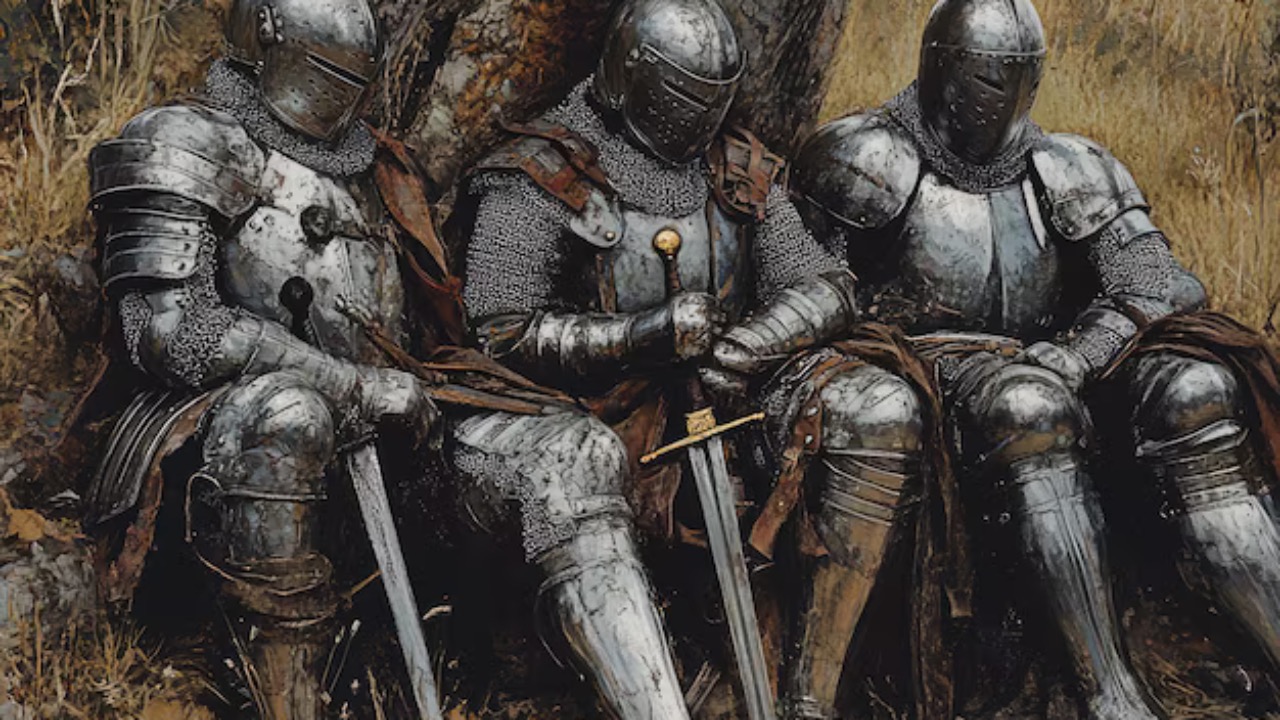
20 Brutal pieces of medieval combat gear
Medieval warfare was anything but romantic. Behind the chivalric myths stood brutally efficient tools designed to crush bone, pierce armor, and terrify opponents. From specialized daggers to nightmarish helmets, each piece of gear on this list shows how far people in the Middle Ages were willing to go to survive, dominate, and psychologically break their enemies in close combat.
1. Rondel Dagger
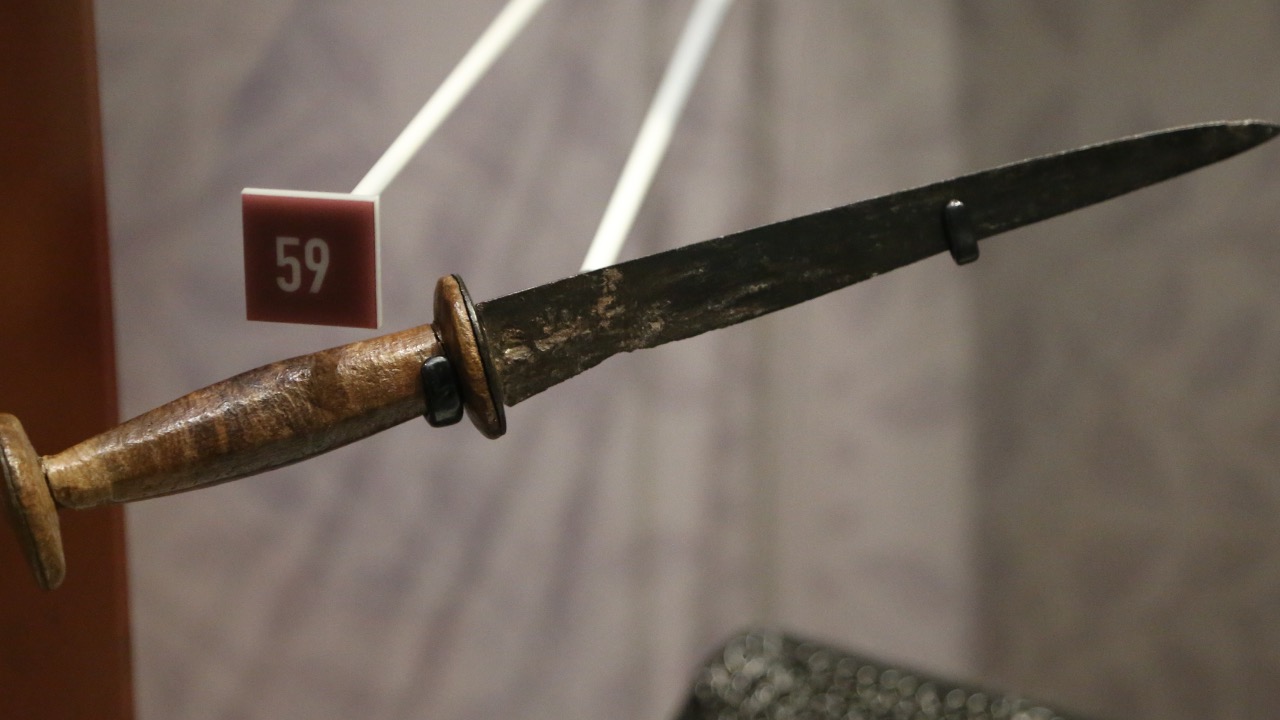
The Rondel Dagger appears in modern lists of nightmare-inducing gear because it was purpose-built for killing at grappling distance. In late Europe during the Middle Ages, it evolved into a stiff, narrow spike that could be driven into the gaps of plate armor. That design turned wrestling matches in the mud into lethal executions, especially once swords became less effective against full harness.
Contemporary descriptions of an English man-at-arms note a 15‑inch steel dagger on the hip, labeled RONDEL, with blades that could be round or triangular. One analysis of Early dagger forms describes a 30‑centimetre needle point flanked by round guards, optimized for punching into joints and visors. In practical terms, this meant the Rondel Dagger was less about slashing and more about calmly inserting steel into an opponent’s most vulnerable seams.
2. Great Helm “Bucket Helmet”
The Great Helm, often called the bucket helmet, turned knights into walking iron cylinders. Accounts of helmet evolution explain that knights and cavalry used these heavy “bucket helmets” because they were effective against the cutting weapons of their day. Later commentary on the pot helmet notes that Its cylindrical shape and narrow eye slits offered formidable protection, making the wearer look inhuman and almost machine-like on the battlefield.
However, the same sources stress that this complete enclosure caused breathing problems and poor visibility, especially in the heat of battle. One modern description even notes a Battlefield Replacement effect, stating that Due to its lack of visibility and ventilation, many knights discarded the Great Helm after the initial clash, relying on a lighter Bascinet underneath. For the opening charge, though, this brutal metal box turned a rider into a near-silent, faceless battering ram.
3. Bascinet Helmet with Visor
The Bascinet Helmet emerged as a more practical yet still intimidating alternative. A modern List of the key medieval helmets highlights the Bascinet alongside the Cervelliere, Spangenhelm, Nasal, and Barbute, underscoring how central it became. Its pointed skull and hinged visor, often pierced with breathing holes, were engineered to deflect downward sword blows and glancing arrows while still allowing movement.
Later armor catalogues pair the Bascinet Helmet with components like Arm Armour, an Arming Doublet, Bracers, and a Breastplate, showing how it integrated into full harness. For opponents, the sight of a visor snapping shut signaled that negotiations were over. Once locked down, the Bascinet turned a knight’s face into a steel mask, erasing any trace of humanity as he advanced behind a narrow slit of vision.
4. Executioner-Style Hooded Helmet
Not all terrifying headgear belonged to knights. The hooded executioner-style helmet, recreated today for live combat and roleplay, was designed to Inspire fear upon your enemies with the terrifying look of this helmet. One modern description emphasizes that the face provides a perfect protection against blows and reflects the merciless character of the executioner, turning the wearer into a symbol of state violence rather than a conventional soldier.
Unlike open-faced helms, this design hides every feature, leaving only dark eye holes or a narrow slit. That anonymity was part of the brutality: the condemned or the enemy never saw a human face, only a featureless iron mask. In a battlefield or punitive context, such a helmet signaled that no quarter would be given, weaponizing psychological terror as effectively as any blade or club.
5. Spiked Morning Star (Morgenstern)
The Morning Star, known in German as Morgenstern, was a spiked club built to maim through armor. A specialist arms dealer describes The Morning Star as a Feared Weapon The medieval battlefield, explaining that its heavy head and long spikes were designed to puncture armor and inflict severe injuries. Unlike a smooth mace, each swing could crush bone and then tear flesh as the spikes ripped free.
Because it relied on momentum rather than finesse, the Morning Star let relatively untrained fighters threaten even elite knights. A single lucky strike could cave in a helmet or drive metal fragments into the skull. For infantry facing mounted opponents, this brutal simplicity mattered: one committed swing could neutralize a heavily armored rider, turning the tide of a chaotic melee in seconds.
6. War Hammer with Armor-Crushing Head
The war hammer emerged as plate armor improved, trading slicing edges for concentrated impact. Enthusiasts who have modeled its physics estimate a Result of 4,858 foot pounds, or 6,587 joules of kinetic energy in a powerful strike, comparing that to the energy of a modern rifle round. EDIT notes that Turns out a standard rifle round more than capable of penetrating armor delivers similar energy, underscoring how devastating a focused hammer blow could be.
Instead of trying to cut, the hammer’s small face or beak concentrated that energy into a tiny area, denting or cracking plate and transmitting bone-breaking shock. Against a fallen knight, repeated blows could crumple cuirasses and helmets like tin. For commanders, this meant that even the most expensive harness was no guarantee of survival once war hammers entered the fray.
7. Halberd with Hook and Spike
The halberd combined axe blade, spear point, and hook into one vicious polearm. One discussion of late medieval tactics notes that Halberdiers also outrange Swordmen, and have stronger formations, because the two-handed poleweapon can be swung with massive leverage. Another technical breakdown of polearms explains that Medieval melee polearms often carried spikes for thrusting, blades for slashing, hammers for crushing, and a hook for pulling enemy knights down.
On the battlefield, that meant a halberdier could stop a charge, hook a rider from the saddle, and finish him on the ground before he could recover. The weapon’s versatility made it a favorite of disciplined infantry, who could form bristling walls of steel. For armored cavalry, once the terror of the field, the halberd signaled a brutal shift in power toward foot soldiers.
8. Poleaxe with Rear Hook
The poleaxe was another knight-killer, optimized for close combat against armor. Historical descriptions note that On the opposite side of the axe-blade, a sharp hook was added that could be used to snare men on horseback and pull them to the ground. This same account stresses that the reinforced haft prevented the weapon from being easily sliced apart by swords, giving the wielder confidence in brutal clinch fighting.
In practice, a poleaxe fighter could smash with the hammer face, chop with the blade, or yank an opponent off balance with the hook. Once a knight was down, the weapon’s concentrated edges and spikes could be driven into visor slits or armpits. The poleaxe turned armored duels into methodical dismantling jobs, where every part of the weapon had a specific, punishing purpose.
9. Longsword with Armor-Focused Techniques
Although swords are iconic, late-medieval longswords became especially brutal when used with specialized techniques. A modern overview of Swords notes that Among the many medieval weapons, the sword became emblematic of status and lethality. Yet as armor improved, fighters shifted to half-swording, gripping the blade with one hand to drive the point into gaps, and mordhau strikes, using the hilt like a hammer against helmets.
Technical treatises show knights smashing pommels into faces or levering opponents to the ground with the crossguard. In that context, the longsword was less a slashing blade and more a multi-tool of violence. For those on the receiving end, the weapon’s prestige did not soften its impact: a thrust into the armpit or a hilt-driven blow to the jaw could be as catastrophic as any axe stroke.
10. Falchion with Cleaver Edge
The falchion took the sword concept and exaggerated its chopping power. One catalog of brutal medieval weapons describes swords, falchions, and scramasaxes as part of a group of seven particularly vicious designs, highlighting the falchion’s heavy, forward-weighted blade. Unlike a straight knightly sword, it behaved more like a butcher’s cleaver, concentrating force into a short, curved edge that excelled at hacking through flesh and lighter armor.
On the battlefield, that meant a falchion could shear through shields, sever limbs, or crush bone beneath mail. Its relatively simple construction also made it accessible to less wealthy soldiers. For opponents, the sight of a broad, stained blade swinging in wide arcs was a visceral reminder that medieval combat was as much about dismemberment as it was about honor or heraldry.
11. The Medieval Longbow The
The Medieval Longbow The longbow was one of the most deadly medieval weapons of the middle ages that could be used by a single soldier. A detailed overview of medieval weapons emphasizes how trained archers could rain arrows on advancing troops, cutting down armored invaders with every “loose” of the bow. Its range and rate of fire turned fields into killing zones long before hand-to-hand combat began.
Another analysis of The English longbow notes that it was originally designed for hunters and paired with the bodkin arrow, which had a sturdy, narrow head that could kill an armored enemy from afar. For knights, this meant that years of investment in armor and horses could be undone in seconds by commoners standing hundreds of meters away, a brutally democratizing force in medieval warfare.
12. Bodkin Arrowhead
The bodkin arrowhead was a small piece of metal with outsized impact. Discussions of armor penetration stress that Unlike plate, it’s possible to pierce mail with bladed weapons; a narrow point, like a bodkin arrowhead or rondel dagger, is best. When launched from a powerful longbow, this hardened spike could punch through rings of chainmail or exploit weak points in plate, turning protective gear into a false sense of security.
Paired with massed archery, bodkins enabled volleys that did more than harass, they killed. Each arrow that found a gap in a visor or armpit could incapacitate a knight who might otherwise dominate in close combat. Strategically, this forced commanders to rethink formations and shielding, as even the most elite troops could be shredded before they ever reached striking distance.
13. Crossbow with Cranequin
The medieval crossbow, especially heavy models, delivered terrifying power at the cost of slow reloads. One survey of nightmare-inducing battle gear notes that Some required cranequins, mechanical winches, to span their prod, and that these devices turned the crossbow into a machine for controlling bodies, not just striking. With a cranequin, a soldier could cock a weapon too strong for human muscle alone, then release a bolt capable of punching through armor.
Because crossbows required less training than longbows, they allowed cities and lords to field deadly shooters quickly. A single quarrel could drop a mounted noble or pierce a shield, making every exposed silhouette a potential casualty. For besieged defenders or ambushers, the crossbow with cranequin became a cold, mechanical equalizer against wealth and lineage.
14. Greek Fire Siphon
Greek Fire was one of History’s Most Feared Weapons, and its delivery systems were as terrifying as the substance itself. A modern overview of Most Feared Weapons highlights Greek Fire as so effective that its victims would continue to burn whilst on water. Later reporting explains that it was Deployed primarily via specialized siphons mounted on Byzantine ships, projecting liquid flame onto enemy vessels.
These siphons turned naval battles into floating infernos, where a single burst could engulf decks and rigging. Because the exact formula was secret, opponents had no reliable countermeasure. For crews watching a Byzantine dromon approach, the sight of a siphon nozzle was enough to trigger panic, knowing that water itself would not save them from the oncoming firestorm.
15. Heavy Cavalry Lance
The heavy cavalry lance was a straightforward but devastating weapon. Analyses of The Middle Ages emphasize that the period saw some of the most devastating bloodsheds in human history, with shock cavalry charges playing a central role. A modern discussion of the Top 10 Deadliest Medieval Weapons Of The Middle Ages notes how couched lances, braced under the arm, allowed riders to deliver enormous kinetic energy into a single point.
When a line of armored knights lowered their lances and spurred forward, the result was often catastrophic for infantry. Wooden shafts could shatter on impact, leaving bodies impaled or crushed. For commanders, the lance charge was both a hammer blow and a psychological weapon, capable of breaking morale before swords or maces were even drawn.
16. Flanged Mace
The flanged mace refined the simple club into a precise armor-breaking tool. One overview of Deadliest Medieval Weapons highlights how blunt weapons rose in importance as armor improved. By adding metal flanges, smiths concentrated force into ridges that could dent helmets and breastplates, transmitting lethal shock even when the steel did not fully break.
Unlike edged weapons, maces did not rely on sharpness, so they were less likely to be blunted or damaged in prolonged fighting. Clergy who were barred from “shedding blood” sometimes favored them, though the internal injuries they caused were no less horrific. For armored opponents, a flanged mace turned every parried blow into a gamble against concussion and shattered bones.
17. Spiked Shield Boss
Shields were not only defensive; some were weaponized with spikes or reinforced bosses. A broad survey of Pieces Of Medieval focuses on how even protective equipment could be adapted to Give You Nightmares, including shields designed to punch or hook. A central metal boss, sometimes sharpened, allowed a fighter to slam forward, turning a block into a counterattack.
In tight formations, such shields could break teeth, crush noses, or drive opponents off balance for a killing blow. The psychological effect was significant: what looked like a barrier suddenly became an attacking surface. For infantry locked in shield walls, every shove carried the risk of hidden spikes driving into ribs or faces, blurring the line between defense and assault.
18. Spiked Gauntlets
Spiked gauntlets extended brutality to the hands themselves. Armor catalogues that list Arm Armour and Bracers alongside gauntlets show how fully encased a knight’s limbs could be, and some surviving examples feature knuckle ridges or studs. In close grappling, these turned punches into bone-breaking strikes, capable of splitting skin even through padded garments.
Because gauntlets were always present, they became weapons of opportunity in chaotic melees. A disarmed fighter could still claw at a visor, rake across a face, or hammer an opponent’s fingers on a sword hilt. For prisoners or wounded enemies, the sight of a mailed fist closing in was a reminder that even “unarmed” knights carried lethal force in every movement.
19. Spiked Pavise for Siege Defense
The pavise was a large shield used by crossbowmen, but some versions incorporated spikes or reinforced edges. Overviews of controlling bodies in siege warfare describe how static defenses could be adapted to push back ladders or impale attackers trying to climb. A spiked pavise turned a simple barrier into an active hazard for anyone who got too close.
Defenders could brace these shields along walls or in streets, creating choke points lined with jagged metal. As assaulting troops pressed forward, they risked being pinned or skewered while under missile fire. Strategically, this allowed smaller garrisons to multiply their killing power, using terrain and brutal hardware to slow and punish every step of an advance.
20. Tournament-Grade Buhurt Armor
Modern full-contact events show how brutal medieval-style gear remains in practice. Video compilations labeled BRUTAL, COMBAT, BUHURT, MEDIEVAL, DEFINITIVE highlight fighters in One-piece forging helmet designs and heavy plate, smashing each other with blunted weapons. Although safety rules apply, the armor closely mirrors historical harness, demonstrating how much force a fully encased body can both deliver and endure.
These tournaments reveal the practical stakes behind historical descriptions: visibility issues, exhaustion, and the sheer impact of repeated blows. Watching a fighter stagger under a flurry of strikes, then drive forward behind a steel-clad shoulder, makes it easier to imagine how terrifying a real battlefield would have been. The gear that protects them also turns them into relentless, armored projectiles, just as it did centuries ago.

Asher was raised in the woods and on the water, and it shows. He’s logged more hours behind a rifle and under a heavy pack than most men twice his age.