Why victory at Okinawa came at an enormous human cost
The Battle of Okinawa ended in Allied victory but at a scale of killing that reshaped how leaders and civilians understood modern war. The island campaign combined industrial firepower, desperate last stands and mass civilian deaths in a way that made triumph almost indistinguishable from catastrophe. I want to trace how strategy, terrain, ideology and politics converged so that winning this fight required a price that still reverberates far beyond the Ryukyu chain.
From the first landings to the final suicides on the cliffs, Okinawa became a test case for what an invasion of the Japanese home islands might have looked like. The enormous human cost, from front‑line troops to families hiding in caves, influenced decisions about atomic weapons, postwar occupation and how later generations in Asia and the United States remember the Pacific War.
The island that became a crossroads of empires
Okinawa was not just another Pacific outpost, it was the largest of the Ryukyu Islands and a natural stepping stone between the Japanese home islands, Taiwan and the broader Asian mainland. Control of this island meant control of airfields and harbors that could cut supply lines and project power in every direction. When I look at wartime planning documents, it is clear that both Tokyo and Washington saw Okinawa as a decisive hinge in the struggle for the western Pacific.
That geography helps explain why the fighting there became so ferocious. For the United States and its allies, seizing Okinawa promised a base close enough to mainland Japan to support bombing campaigns and a possible invasion. For Japanese commanders, losing it meant exposing the home islands to direct assault. Even today, a basic search for Okinawa turns up references to this strategic crossroads role, a reminder that the island’s location, not just its size, made it the stage for such a costly battle.
Operation Iceberg and the logic of total commitment
American planners framed the invasion as Operation Iceberg, a campaign to seize the Ryukyu chain and use it as a forward base. Controlling the Ryukyu Islands would allow the Americans to finally sever Japan from its remaining conquests and choke off fuel, food and munitions. That logic of total commitment meant the invading force arrived with overwhelming naval and air power, prepared to grind down any resistance rather than maneuver around it.
On the ground, the operation unfolded as a slow, attritional push rather than a quick island raid. Amphibious landings, artillery barrages and close air support were all calibrated to break fortified lines, not simply to dislodge scattered defenders. The very design of Operation Iceberg, with its focus on occupying and holding Okinawa as a permanent base, guaranteed that the battle would drag on and that both sides would pour in reinforcements, raising the human cost with every passing week.
“Typhoon of steel”: how tactics turned the island into a killing ground
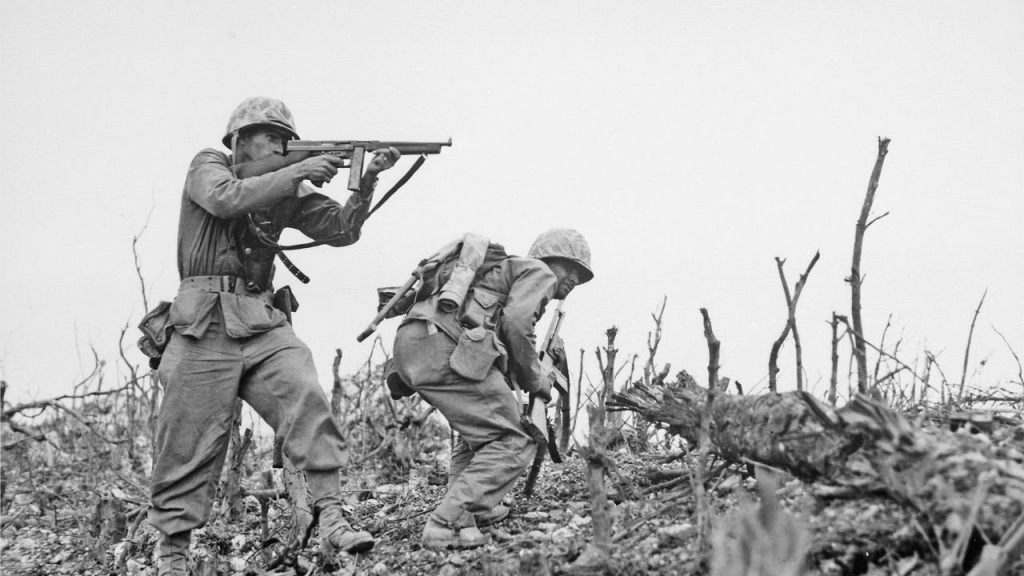
The fighting on Okinawa earned the nickname “typhoon of steel” in English, and in Japanese as “tetsu no bōfū,” a phrase that captures both the intensity of the bombardment and the density of defensive positions. Japanese forces had spent months digging into hillsides and limestone ridges, creating tunnel networks and bunkers that turned every ridge into a fortress. That choice of defense in depth forced American infantry to fight for ground yard by yard, often under constant artillery and mortar fire.
Naval and air tactics added another layer of brutality. Anticipating the invasion, Japanese commanders relied heavily on suicide attacks at sea, sending waves of kamikaze aircraft against Allied ships to inflict severe losses and sap morale. On land, counterattacks were often launched at night or in poor weather, when artillery spotting was difficult and close‑quarters combat more likely. The combination of fortified caves, relentless bombardment and suicide tactics turned the island into a place where almost every tactical choice translated directly into higher casualties.
American forces and the arithmetic of attrition
For American units, Okinawa became a test of endurance as much as of maneuver. Official figures list roughly 50,000American battle casualties, including about 12,500 dead. The breakdown underscores how widely the suffering was spread: the Army recorded 19,929 casualties, while the Navy suffered 10,007 casualties at Okinawa and another 1,294 on the USS ships engaged in the campaign. These numbers reflect not only the ferocity of ground combat but also the toll of kamikaze strikes and constant exposure to artillery.
Individual episodes illustrate how attrition worked in practice. When American troops pushed North toward the Motobu Peninsula, they encountered intense resistance and took over 1,000 casualties in that sector alone. Offshore, the Japanese dispatched the Battleship Yamato on a one‑way mission to strike the invasion fleet, a move that ended in its destruction but also signaled how far Tokyo was willing to go to bleed the American forces. The arithmetic of attrition on Okinawa was not abstract; it was measured in shattered units and ships burning offshore.
Japanese strategy, logistics and the culture of no surrender
Japanese infantry on Okinawa fought under a doctrine that treated surrender as dishonor and retreat as nearly unthinkable. Discussions of why Japanese infantry suffered such disproportionate fatalities in the war often point to logistics and command culture: units were ordered to hold positions long after they were cut off, and evacuation from isolated pockets was rare. When I look at Okinawa through that lens, the staggering number of Japanese dead becomes less a surprise and more a grimly predictable outcome of policy.
On the island, this ethos translated into a deliberate strategy of delay. Commanders pulled back from the beaches and concentrated their forces in the south, forcing the Americans into a grinding advance against layered defenses. The goal was not to win in a conventional sense but to inflict such losses that Washington might reconsider demanding the unconditional surrender of Japan. That approach, combined with the logistical reality that being surrounded was “virtually always a death sentence,” meant that Japanese units fought on even when the broader battle was clearly lost, driving their own casualty rates to catastrophic levels.
Civilians trapped between armies and propaganda
Okinawan civilians paid a price that still defies easy comprehension. Estimates suggest that civilian casualties may have been higher than 100,000, a figure that includes people killed by shelling, crossfire, disease and starvation. Many families sought shelter in caves or dugouts, only to find those same spaces targeted once Japanese troops used them as firing positions. The island’s villages, farms and schools became battlefields overnight, with little distinction between front lines and civilian spaces.
Accounts from the period describe how propaganda and fear shaped civilian choices. Some residents were told that American troops would commit unspeakable atrocities, a message that pushed people toward hiding or even suicide rather than surrender. The broader pattern of wartime deprivation in the region, where Crooked local officials, hunger and disease had already eroded trust in authorities, made it even harder for civilians to know whom to believe. On Okinawa, that confusion and fear translated into thousands of deaths that were not the result of direct combat but of a system that left ordinary people with no safe choices.
The bloodiest battle of the Pacific War
By the time the guns fell silent, Okinawa had become, in the words of one museum exhibit, the bloodiest battle of the Pacific War. Japanese forces had dug into the island’s ridges and caves so thoroughly that every advance required massive firepower, and civilians were swept up in the vicious battle. The invasion itself began on Okinawa on On Easter Sunday, which was also April Fool’s Day, a grim coincidence for troops who expected a hard fight but not the months of attrition that followed.
Japanese military losses were staggering. One detailed account notes that Japan sacrificed at least 110,000 soldiers, many of them dying after the battle was already effectively lost, and an estimated 100,000 civilians also perished. When I compare these figures with casualty lists from other Pacific campaigns, the scale of Okinawa stands out not just as another brutal battle but as a singularly costly struggle in the entire war.
Psychological trauma and the invisible wounds of victory
Numbers alone cannot capture what Okinawa did to the minds of those who survived. Veterans’ accounts describe a landscape of mud, corpses and shattered villages, where the constant threat of ambush or artillery fire eroded any sense of safety. Analysts who study the campaign point to the sheer volume of ammunition expended and the length of the fighting as indicators of how relentless the combat was. One assessment of the battle notes that Victory came at a high cost, not only in casualties but in the psychological stress of combat that left deep scars on those who fought.
For civilians, the trauma took different forms. Families who had watched relatives die in caves or under bombardment carried those memories into the postwar years, shaping local attitudes toward both the Japanese state and the continuing American military presence. The Battle of Okinawa, one of Battle of Okinawa campaigns that turned the island into a symbol of the Pacific War, became not just a military event but a collective trauma. When I listen to later oral histories, what stands out is how often people describe the sense that the entire island had become a graveyard, a place where victory and loss were impossible to separate.
From Okinawa to Hiroshima: how the battle shaped the end of the war
The carnage on Okinawa did not stay confined to the island; it rippled into the highest levels of Allied decision‑making. Political leaders who were already debating how to force Japan’s surrender looked at the casualty figures and the ferocity of resistance and drew stark conclusions about what an invasion of the home islands might entail. One analysis of the campaign notes that it directly influenced the American decision to use atomic bombs on Hiroshima and Nagasakitherefore, in the view of some contemporaries, saved American lives who would otherwise have died in a mainland invasion.
At the same time, Allied leaders were weighing diplomatic and strategic considerations. A briefing that highlighted how Casualties were high on Okinawa circulated among figures such as Winston Churchill, President Harry Truman, shaping their discussions about whether to use the atomic bomb and how to manage the endgame in Asia. When I connect those deliberations back to the hills and villages of Okinawa, the link is clear: the enormous human cost of that single battle became a central data point in decisions that would unleash a new kind of destruction on Japanese cities.
Memory, meaning and the unfinished reckoning with Okinawa
Decades later, Okinawa remains a place where the meaning of victory is still contested. For many in the United States, the battle is remembered as a necessary, if tragic, step toward ending Battle of Okinawa phase of World War II, a campaign that demonstrated the cost of forcing Tokyo to accept unconditional surrender. In Japan, and especially on the island itself, the memory is more ambivalent, blending respect for sacrifice with anger at how civilians were used as shields and how the landscape was turned into a battlefield. Commemorations often highlight the final days, when organized resistance collapsed and mass suicides and surrenders marked the Suicide or Surrender choices that ended the fighting.
Historical institutions and memorials continue to frame Okinawa as one of the bloodiest battles in all of human history, a place where the logic of total war reached its most intimate and devastating form. Commentaries marking the battle’s end note how The Japanese fought intensely with last‑ditch kamikaze attacks and suicide‑before‑surrender tactics, reinforcing the sense that Okinawa was both a military victory and a humanitarian disaster. When I weigh all of this, I see a battle that delivered its strategic objectives but at a human cost so vast that it still challenges any simple story about what it means to win a war.

Leo’s been tracking game and tuning gear since he could stand upright. He’s sharp, driven, and knows how to keep things running when conditions turn.