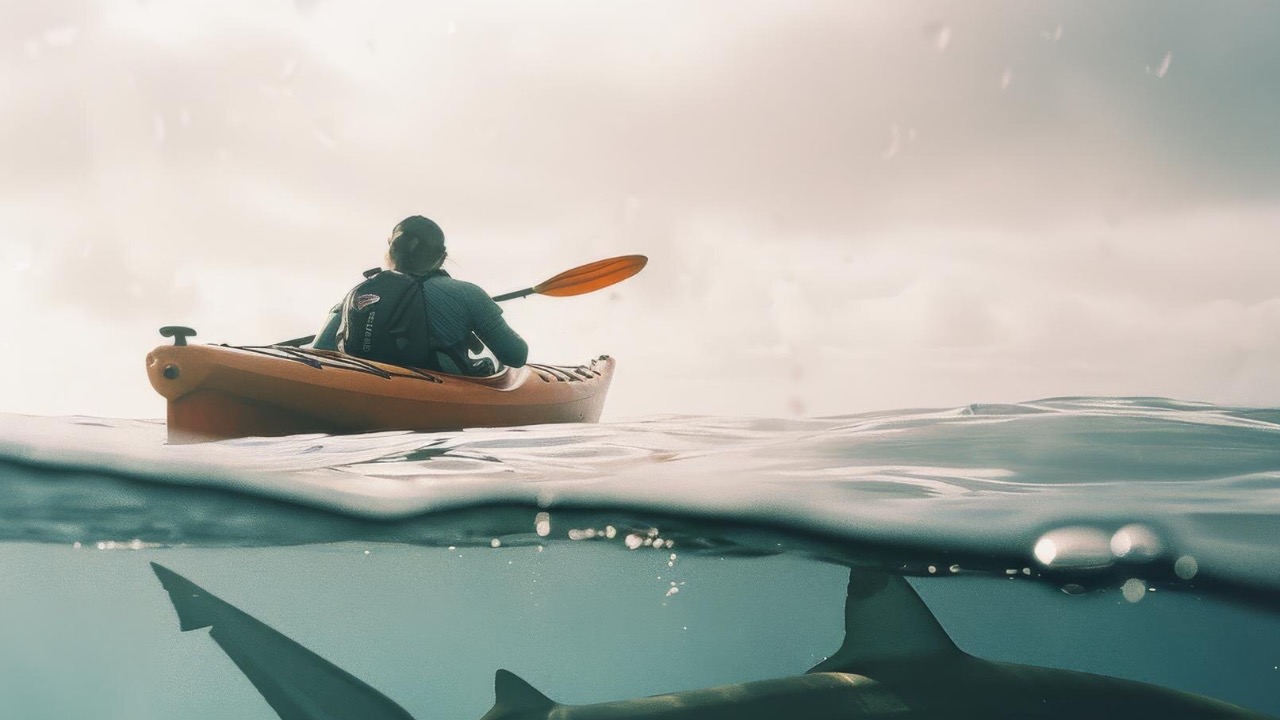
Kayaker surrounded in open water says shark began circling his boat
A kayaker alone in open water, a towering dorsal fin slicing the surface, and a shark that refuses to leave. The scene has become a familiar kind of viral nightmare, as more paddlers share footage of predators circling their small plastic boats. What looks like a near miss from a horror film is, in reality, a complex mix of shark behavior, human risk and the growing popularity of kayak fishing in shark country.
Across coastlines from California to Western Australia and New Zealand, paddlers have described the same chilling pattern: a large shark appears without warning, begins to shadow the kayak and then circles, nudges or bumps the hull while the person on board tries to stay calm and reach safety.
From calm paddle to circling shark
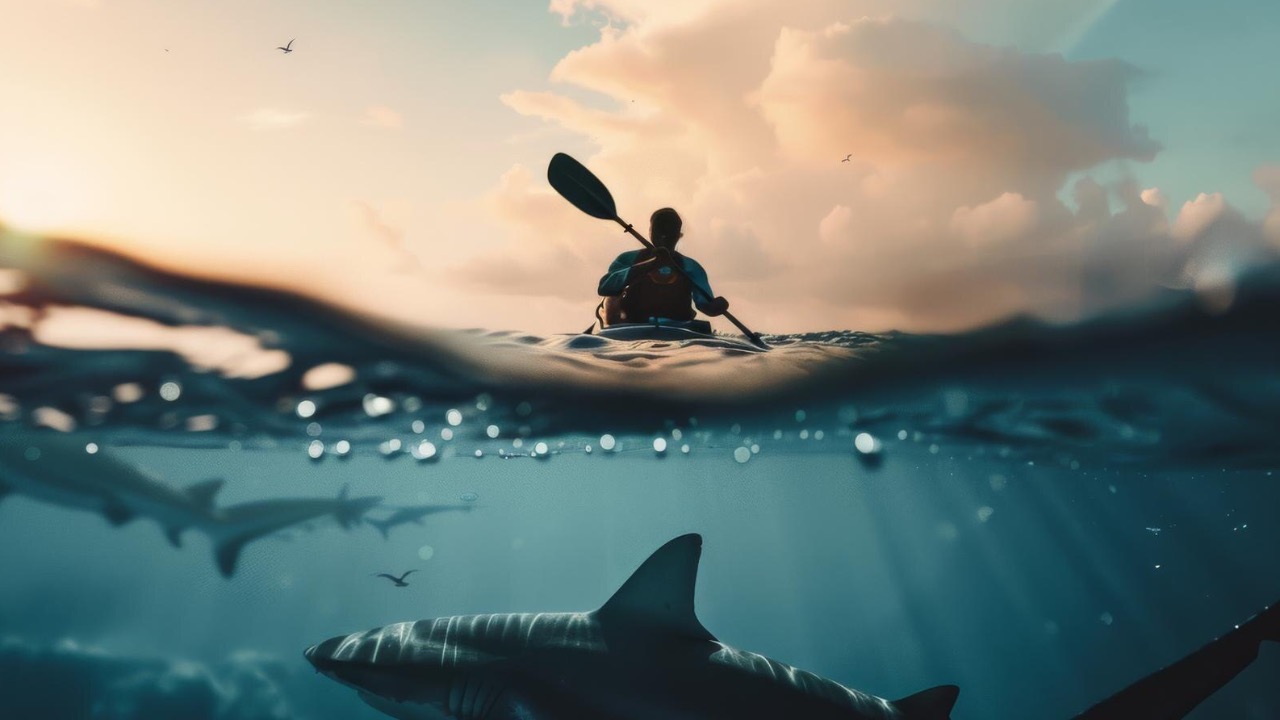
One of the clearest recent examples comes from a paddler who recorded a great white tracking his small craft off the coast of New Zealand. In the video, the kayaker speaks in a low, controlled voice about the predator that could, in his words, “be swimming underneath me too,” while he tries “not to be too frantic” and focuses on getting to shore in one piece. According to that account, he needed about an hour to calm down after he finally made it back to land, a measure of how intense the encounter felt even though there was no bite to the boat.
Another clip, shared by Matthew John Patrick Wells, shows what he described as a 4.5-meter great white pacing his kayak and showing what he called a “curious and terrifying interest” in the small vessel. In the footage, the shark stays close and keeps returning, as if testing the object in its territory rather than making a single pass and disappearing. For Wells, the experience was frightening enough to narrate in real time, but it also gave viewers a rare look at how a large predator behaves around a lone paddler.
In North America, kayak anglers have reported similar scenes. One video from Half Moon Bay shows the dorsal fin of a great white rising behind the kayak of John Patrick Thomas while he and a companion fish for ling cod and halibut. The shark appears to trail the boat, close enough that the men can see its size and direction, and long enough that the moment shifts from surprise to a drawn-out test of nerves.
Groups of kayakers are not immune
Traveling in a group does not always end the tension. Off the Western Australia coast, a group of kayakers described a 5-meter great white that circled and nudged their boat while they tried to stay rafted together for stability. Video from that encounter shows the shark moving around the cluster of kayaks and even passing underneath them, a reminder that numbers alone do not remove the sense of being small on the water when a large predator arrives.
A second group of five paddlers about a kilometer off Whitford’s dog beach had a similar scare with a large shark. They had rafted their kayaks together for safety when the animal approached and circled multiple times. Authorities later closed Hillary’s dog beach after the incident, a sign that officials took the behavior seriously enough to restrict access to the area while they assessed the risk.
In a separate case off the northern beaches, video shows a group of kayakers watching as a 5-meter shark carried on circling them and swam under them a few times. At one point, a shark came in very fast with its fin out of the water and headed straight toward the group, then veered and continued to move around the kayaks. That sequence, captured from the paddlers’ perspective, illustrates how quickly a relaxed outing can turn into a prolonged confrontation when a shark decides to inspect the flotilla.
When the shark wants something in the kayak
Many of the most intense encounters involve kayak anglers who have fish on board. In one widely shared clip, a fisherman in a small craft found himself being repeatedly bumped by a shark that appeared fixated on his kayak. The description from that scene is blunt: the shark wanted something in that kayak and kept bumping and bumping the hull. In a bid to draw the predator away, the fisherman even tossed his prize catch over the side, sacrificing the fish in the hope that the shark would follow the easier meal instead of the plastic boat.
Another video from New York’s south shore shows a kayak angler being circled by a shark while he has a fish on his lap. Observers later suggested that the shark was likely attracted to that fish, which meant the paddler was sitting directly over the source of the animal’s interest. When a boat arrived to help, the crew got a closer look at the shark as it continued to move around the kayak, a stark example of how quickly a routine catch can turn into a dangerous standoff.
In a separate recording, a shark was seen cutting live bait off the line, then following the kayak closely and going after the rudder. That behavior suggests the animal was not just curious about the hull but was actively investigating anything that smelled like food or moved in a way that resembled prey. For the paddler, the problem was not just the possibility of a bite but also the risk of losing control of steering if the rudder was damaged.
Solo paddlers and the fear of no escape
Solitary kayakers often describe a sharper edge of fear, because there is no nearby boat to intervene. One Australian fisherman, alone in his kayak when a giant 13-foot-long great white began circling, later said he feared he was “probably going to die.” As the shark continued to move around his boat, he made the decision to dump his gear into the sea, hoping to distract the animal and lighten the kayak in case he needed to paddle hard for shore.
Another paddler recorded a massive shark that appeared to hunt his kayak while he was fishing. The shark cut bait from his line, then tracked the small craft and targeted the rudder, behavior that made the fisherman uneasy not only because of the animal’s size but also because of its persistence. He believed the shark was drawn by the scent of blood from a lingcod that had just been caught and bled, which meant the source of attraction was literally on his boat.
In New Zealand, the kayaker who spoke about keeping his paddle strokes “nice and quiet” explained that he was trying to avoid any movement that could be read as aggression. His strategy was to stay calm, keep the kayak stable and move steadily toward the coast without splashing. That approach reflects advice often shared among paddlers who fish in shark habitats: avoid sudden movements, do not thrash the paddle and resist the urge to sprint away in a panic.
Why great whites circle small boats
To understand these encounters, it helps to look at the behavior of white sharks, often called great whites. Marine biologists describe these animals as apex predators that have been present in the oceans for millions of years. They are known for their size, with adults that can reach more than 14 feet, and for their preference for rich feeding grounds where seals and other prey are abundant.
Searches for information on great whites show that scientists have documented a wide range of investigative behaviors, including circling, bumping and mouthing unfamiliar objects. A kayak that smells of fish or carries a bleeding catch can resemble a floating bait source. In some videos, the shark appears to be sampling the environment rather than launching a full attack, which is consistent with the idea that many encounters are exploratory.
Dr. Paul Kanive, president of the California White Shark Project, has examined footage of a large shark following kayakers and concluded that the animal in that clip appeared to be a 14-foot-long adult white shark. His assessment highlights how often these encounters involve fully grown predators, not juveniles. A mature shark of that size can easily keep pace with a kayak and, in the words of paddler and commentator Dan Harris, can swim fast enough to keep a group “corraled” a kilometer off the coast, effectively controlling their movements without making contact.
In one case off Western Australia, nearby boats were alerted by a rescue helicopter to a shark circling a group of five kayakers. Those vessels moved in and used their presence to push the shark away, and authorities later closed Hillary’s dog beach after reviewing what had happened. That sequence shows how human intervention can break the pattern of a shark trying to contain or test a cluster of small craft.
The role of bait, blood and behavior
Several encounters point to a common denominator: fish. In the video where the shark wanted something in the kayak and kept bumping it, the fisherman was carrying a fresh catch. When he finally threw the fish overboard, he was acting on a reasonable assumption that the shark’s focus was on the scent and movement of that prey. Similarly, the angler off New York’s south shore who had a fish on his lap was effectively sitting over a bait source, which likely explained why the shark circled so intently.
In another recording, a shark cut live bait from a line, then followed the kayak and targeted the rudder. That pattern suggests the predator associated the kayak with food and was willing to investigate the moving parts of the boat to find it. The fisherman who believed his shark was drawn by blood from a lingcod that had just been caught and bled was making a similar connection: in his mind, the scent trail from that fish was the main reason the shark treated his kayak as something worth following.
Practical lessons for kayakers in shark country
- Avoid keeping bleeding fish on your lap or directly on the deck. Use a sealed fish bag or quickly transfer catches to a support boat when possible.
- If a shark appears, stay calm, keep paddle strokes smooth and avoid frantic splashing. The New Zealand kayaker who spoke about keeping strokes “nice and quiet” was applying this principle in real time.
- When safe, slowly head toward shore or a nearby vessel rather than sitting stationary over bait or blood. Nearby boats that moved in to help the group off Whitford’s dog beach show how larger craft can provide a buffer.
- If a shark begins bumping the kayak and there is fish on board, consider discarding the catch away from the boat, as the fisherman who threw his prize catch overboard did when the shark wanted something in his kayak.
- Travel in groups where possible, but do not assume that numbers alone prevent a shark from circling. The 5-meter shark that circled and nudged a group off the Western Australia coast demonstrates that a cluster of kayaks can still be treated as a single object of interest.

Leo’s been tracking game and tuning gear since he could stand upright. He’s sharp, driven, and knows how to keep things running when conditions turn.