13 Firearms that demanded extensive training to use effectively
Some guns are forgiving. Others punish every sloppy habit you bring to the range. The firearms here fall squarely in that second camp, machines that demanded long hours of instruction before anyone could run them well. Each one shows why serious training, not hardware alone, decides who controls a firefight and who gets overwhelmed by their own weapon.
1. Chauchat Light Machine Gun
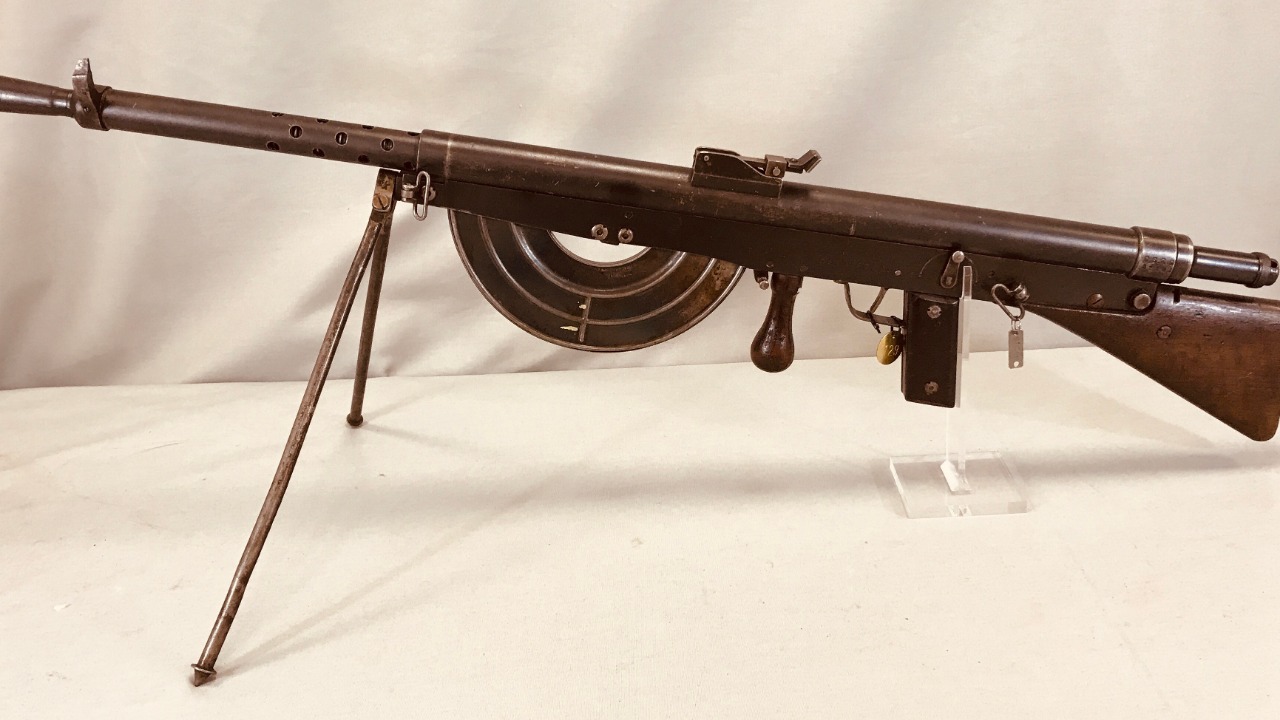
The Chauchat light machine gun gave French troops badly needed mobile firepower in World War I, but it came with a steep learning curve. Its long recoil system, open-sided magazine, and awkward bipod meant that dirt, mud, and poor handling turned it into a jam factory. In the context of firearms that required, the Chauchat stands out because basic marksmanship was the easy part, keeping it running was the real skill.
Gunners had to be drilled on magazine loading, careful lubrication, and how to clear stoppages under fire without wrecking fragile parts. Crews also needed to learn realistic rates of fire so the barrel and mechanism did not overheat or seize. For commanders, that meant extra time in the trenches teaching machine-gun discipline, or watching a theoretically powerful weapon turn into dead weight when the fight got messy.
2. M1918 Browning Automatic Rifle
The M1918 Browning Automatic Rifle, or BAR, was never a “pick it up and go” rifle. Training units even used dedicated Models that replicated the Browning Automatic Rifle, the M1 Garand, M1/M2 carbines, and the Browning machine gun family so recruits could learn handling before touching live guns. That alone tells me how seriously the U.S. military treated the BAR’s learning curve.
John Browning built the Browning Automatic Rifle American troops in World War One, and doctrine expected “walking fire” straight from the hip. Later analysis of that technique showed how much practice it took to keep rounds on target while moving. The AEF even pushed a redesign so the gun would run the U.S. Caliber 30.06 Springfield cartridge from a new box magazine, adding more details soldiers had to master under stress.
3. Thompson Submachine Gun
The Thompson submachine gun earned its reputation in back alleys and on battlefields, but its high cyclic rate punished sloppy shooters. Early drum magazines were heavy and finicky, and the straight blowback action cycled so fast that untrained users tended to spray over their targets. In the same way the BAR demanded discipline, the Thompson forced users to learn short, controlled bursts.
Lawmen and soldiers had to spend real time on the range learning stance, grip, and how to ride the recoil so the muzzle did not climb off target. Clearing jams under pressure, especially with early ammunition, was another skill that separated professionals from amateurs. For agencies and units that adopted it, the Thompson became a training issue as much as a procurement decision, shaping how close-quarters tactics were taught.
4. FG 42 Paratrooper Rifle
The FG 42 paratrooper rifle tried to give WWII German airborne troops one gun that could do nearly everything, and that ambition made it complex to run. It used a gas-operated system, side-mounted magazine, and full-power rifle cartridge in a relatively light package. According to detailed work on the FG42 rifle, it was intended to cover all the combat roles a paratrooper might face after landing.
That versatility came at the cost of a sharp recoil impulse and finicky handling that demanded serious practice. Fallschirmjäger had to learn how to manage automatic fire without losing control, when to treat it like a rifle versus a light machine gun, and how to maintain the unusual internals. For airborne units that already trained hard, the FG 42 added another layer of technical skill they had to master before jumping.
5. StG 44 Assault Rifle
The StG 44 was the first true assault rifle to see wide service, and it forced late-war German units to rethink how they trained riflemen. Its intermediate cartridge and select-fire capability were a big shift from bolt-action doctrine. Troops had to learn new engagement distances, new burst techniques, and how to manage ammunition when they suddenly had far more firepower at their fingertips.
Inexperienced soldiers tended to lean on full-auto, burning through magazines and losing accuracy. Instructors had to emphasize semi-automatic fire as the default, with short bursts reserved for close fights. That change in mindset, from slow deliberate shots to flexible fire modes, is exactly the kind of adjustment that turns a groundbreaking design into something that actually improves squad performance.
6. M249 Squad Automatic Weapon
The M249 Squad Automatic Weapon gave U.S. infantry squads belt-fed suppressive fire, but it also brought a long checklist of skills. Gunners had to learn how to load belts correctly, manage the quick-change barrel, and keep the feed system clean enough to avoid stoppages. Since its adoption, the SAW has been a textbook example of a light machine gun that rewards careful training.
Small-unit tactics courses spend a lot of time on where the M249 should be positioned, how it controls terrain, and how the assistant gunner supports ammo and barrel changes. When a SAW gunner understands those roles, the weapon anchors the whole squad. When they do not, it becomes a heavy rifle that chews through belts without shaping the fight.
7. M2 Browning Machine Gun
The M2 Browning Machine Gun, the classic Browning .50 Caliber Machine Gun, has been in service since 1933 and still demands respect. It fires a massive 50 caliber round, and everything about it, from headspace and timing to loading procedures, requires careful instruction. Designed by John Browning, this heavy Machine Gun is not something you “figure out” on the fly.
Modern crews still run extensive live-fire exercises to keep their skills sharp, and Ever since it was introduced, the Browning has been a training staple. Mis-set headspace can damage the gun or injure the crew, and poor control can waste ammunition or miss critical targets. For vehicle gunners and ship crews, mastering the M2 is a career-long process, not a one-time qual.
8. Barrett M82 Sniper Rifle
The Barrett M82 is a recoil-operated, semi-automatic anti-materiel rifle built by Barrett Firearms Manufacturing produced in the United States. Chambered in .50 BMG, it pushes a heavy bullet far enough that wind, mirage, and target movement all become serious problems. Fire training with the Barrett as the M107 variant shows how much emphasis instructors put on spotting impacts and reading conditions.
Snipers have to learn to manage the rifle’s recoil, set up optics correctly, and coordinate with spotters to engage vehicles and equipment at long range. The gun’s weight and blast also change how teams move and choose firing positions. Without that specialized schooling, the M82 is more likely to intimidate its user than deliver precise hits on high-value targets.
9. Mk 19 Grenade Launcher
The Mk 19 automatic grenade launcher looks straightforward until you try to keep it running under field conditions. Feeding 40 mm belts, charging the action correctly, and clearing misfires all require hands-on instruction. Crews also have to understand arming distances and the ballistic arc of grenades so they do not drop rounds short of cover or too close to friendly positions.
Vehicle gunners and dismounted teams spend a lot of time learning range estimation and beaten zones, because the Mk 19 is an area weapon, not a precision rifle. When they get that training, it becomes a powerful tool for breaking ambushes and locking down avenues of approach. Without it, the launcher can be slow to bring into action or dangerously misused.
10. M134 Minigun
The M134 Minigun is a six-barrel rotary cannon that spits out rifle rounds at a rate most shooters only see in movies. That kind of volume brings unique challenges, from power supply to barrel heat. Crews have to learn how to manage spin-up, burst length, and ammunition feed so the system does not outrun its own support gear.
Helicopter and vehicle mounts add another layer, because the gunner is often firing from a moving platform at moving targets. Training focuses on lead, communication with pilots or drivers, and strict fire discipline. When operators understand those pieces, the Minigun becomes a precise suppression tool instead of a noisy way to waste thousands of rounds.
11. AA-12 Automatic Shotgun
The AA-12 automatic shotgun takes the familiar 12-gauge concept and turns it into a full-auto tool for close-quarters fights. Its drum magazines, unique recoil mitigation, and high rate of fire mean users must relearn how they think about shotguns. Instead of a handful of carefully aimed shells, they suddenly have sustained fire at room distances.
That power makes target discrimination and trigger control absolutely critical. Law enforcement and military users who experiment with the AA-12 have to build training blocks around safe transitions, reloads, and patterning at different ranges. Without that groundwork, the shotgun’s advantages in breaching or urban fighting can quickly turn into liability and overpenetration problems.
12. XM214 Belt-Fed Microgun
The XM214 belt-fed microgun was a lightweight spin on the Minigun idea, and even in prototype form it demanded serious handling drills. High-speed rotation and a compact frame made it sensitive to how it was mounted and fed. Test crews had to learn to balance power input, belt tension, and burst control so the gun did not outrun its ammunition or shake itself apart.
Because it never saw wide service, the XM214 stayed in the realm of specialized evaluation, where every session doubled as both testing and training. That limited exposure does not change the underlying point, though, which is that ultra-high-rate rotary guns are only as effective as the teams that spend the time to master them.
13. DShK Heavy Machine Gun
The DShK heavy machine gun has armed Soviet, Warsaw Pact, and insurgent forces for generations, and it is far from user-friendly. Its 12.7 mm cartridge, heavy tripod, and feed system all require coordinated crew work. Setting it up for anti-aircraft use, then shifting to ground targets, adds more steps that crews must rehearse until they are automatic.
Units that rely on the DShK invest time in teaching range estimation, traverse and elevation adjustments, and how to keep the gun supplied with belts under fire. When that training is in place, the DShK can dominate roads, rooftops, and low-flying aircraft. When it is not, the weapon’s weight and complexity can slow a unit down more than it helps.

Asher was raised in the woods and on the water, and it shows. He’s logged more hours behind a rifle and under a heavy pack than most men twice his age.