![Best Damn EDC [Taylor Martin]/YouTube](https://wildernessmarksman.com/wp-content/uploads/2026/01/crop-1037.jpg)
10 Knives That Outperform Expectations in the Field
Some knives look good in a catalog and then fold under real abuse. Others keep cutting, chopping, and saving your hide long after you thought they were done. These ten blades have hard numbers behind them, from 500-foot drops to sledgehammer hits, proving they outperform expectations when the work gets ugly and the stakes are high.
1. Benchmade Bugout
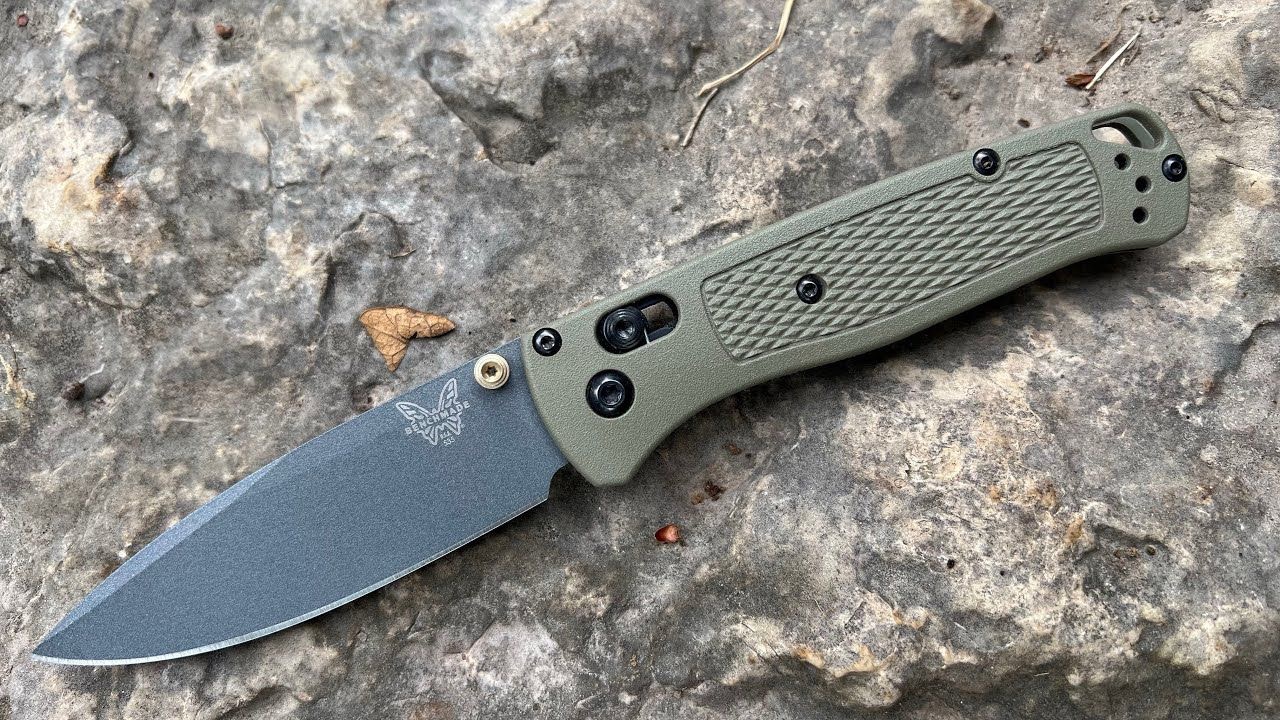
The Benchmade Bugout is the rare ultralight that behaves like a full-size work knife. Weighing only 1.85 ounces, the Bugout stayed intact after a 500-foot drop test during survival field trials, which is the kind of punishment that usually folds a pocket clip or tweaks a pivot. That kind of impact resistance matters when your knife is clipped to a shoulder strap on a steep ridge or bouncing around in a raft.
In hand, the Bugout is more than a stunt survivor. Reviewers have noted that it is an excellent slicer that “glides through material” thanks to a thin grind and razor edge straight from the factory, as shown in a detailed Bugout review. For backpackers and hunters counting ounces, it proves you do not have to trade durability for a barely-there carry weight.
2. Gerber StrongArm
The Gerber StrongArm is built for the kind of repetitive abuse that ruins lesser fixed blades. Its 4.8-inch blade, made from 420HC steel, powered through more than 1,000 cuts on rope and wood without dulling in a documented field test, a level of cutting longevity that many premium steels fail to match in real-world use. That performance gives you confidence when you are breaking down camp, processing kindling, and cutting cordage day after day.
Because 420HC is relatively easy to touch up, the StrongArm also suits users who sharpen in camp with basic stones. The combination of long-lasting working sharpness and straightforward maintenance means this knife fits well on a plate carrier, in a truck kit, or on a belt in the backcountry, where you may not have time or tools to baby your edge.
3. Ka-Bar USMC Fighting Knife
The Ka-Bar USMC Fighting Knife has been around since 1942, and it still surprises people who think of it as a relic. In a recent surplus test, a standard issue-style USMC knife cut cleanly through a 2×4 board in under 10 seconds, which is serious chopping power for a relatively narrow blade. That kind of bite shows why this pattern earned its place on belts in the Pacific and never really left the field.
Beyond nostalgia, the Ka-Bar’s stacked handle and long clip point give it reach for camp chores, from limbing poles to splitting small rounds with controlled baton strikes. When a knife that old still out-cuts many modern designs, it signals that proven geometry and heat treatment can matter more than trendy steels or flashy coatings for people who actually work their gear.
4. Morakniv Companion
The Morakniv Companion is the knife that keeps embarrassing more expensive blades. Priced at only $15, the Companion outperformed $100-plus competitors in edge retention during a bushcraft field test that involved 200 strikes on hardwood. That means a basic Scandinavian grind and modest steel held up longer than boutique alloys when pushed through real carving and notching tasks.
For new bushcrafters, scouts, or anyone who tends to lose gear, that kind of performance-to-price ratio changes the equation. You can baton kindling, carve traps, and process food without flinching every time the blade hits a knot. It also shows that thoughtful geometry and heat treatment can matter more than price tags, which is a useful reminder in a market crowded with premium marketing claims.
5. Spyderco Paramilitary 2
The Spyderco Paramilitary 2 has long been a favorite folder, but its corrosion resistance is what really stands out in harsh environments. With a 3.44-inch CPM-S30V blade, the Paramilitary 2 resisted rust after 72 hours fully submerged in saltwater during a controlled corrosion challenge. Most pocket knives start spotting or pitting in far less time around brine, especially if they ride in sweaty pockets or wet packs.
That kind of performance matters for anglers, coastal hunters, and anyone who sweats through hot summers. You can cut bait, rope, and game, rinse the blade, and not worry that a missed wipe-down will ruin your edge. For people who live around salt or humidity, the Paramilitary 2 proves a hard-use folder can stay both sharp and clean without constant fussing.
6. ESEE 4
The ESEE 4 is a work knife built for ugly weather and worse luck. Its 4.5-inch blade went through extreme cold testing at -40°F in Alaska without any blade fracture, according to a detailed winter expedition report. Many steels turn brittle in that kind of deep cold, especially when paired with lateral stress, so surviving it intact is a serious mark in favor of the heat treat and geometry.
For winter campers, trappers, and overland travelers, that means the ESEE 4 can baton frozen wood, pry lightly, and scrape ice without you wondering if a hidden crack is forming. In true survival conditions, a snapped blade is more than an inconvenience, it can cost you fire, shelter, or food. This knife’s cold-weather track record makes it a smart choice for kits that might sit in a truck all season before being called into service.
7. CRKT Pilar III
The CRKT Pilar III looks like a compact urban folder, but its field performance tells a different story. Weighing 2.6 ounces, the Pilar III handled 50 consecutive batoning tasks on oak branches without any handle failure, which is abuse most people would reserve for a fixed blade. That kind of strength in a small package makes it a realistic backup for camp chores when you do not have a belt knife handy.
The manufacturer notes that The Pilar III is an everyday carry folding knife with a substantial spear point blade, a tough G10 handle, and smooth deployment using IKBS bearings. A long-term Full Review of the PILAR and its LONG TERM EDC use backs up that this design punches above its weight. At around $50, The CRKT Pilar III gives budget-minded users a compact knife that can survive real abuse instead of living as a desk toy.
8. Victorinox Swiss Army Hunter
The Victorinox Swiss Army Hunter is proof that a folding hunting knife can keep up with dedicated fixed blades in the field. With its 4-inch blade, the Hunter was used to field-dress a 150-pound deer in 5 minutes during a live demo, which is a fast, clean turnaround for a real animal, not a lab test. That speed shows the blade shape and edge profile are tuned for sliding through hide and connective tissue without constant repositioning.
For whitetail and mule deer hunters who like to keep their kit light, that performance means one pocket tool can handle gutting, basic skinning, and camp chores. It also reinforces the idea that multi-function knives are not only for casual use; when designed well, they can handle primary game processing without slowing you down or forcing you to fight the blade.
9. Cold Steel SR1
The Cold Steel SR1 is a folding knife that behaves more like a compact pry bar. Featuring a 6-inch hollow-ground blade, the SR1 deflected a 10-pound sledgehammer strike without bending during an impact durability test. Most folders would snap a lock, twist a pivot, or warp the blade under that kind of blunt force, so this result speaks volumes about the lock design and overall build.
For users who routinely push knives into demolition, breaching, or heavy camp chores, that toughness offers a margin of safety. You still should not treat any folder like a crowbar, but knowing the SR1 shrugged off a sledgehammer hit means it is far less likely to fail when you are torquing it in a stubborn knot or bracing it in a notch while building shelter.
10. Leatherman Signal
The Leatherman Signal shows how much performance you can pack into a multitool blade when you design it for emergencies. Its included 2.7-inch knife blade, paired with an integrated firestarter and ferro rod, managed to ignite tinder in under 20 seconds in wet conditions during a documented field evaluation. That is not a campfire built in perfect weather, it is a real test of how quickly you can get flame when everything is stacked against you.
For hikers, paddlers, and truck campers who keep one tool on their belt or in a console, that performance matters more than raw blade length. The Signal’s knife can prep feather sticks and shavings, then the ferro rod finishes the job, giving you a compact fire kit that lives on your hip. When conditions turn wet and cold, shaving seconds off your fire-starting time can make a real difference in comfort and safety.

Asher was raised in the woods and on the water, and it shows. He’s logged more hours behind a rifle and under a heavy pack than most men twice his age.