Pete Hegseth outlines new weapons for U.S. troops — “Not all threats are foreign”
Secretary of War Pete Hegseth is moving quickly to redefine what it means to arm the American military, and not only for combat overseas. His latest directive gives U.S. troops a new kind of “weapon” at home: the ability to carry their own firearms on base for personal protection, a change he frames as a response to threats that originate inside the wire as much as beyond it.
The decision fits into a broader push by Hegseth to accelerate weapons acquisition, revive the defense industrial base, and treat internal security as part of national defense. It also raises sharp questions about safety, command authority, and how the Pentagon balances individual rights with collective risk.
From gun-free zones to armed installations

In a memorandum described by the Department of War, Secretary of War Pete Hegseth directed that off-duty service members and certain Defense Department personnel be allowed to carry privately owned firearms on military installations for personal protection. The policy, detailed in a memo reported by By Matthew Olay, ends the long-standing default that bases function as gun-free zones for most troops once they leave duty.
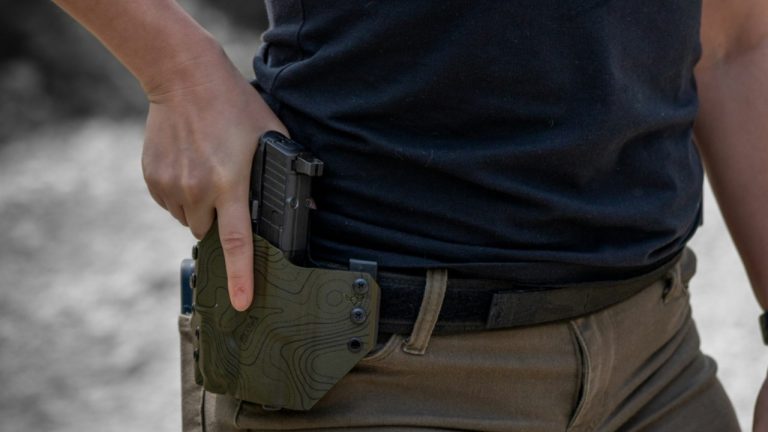
Under Hegseth’s order, installation commanders are instructed to consider requests from service members who want to carry personal handguns on base when they are off duty. The memo describes these privately owned weapons as tools for “personal protection” in the event of an active shooter or similar threat, not as substitutes for issued arms or as a way to bypass existing security forces.
The directive applies across the Defense Department, covering U.S. service members and other authorized personnel who meet the criteria. It effectively creates a new category of armed presence on base, alongside military police, security forces, and quick reaction units.
Hegseth’s public case: “They should be able to carry themselves”
Hegseth has been unusually blunt in public about why he believes troops should be armed at home as well as abroad. In a video message posted in Apr, he told viewers that U.S. military bases are “no longer” gun-free and described the memo he was signing as a direct response to service members who feel vulnerable on their own installations. In that clip, available on Pete Hegseth |, he argues that trained volunteers in uniform should not be forced to rely solely on gate guards and emergency response teams if violence erupts in a barracks, office, or classroom.
In separate remarks about the same policy, Hegseth said of troops who want to carry that “They should be able to carry themselves.” He linked the new guidance to a series of deadly incidents at Fort Stewart, Holloman Air Force Base and Pensacola Naval facilities, citing those tragedies as examples of what can happen when attackers exploit soft targets on installations. Those comments were reported in coverage of his memo that described how he is opening the door for more troops to carry personal firearms on bases, with the quote and the references to Fort Stewart, Holloman presented as central to his argument.
The rhetorical throughline is clear: Hegseth sees armed service members as a deterrent to internal attacks and as a last line of defense if one occurs, and he is willing to rewrite long-standing Pentagon norms to align policy with that belief.
How the new carry policy will work
Although full implementation details are still emerging, the broad contours of the policy are visible in the official memo and subsequent briefings. Commanders will retain authority to approve or deny individual requests, and the guidance emphasizes that privately owned firearms must be registered and carried in accordance with state and federal law. The Department of War description notes that the order is aimed at off-duty personnel and explicitly ties authorization to “personal protection.”
Reporting on the rollout explains that U.S. service members and other Defense Department personnel will be able to apply to carry personal weapons on base, subject to background checks, training verification, and local installation rules. One account of the change states that service members can on military installations after Hegseth’s decision, describing it as a significant shift in daily life for troops and civilians who live or work on post.
In a televised interview, Hegseth reiterated that he would allow troops to take personal weapons onto military bases for their own protection. He framed the move as consistent with the idea that those in uniform are trusted with lethal force overseas and should not be disarmed at home if they are properly vetted and trained. That position was captured in coverage that quoted him saying he would allow troops to bring firearms “for their own personal protection onto post,” a line that appears in a report on how Hegseth says he to carry privately owned guns.
“Not all threats are foreign”: internal security as a weapons issue
Hegseth’s language about threats is as notable as the policy itself. By pointing to Fort Stewart, Holloman Air Force Base and Pensacola Naval as case studies, he is treating insider attacks, domestic terrorism, and workplace violence as part of the same problem set as foreign adversaries. The implication is that a modern “weapons” portfolio for U.S. troops must include tools that protect them in garrison, not only on deployment.
That logic aligns with his broader message to the force, in which he has called for reviving the defense industrial base, reforming acquisition, and passing a financial audit to ensure that weapons and resources reach units quickly and efficiently. In his formal communication to personnel, available through a Department of War release that highlights his push to pass a financial, he links faster fielding of equipment to deterrence and warfighting credibility.
By folding base security into that same modernization drive, Hegseth is effectively redefining what counts as a “new weapon” for U.S. troops. In his view, a privately owned handgun carried by a trained sergeant in a barracks hallway can be as relevant to force protection as a new missile system in a distant theater.
Pressure on defense contractors and the weapons pipeline
The carry policy also arrives as Hegseth increases pressure on the traditional weapons pipeline. In remarks in WASHINGTON that were reported by TNND, Secretary of War Pete Hegseth urged Pentagon contractors to move faster on weapons production and acquisition reforms. He has signaled that he intends to reveal major changes to how the Pentagon manages portfolios across the Army and Navy, naming large firms such as Lockheed Martin, RTX, Boeing and Meta AI as part of the industrial base that must adapt.
Coverage of those comments describes how he plans to use executive authority to push acquisition executives toward quicker delivery of new systems, with a warning that delays will no longer be tolerated. The report on how Hegseth warns defense to move faster frames this as a break from business as usual at the Pentagon.
Taken together, the push for armed troops on base and the demand for faster weapons delivery reflect a consistent philosophy: Hegseth believes the United States must shorten the distance between threat and response, whether that threat is a near-peer rival or a shooter in a base classroom.
Supporters, skeptics and unanswered questions
Supporters of the new carry policy argue that it simply recognizes reality. They point out that many service members already own firearms, that they are trained to handle them, and that past base shootings have often unfolded faster than unarmed personnel could escape or security forces could respond. For those advocates, allowing vetted volunteers to carry on base is an overdue step that may deter attackers or at least limit casualties.

Asher was raised in the woods and on the water, and it shows. He’s logged more hours behind a rifle and under a heavy pack than most men twice his age.