President Trump awards Medal of Honor to soldier for heroism in Operation Absolute Resolve
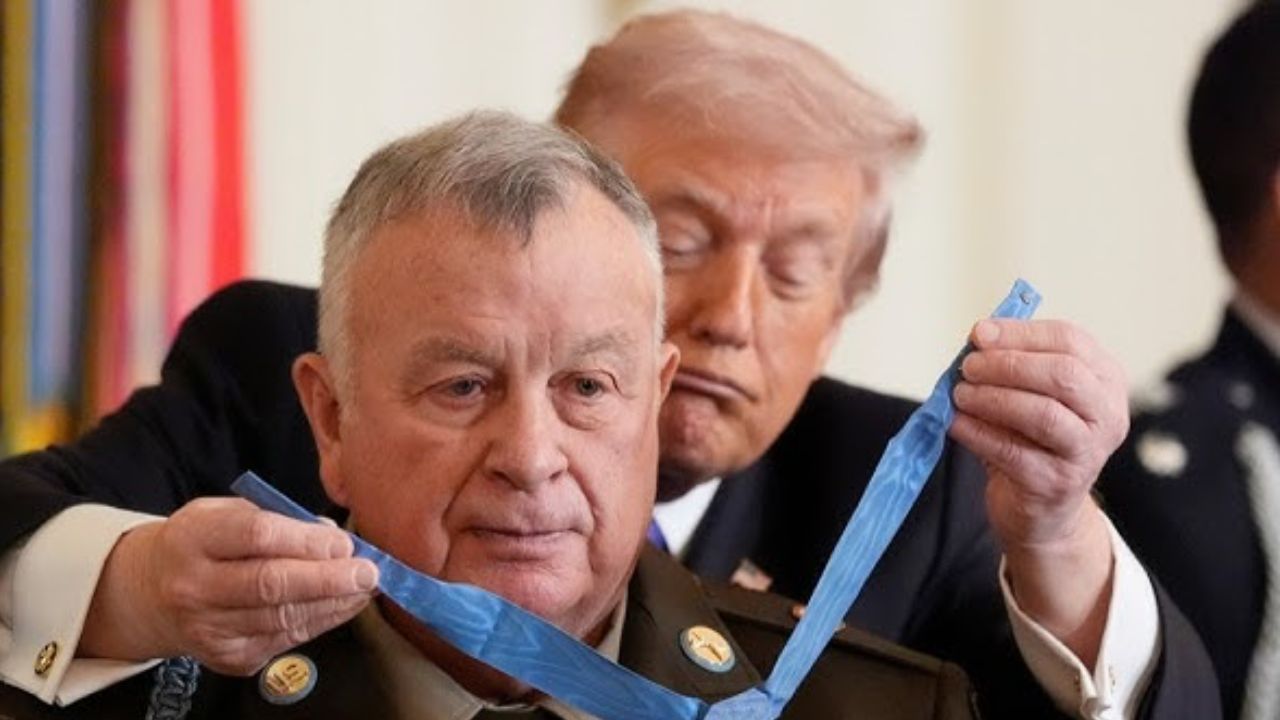
President Donald Trump has awarded the Medal of Honor to an Army helicopter pilot for his actions during Operation Absolute Resolve, a high-risk mission tied to a raid targeting Venezuelan leader Nicolás Maduro. Presented during Trump’s State of the Union address, the award brings a once-secretive operation into public view as a defining story of individual courage and modern special operations warfare.
The ceremony not only recognizes one soldier’s split-second decisions under fire, it also places a politically charged mission at the center of a national conversation about sacrifice, strategy, and how the United States honors those who carry out its most sensitive orders.
What happened
During his State of the Union address, President Trump called Army Chief Warrant Officer 4 Eric Slover to the House chamber balcony and presented him with the Medal of Honor for his role in Operation Absolute Resolve, the mission that supported a raid to capture Nicolás Maduro in Venezuela. According to detailed accounts of the operation, Slover was serving as a pilot with the 160th Special Operations Aviation Regiment, the “Night Stalkers,” when his helicopter came under intense fire during the infiltration phase of the raid.
Reporting on the ceremony describes Trump recounting Slover’s actions as he flew an MH-60 helicopter into heavily defended airspace to insert special operations forces near Caracas. As hostile fire struck the aircraft, Slover was wounded, yet he maintained control of the helicopter and kept it in the fight long enough to deliver the assault force to its landing zone. The official narrative credits him with saving the lives of the troops on board and preventing the mission from collapsing in its opening minutes, a sequence highlighted in accounts of the.
Military-focused reporting adds that Slover’s aircraft absorbed significant damage as Venezuelan forces responded to the incursion. Despite his injuries, he reportedly executed emergency procedures, coordinated with other aircraft, and maneuvered to avoid a crash that could have killed the special operators and exposed the mission. Coverage of the raid describes a chaotic night in which multiple helicopters were engaged, with Slover’s crew playing a central role in keeping the assault element on timeline and enabling follow-on strikes, as reconstructed in operational summaries of the Maduro raid.
Local reporting from Fort Liberty, formerly Fort Bragg, where Slover is based, has filled in personal details about the pilot’s background and the community’s reaction. Neighbors and fellow soldiers in North Carolina learned that the quiet warrant officer who deployed repeatedly with special operations units had become the first service member from the post in years to receive the nation’s highest award for valor, a milestone detailed in coverage of the Fort Liberty ceremony that followed the address.
Analysts of special operations history have emphasized that the Maduro raid was one of the most politically sensitive missions conducted by the 160th Special Operations Aviation Regiment in recent memory. Commentaries on the unit’s role describe how Night Stalker pilots train for precisely the kind of low-level, high-threat approach that Slover executed over Venezuela, and they have drawn parallels to earlier operations in Iraq and Afghanistan where helicopter crews absorbed heavy fire to protect ground forces. One such analysis of the Night Stalkers’ mission places Slover’s flight squarely in that lineage of risk.
Why it matters
The decision to award a Medal of Honor for a mission tied directly to the attempted capture of Nicolás Maduro carries weight far beyond one soldier’s story. At the most basic level, it signals that the Pentagon and the White House view Operation Absolute Resolve as a success worth celebrating publicly, even as the broader strategy toward Venezuela remains contested in international forums and domestic politics.
Within the military, Slover’s recognition underscores how helicopter pilots and aircrews have become central figures in modern combat. For much of the post-9/11 era, the public image of valor has focused on ground troops kicking down doors or holding defensive positions. In recent years, however, a growing share of Medals of Honor have gone to aviators who used their aircraft as both shield and lifeline for ground forces, a trend tracked in broader reviews of recent Medal of. Slover’s case reinforces that shift, showing how a pilot’s decisions in a cockpit can determine whether an entire mission survives contact.
The ceremony also matters for what it reveals about secrecy and transparency. Operations involving the 160th Special Operations Aviation Regiment are typically classified, with details emerging only years later in memoirs or heavily redacted documents. By placing Slover at the center of a nationally televised address, the administration chose to declassify key aspects of the Maduro raid and frame them as a success story. That choice allows the government to highlight the professionalism of its special operators, but it also invites new scrutiny of the legal and diplomatic framework that surrounded the attempt to seize a foreign head of state.
For Slover’s home station at Fort Liberty, the award arrives at a time when the installation is trying to redefine its identity after the removal of its Confederate-linked name. Local leaders and veterans have pointed to Slover’s actions in Operation Absolute Resolve as a powerful example of the post’s modern mission set, which now centers on global special operations and rapid crisis response rather than the legacy of past wars. The fact that a Night Stalker pilot from North Carolina received the medal for a mission in Venezuela reinforces that updated narrative.
More broadly, the award feeds into a long-running debate over how the United States selects and publicizes its highest valor decorations. Advocates for other service members have argued that some acts of heroism, particularly in earlier phases of the post-9/11 conflicts, were overlooked or downgraded for political or bureaucratic reasons. The high-profile recognition of Slover for a recent and controversial mission will likely intensify calls to revisit older cases and to apply consistent standards across theaters and eras.
The ceremony also intersects with ongoing efforts by lawmakers to secure the Medal of Honor for other soldiers whose actions occurred years ago. Representative Nicole Malliotakis, for example, has pressed the White House to upgrade the award for Staff Sergeant Michael Ollis, a Staten Island native killed in Afghanistan while shielding a Polish soldier from a suicide bomber, as described in her appeal to President Trump. The contrast between a newly recognized pilot and long-pending cases from earlier wars will shape how veterans’ groups judge the administration’s overall record on military honors.
What to watch next
In the months ahead, attention will shift from the ceremony in Washington to how Slover’s story is integrated into training, doctrine, and public memory. Within the 160th Special Operations Aviation Regiment, instructors are expected to dissect the Maduro raid in detail, using cockpit recordings, mission logs, and after-action reviews to extract lessons on risk management, air assault planning, and crew coordination under fire. Those internal discussions will influence how future pilots are taught to balance mission accomplishment with aircraft survivability when they face dense air defenses similar to those around Caracas.
At the Pentagon level, the Medal of Honor may accelerate efforts to codify best practices for joint special operations raids that require precise timing between air and ground elements. Operation Absolute Resolve relied on a tight choreography of helicopters, fixed-wing aircraft, and special operations teams on the ground. Any refinements that emerge from the Maduro raid could shape planning for future missions against high-value targets, whether in Latin America, the Middle East, or other contested regions. Analysts will watch for doctrinal updates and training exercises that reference lessons from the Venezuelan operation, including any public remarks that echo the detailed reconstructions found in Pentagon briefings.

Leo’s been tracking game and tuning gear since he could stand upright. He’s sharp, driven, and knows how to keep things running when conditions turn.