The firearm designs that shaped American gun culture more than people realize
Firearms in the United States are often discussed in terms of politics or crime statistics, but the hardware itself quietly shapes how Americans think about power, freedom, and identity. Certain designs became icons, while others rewired habits, markets, and even language without getting much public credit. By tracing a handful of influential models, I can show how specific engineering choices helped build the gun culture Americans now argue over.
Some of these designs are famous, others hide in plain sight, yet each helped set expectations about what a gun should do and who it is for. From early long rifles to compact pistols and military workhorses, the story of American gun culture is really a story of particular mechanisms, calibers, and marketing strategies that proved sticky enough to survive generations.
The long rifle and the myth of the American marksman
Long before polymer pistols and tactical carbines, the American Long Rifle taught colonists to see accuracy as a national trait rather than just a technical feature. Rifling, a longer barrel, and careful craftsmanship let early shooters hit targets at distances that smoothbore muskets could not match, and that performance fed stories about frontier hunters who could pick off game or enemies from improbable ranges. One detailed account of Revolutionary War weapons notes that this was the beginning of the myth behind Why the Long an Excellent Marksman Weapon This, and that the legend of the American marksman grew even when battlefield realities were more complicated.
That mythology still echoes in how Americans talk about precision shooting and rural self-reliance. Guides to early arms point out that Legendary guns and developments in firearms technology are interwoven with America itself, and the long rifle sits near the start of that lineage. By proving that a civilian-owned shoulder arm could be both practical and symbolically powerful, it set a template for later rifles that promised not just performance, but a certain kind of national character.
From John Alden’s wheellock to the idea of a personal sidearm
American gun culture did not begin with mass production; it began with individual weapons that carried stories. One often cited example is John Alden’s Wheellock, a firearm Said to have come over with John Alden on the Mayflower, which shows how early colonists treated a gun as both tool and heirloom. The same source that recounts the Mayflower gun also ties it to later militia arms, noting that the Mayflower Gun, as it is sometimes called, appears in a lineage that runs toward Captain John Parker’s Musket and other iconic pieces of early American history, as described in detail in a discussion of John Alden and his Wheellock.
That tradition of the personal sidearm as a symbol of status and responsibility persists in how many modern owners talk about their first handgun or a family shotgun. Collectors and historians often treat these early pieces as touchstones for a broader narrative that links settlers, militias, and later civilian gun owners. By framing a single wheellock as part of a national story, enthusiasts implicitly argue that private firearms have always been entwined with American identity, long before industrial design or federal law entered the picture.
Samuel Colt, revolvers, and the promise of mechanical equality
When Samuel Colt began selling revolvers, he did more than add extra shots to a handgun. He helped popularize the idea that a clever mechanism could flatten power differences between people who otherwise would not stand a chance in a fight. The famous slogan that “God made men, and Samuel Colt made them equal” captures how his marketing fused theology, technology, and social anxiety into a single narrative about self-defense and authority, as recounted in a profile of Samuel Colt and other designers.
Once Colt’s patent expired, other firms rushed into the market, and Civil War Firearms Once Colt lost that exclusive control, companies including Remington, Starr, Whitney and Manhattan began manufacturing their own revolvers, which spread the basic design across both military and civilian life. One historical overview notes that these Civil War Firearms Once Colt’s patent lifted became templates for later models that stayed in production into the twentieth century, a pattern that shows how revolver technology locked in certain expectations about capacity and reliability, as detailed in an account that highlights Civil War Firearms and the rise of Remington, Starr, Whitney and Manhattan.
The M1911 and the American romance with the .45 pistol
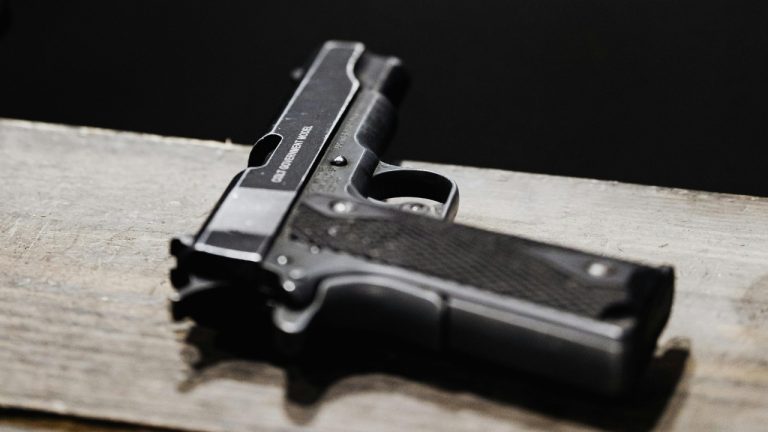
The M1911 pistol helped define what many Americans still imagine when they picture a serious handgun. Designed around the .45 ACP cartridge and carried by generations of soldiers, it combined stopping power, a single action trigger, and a slim steel frame that lent itself to both military holsters and later civilian carry. One survey of influential guns points out that the M1911 Pistol is listed alongside the American Long Rifle in a roster of firearms that shaped American history, underlining how a sidearm can become as culturally freighted as a long gun, as seen in a feature on American Long Rifleand the M1911.
The M1911 also helped cement a broader preference for large caliber pistols. Later data on manufacturing trends show that Pistol production in the United States shifted toward bigger frames as demand for large and . 38-caliber pistols grew, which analysts interpret as evidence that Americans increasingly associated handguns with self-defense and concealed carry rather than only with sport. A chart-driven analysis notes that the number of manufactured large, semiautomatic handguns rose alongside semiautomatic rifles, and explicitly cites the growing demand for large and . 38-caliber pistols as a sign that Americans were gravitating toward guns they believed could stop a threat quickly, as explained in a breakdown of Pistol manufacturing and Americans’ preferences.
The M1 Garand and the normalization of semi‑automatic fire
Among military rifles, the M1 Garand occupies a special place in American memory, in part because of what its design signaled about the future. Its semi automatic operation, en bloc clip system, and rugged construction allowed soldiers to fire more quickly and with less manual effort than bolt action rifles, which changed both tactics and expectations. A detailed history of the weapon notes that Its ( M 1 Garand ) design innovations paved the way for future semi-automatic and automatic firearms, and that the M1 Garand has also achieved a kind of celebrity status that further solidified its place in popular culture, as described in a technical overview of Its Garand history.
That cultural afterlife matters because it helped normalize the idea that a semi automatic rifle is a standard infantry and civilian arm. Later platforms, from the M14 to the AR family, inherited both mechanical concepts and the aura of a “service rifle” that an ordinary citizen might reasonably own. When people talk about the right to own a rifle that is “similar to what the troops carry,” they are often drawing, consciously or not, on the legacy of the M1 Garand as the rifle that bridged older bolt actions and modern self loading designs.
John Browning’s machine guns and the industrialization of firepower
While handguns and rifles shaped personal identity, John Browning’s automatic weapons changed how Americans thought about firepower on a larger scale. Designs like the M1919 Browning Machine Gun introduced sustained, belt fed fire that could support infantry, defend vehicles, and anchor battlefield tactics, and they stayed in use in various forms for decades. One survey of iconic weapons lists the M1919 Browning Machine Gun among the most significant arms From the Revolutionary War era to modern conflicts, placing it in a continuum of tools that repeatedly reshaped how the U.S. military fights, as recounted in an overview that highlights weapons Revolutionary War through the twentieth century.
These designs also affected civilian gun culture indirectly. As veterans returned home and popular media dramatized wars, belt fed guns and heavy automatics became symbols of overwhelming force, even if they remained tightly regulated. Browning’s work on automatic mechanisms influenced smaller arms too, including semiautomatic pistols and shotguns that borrowed concepts from his machine guns. That cross pollination helped make rapid fire capability feel like a normal, almost expected feature rather than a rare military specialty.
From Annie Oakley’s Parker to celebrity firearms
Not every influential firearm is famous for its engineering; some matter because of who held them. Annie Oakley’s Parker shotgun is a classic example, a Parker BHE given to Annie Oakley by her husband, Frank Butler, that became part of her public persona as one of the most celebrated exhibition shooters in American history. A catalog of notable guns describes how This Parker BHE, associated with Annie Oakley, represents how a single shotgun can stand in for an entire era of entertainment, gender expectations, and attitudes toward marksmanship, as detailed in a feature on Annie Oakley and her Parker.
Celebrity firearms like Oakley’s Parker helped make shooting a spectator sport and a respectable pastime, especially for women who saw her as a model. They also reinforced the idea that a finely made gun is both a tool and an art object, something to be shown off as much as used. That blend of performance, craftsmanship, and personality still drives parts of the market today, from high grade shotguns to custom engraved pistols that promise buyers a link to a storied past.
AR style rifles, Gun Culture 2.0, and the modern market
In recent decades, the center of gravity in American gun culture has shifted from hunting and heritage to self defense, tactical training, and personal identity, a trend some researchers call Gun Culture 2.0. One in depth survey of owners notes that Much of a study titled Who Might Buy a Gun focuses on this shift, arguing that Gun Culture 2.0 has fundamentally changed how people talk about risk, responsibility, and everyday carry, as summarized in research that analyzes Much of Who Might Buy a Gun and the rise of Gun Culture.
AR pattern rifles and modern pistols sit at the heart of this transformation. Industry data show that manufacturers have ramped up production of semiautomatic rifles and large pistols, with one analysis charting how Americans’ interest in self defense and concealed carry helped drive sales of both . 38-caliber handguns and semiautomatic rifles. Another overview of American firearms history notes that Legendary guns and developments, from early muskets to the ArmaLite AR-18 machine gun, track closely with broader social and legal changes, suggesting that the popularity of AR style rifles is part of a long pattern in which new designs both respond to and shape public attitudes, as explained in a Library guide that starts with Legendary guns and ends with the ArmaLite AR-18.
Courts, commerce, and the feedback loop of design
Firearm design does not evolve in a vacuum; it reacts to law and then pushes back on it. A detailed timeline of gun history in America traces how Supreme Court decisions, federal statutes, and local regulations have alternately constrained and encouraged certain types of weapons, from early revolvers to modern semiautomatics. That same account argues that each legal shift changed what kinds of guns were profitable to make, which in turn influenced what ordinary buyers saw on store shelves, as documented in a long form look at gun history and the Supreme Court.
Commerce then amplifies those shifts. One analysis of the firearms industry uses six charts to show how manufacturers responded to consumer demand for self defense oriented products, highlighting the rise in production of large pistols and semiautomatic weapons, including assault rifles, as Americans increasingly framed gun ownership around personal protection. At the same time, enthusiasts and commentators on forums and blogs trade lists of the “most iconic” guns, such as a discussion that opens with the claim that There has been a handful of American firearms that could be considered the most iconic and then makes a case for each, including models used in World War II, as seen in a thread that begins with the assertion that There are several American firearms that deserve that label.

Leo’s been tracking game and tuning gear since he could stand upright. He’s sharp, driven, and knows how to keep things running when conditions turn.