The Iran War Is Already Producing Major Military Firsts—Here Are the Biggest So Far
The war between the United States, Israel and Iran has already rewritten parts of the modern military playbook. In a matter of days, weapons that had never been fired in anger, artificial intelligence systems that once sat in labs, and new concepts for air and naval combat have all moved from theory to practice. The result is a conflict that is not only reshaping regional security, but also offering an early glimpse of how great power militaries intend to fight over the next decade.
These innovations are emerging amid a fast-moving campaign marked by coordinated Israeli and US strikes, deep Iranian retaliation and a widening geographic footprint. Behind the headlines, a series of specific combat and technology firsts is quietly setting the template for future wars.
The war’s opening phase and a new kind of air campaign

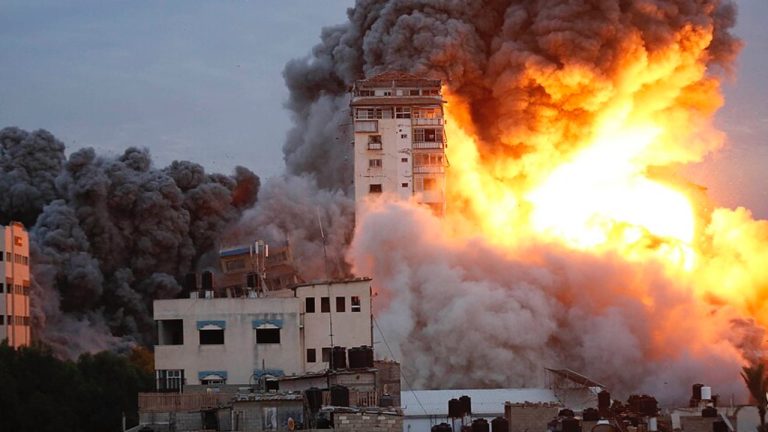
The conflict that many in the region now simply call the 2026 Iran war began with coordinated Israeli and US action. According to the official 2026 Iran war chronology, The Abraham Lincoln Carrier Strike Group took up position in the Arabian Sea and US forces launched Tomahawk cruise missiles as part of a broader opening salvo. At roughly the same time, Israeli aircraft and missiles targeted Iranian facilities, including sites in Kermanshah, while US Central Command coordinated strikes from the sea and air.
A separate timeline of the notes that at 06:35 UTC, CENTCOM announced that it and partner forces had begun airstrikes against Iran. That timestamp, 06:35 UTC, already hints at the level of coordination required between Israeli squadrons, US bombers, naval platforms and regional partners. Iran responded with its own salvos, including drones and missiles aimed at bases and infrastructure, setting the pattern for a rapid cycle of strike and counterstrike.
From the first hours, the air campaign relied heavily on precision munitions, stand-off weapons and a layered defense network. Reports describe US and Israeli aircraft operating under dense umbrella coverage from ships and land-based systems, while Iranian forces attempted to saturate those defenses with swarms of drones and cruise missiles. The tempo has given militaries a real-world test of how integrated air and missile defenses perform under sustained pressure.
New long range missiles enter combat
Among the clearest military firsts has been the debut of new long-range precision strike missiles in actual combat. US Central Command revealed that the Army fired the New Precision Strike Missile, often referred to as PrSM, in the campaign. A detailed account of these New PrSM ballistic firings explains that Centcom confirmed on Wednesday that the Army used the weapon in strikes on Iranian targets.
PrSM is designed to replace older tactical ballistic missiles with a longer range and more flexible payload. Combat use in Iran gives planners a live test of how accurately it hits hardened or mobile targets, how quickly crews can reload launchers and how effectively the system integrates with joint targeting networks. The fact that the Army could fire PrSM from dispersed launchers, yet still synchronize with naval and air strikes, offers a preview of more distributed, networked campaigns.
These launches also carry a signaling function. By choosing to employ a brand-new ballistic missile against Iranian infrastructure, the United States is demonstrating both to Tehran and to other observers that it can hold distant, defended targets at risk without relying solely on manned aircraft. That has implications for deterrence in other theaters where US forces might face dense air defenses.
Submarine warfare and the Mark 48 moment
Another milestone came beneath the surface. In one of the most widely discussed naval engagements of the war, an American submarine sank an Iranian navy ship with a heavyweight torpedo. Officials later confirmed that the weapon was a Mark 48, and one report on combat firsts notes that a Mark 48 torpedo was used to destroy a vessel that Iranian officials had touted as a symbol of their naval strength.
The Mark 48 has existed for decades, but this strike is being treated as a landmark because it is the first time in years that the United States has used such a torpedo to sink a major warship in combat. The engagement tested not just the torpedo itself, but also the submarine’s ability to approach undetected, classify its target in a crowded maritime environment and coordinate with surface and air units to avoid fratricide.
For Iran, the loss exposes the vulnerability of surface ships in a conflict where the United States can bring quiet submarines to bear from multiple directions. For other navies, the incident will reignite debates about whether large surface combatants can survive against modern undersea threats without far more robust anti-submarine protection.
Cheap attack drones and the Scorpion Strike experiment
On the first day of the war, US Central Command disclosed that a formation known as the Scorpion Strike task force had used one-way attack drones against Iranian targets. Accounts of these Weaponry firsts describe Scorpion Strike as an experiment in pairing cheap, expendable drones with more traditional strike aircraft to overwhelm defenses and extend deep-strike capability.
The one-way drones used by Scorpion Strike are conceptually similar to the Shahed 136 projectiles that Iran has supplied to Russia. They are inexpensive, relatively slow and packed with explosives, but their main advantage is numbers. When sent in waves, they can force defenders to expend valuable interceptor missiles or reveal radar positions that can then be targeted by higher-end weapons.
By integrating these drones into a joint task force from the outset of the war, the United States is effectively validating a new tier in its strike arsenal. Instead of relying solely on Tomahawks or manned bombers, commanders can now mix in swarms of low-cost drones to probe Iranian air defenses and soak up fire. That approach reflects lessons learned from Ukraine and other recent conflicts, but this is the first time Washington has used such a system at scale against a state adversary.
AI on the kill chain and real time targeting
Perhaps the most consequential innovation is less visible than a torpedo or missile. Multiple reports indicate that the United States is using artificial intelligence systems to help identify and prioritize targets in Iran. One detailed social media explainer describes how Now Artificial Intelligence is being used to analyze sensor data and flag potential strike candidates for human review.
Another assessment of historical firsts in the conflict highlights the first known use of AI for real-time target identification by the US military. That report notes that while the Venezuela raid to capture former Venezuelan officials involved advanced analytics, the Iran war marks a step change in how algorithms are integrated into the live targeting process. Instead of simply helping with post-strike analysis, AI tools are now scanning drone feeds, satellite imagery and intercepted communications to build dynamic target lists in near real time.
This shift raises obvious ethical and strategic questions. Officials insist that humans remain in the loop and that AI suggestions are only one input into a broader decision process. Yet by compressing the time between detection and strike, these systems make it easier to hit fleeting targets such as mobile missile launchers or command vehicles. They also increase the risk of misidentification if the underlying data or models are flawed. The Iran war is therefore serving as a test case for how far militaries are willing to push machine-assisted warfare.
A stunning aerial success and the rise of LUCAS
Airpower has been central to the campaign, and several assessments describe it as a stunning aerial success for the United States and Israel. One detailed analysis notes that, at the bottom end of the cost spectrum, America has debuted its Low cost Uncrewed Combat Attack System, or LUCAS. According to that report, At the lower tier, the United States has used LUCAS as a cheap, long-range attack drone designed to compete with the Shahed 136 projectiles used by Russia in Ukraine.
LUCAS fills a gap between small quadcopters and high-end stealth drones. It can fly long distances, carry a meaningful payload and be produced in large numbers at relatively low cost. In Iran, it has reportedly been used to strike air defense radars, ammunition depots and even some naval targets, often in coordination with manned aircraft that arrive later to exploit gaps in the defense.
The performance of LUCAS will shape procurement debates in Washington and allied capitals. If the system proves reliable and effective, it will strengthen arguments for investing in large fleets of attritable drones rather than a small number of exquisite platforms. For Iran and other potential adversaries, it highlights the need to develop cheaper, more agile air defense options that can engage swarms without depleting expensive interceptor stocks.
Iranian retaliation, NATO territory and escalation risks
The war has not been a one-sided demonstration. Iran has continued retaliating with strikes of its own, including drones and missiles that have tested regional defenses. A focused section of the Iran continued retaliating account notes that Iranian forces launched drones that caused a fire after impacting a target, underlining both the destructive potential and the relative inaccuracy of some of these systems.
In a separate escalation, Iran fired a drone into NATO territory, prompting warnings from US officials that the war had only just begun and that strikes would go deeper into Iran if necessary. A televised segment explained how, on Wednesday, the United States characterized the conflict as still in its early stages after On Wednesday Iran expanded the fight into NATO airspace.
These Iranian moves are not technological firsts in the same way as LUCAS or PrSM, but they have strategic significance. By striking NATO territory, Tehran is testing alliance cohesion and the willingness of European members to tolerate spillover from a conflict that some citizens already view as remote. At the same time, the use of relatively cheap drones for such a high-stakes escalation shows how accessible long-range strike has become, even for a sanctioned state.
Domestic debate in the United States and Israel
The rapid advance of the campaign has also sparked intense political debate, especially in the United States. Some analysts and citizens argue that the conflict is, in their words, “Not America’s war,” and that Washington is being drawn too deeply into a confrontation that primarily serves Israeli security interests. A detailed report on public reaction quotes listeners and Not America experts reacting to US and Israel strikes on Iran and noting that the operation, referred to as Epic Fury, began on February 28, 2026.
Critics worry that each new technological first increases the risk of miscalculation or blowback. AI-driven targeting, long-range missiles and deep strikes can all shorten decision timelines and raise the stakes of each engagement. Supporters counter that overwhelming military superiority and precision tools are the best way to compel Iran to curb its regional activities and missile programs.

Leo’s been tracking game and tuning gear since he could stand upright. He’s sharp, driven, and knows how to keep things running when conditions turn.