U.S. Army unveils first new grenade design since Vietnam
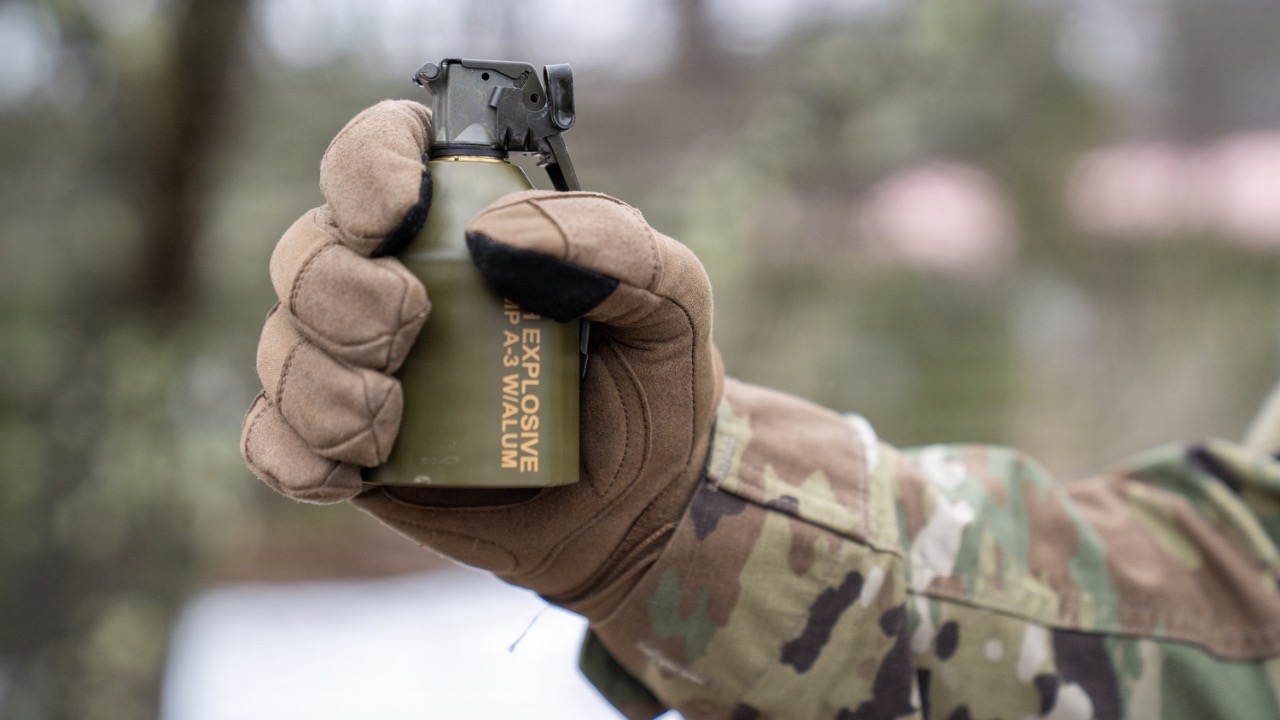
The U.S. Army has quietly crossed a historic threshold, approving its first new lethal hand grenade design since the Vietnam era. The M111 Offensive Hand Grenade, a plastic-bodied weapon that relies on shock waves rather than metal fragments, is intended to give Soldiers more options in tight urban fights while reducing some of the risks that come with traditional fragmentation grenades.
Paired with a dedicated training version and designed to complement, not replace, the long-serving M67, the M111 reflects how the Army expects future close combat to unfold: in rooms, hallways, and dense urban blocks where blast pressure can matter more than flying steel.
A new kind of “offensive” grenade

The Army formally cleared the M111 Offensive Hand Grenade for full material release earlier this year, describing it as the first new lethal hand grenade approved since 1968. In official material, the service identifies the M111 as an Offensive Hand Grenade, a label that reflects how it is meant to be used at shorter ranges and in more confined spaces than a standard fragmentation grenade.
Unlike the M67, which scatters metal fragments in all directions, the M111 uses a plastic body and a high explosive charge to generate intense overpressure. The weapon is designed to kill or incapacitate through the shock waves and blast force created by the explosion, not through shrapnel. Reporting on the program describes the M111 as a plastic weapon that uses shock waves instead of shrapnel to neutralize enemies in close-quarters combat, with the blast effect rather than fragments doing the lethal work inside a room.
That design choice is not cosmetic. It addresses a specific tactical problem that emerged from decades of urban warfare and counterinsurgency, where Soldiers often had to choose between using a fragmentation grenade and risking friendly casualties, or entering a room without any explosive support at all.
Why the Army wanted a blast grenade
Traditional grenades like the M67 were built for open terrain. Their steel bodies break apart into hundreds of fragments that can fly well beyond the intended target area. In enclosed spaces, that behavior becomes unpredictable. Shrapnel can be limited by enclosed spaces or barriers, and fragments can pierce a thin wall and risk the lives of American personnel or civilians on the other side. Commanders in Iraq and Afghanistan often faced that tradeoff when clearing compounds with interior courtyards and shared walls.
The M111 is meant to address that problem by emphasizing blast over fragmentation. According to an official Army description, the grenade is optimized for enclosed spaces and is intended to give Soldiers a more controlled lethal effect inside buildings. The plastic body contains the explosive charge in a way that directs energy into pressure waves rather than turning the casing into high-velocity projectiles.
Those shock waves are particularly effective in rooms, hallways, and other confined environments where blast pressure can reflect off surfaces and compound. Under the Army’s concept, a Soldier can throw an M111 into a room of enemy combatants and expect the blast to incapacitate anyone inside without sending metal fragments through multiple walls and into friendly positions.
How the M111 pairs with the M67
The new grenade is not a replacement for the M67. The Army has been explicit that the M67 fragmentation grenade is staying in the inventory. Troops will still carry it for use in open terrain to maximize lethal fragment effects, where its steel body and wide fragmentation pattern are an advantage rather than a liability.
Instead, the service designed the two grenades to work as a pair. According to one description, The Army expects Soldiers to use the M67 in open terrain to maximize lethal fragment effects, and the M111 in enclosed spaces where blast is more effective and safer for nearby friendly forces.
That pairing reflects a broader shift in infantry kit toward specialization. Just as riflemen now choose between different types of ammunition for different targets, small units will have to decide which grenade type fits a given scenario. In a trench line or a tree line, the M67 still makes sense. In a stairwell or a mud-walled compound, the M111 gives leaders another option.
Training with the M112 and a shared arming process
To make the transition smoother, the Army built a dedicated training version of the new grenade. The M112 is a nonlethal counterpart that mimics the size, shape, and handling of the M111 but is intended for training environments. The service has emphasized that the new grenade and its training version, the M112, leverage the same five-step arming process so Soldiers can train as they fight and build consistent muscle memory.
That five-step sequence is a deliberate design choice. According to an official Army statement, using the same arming process for both the M111 and M112 lets Soldiers train with the exact motions they will use in combat, which is intended to improve performance and reduce errors under stress.
The focus on a consistent arming sequence also reflects hard lessons from past mishaps with grenades and other munitions. Simplifying and standardizing the steps from pulling the pin to throwing the grenade can cut down on confusion, especially when units mix live and training rounds on the same range.
Inside the blast: how the M111 works
Publicly available descriptions of the M111 highlight its plastic construction and its reliance on overpressure. One account describes a plastic weapon that uses shock waves instead of shrapnel to neutralize enemies in close-quarters combat. Instead of metal fragments, the M111 uses the force created by the explosion itself to kill or incapacitate.
Blast weapons of this type are particularly dangerous in confined areas because the pressure wave can reflect and amplify. That same effect makes them less hazardous at longer distances in open terrain, where the wave dissipates quickly and does not have surfaces to bounce off. The M111 is calibrated around that physics problem, with an explosive charge sized to be lethal inside a room but less likely to cause unintended casualties far beyond the doorway.
At the same time, the grenade is still lethal. Official material describes it as a new lethal hand grenade, and the Army’s decision to field it alongside the M67 rather than replace the older grenade suggests that commanders will treat it as a specialized tool for specific situations, not a safer or “less lethal” alternative.
Urban warfare and the Vietnam comparison
The Army’s own framing of the M111 as the first new lethal hand grenade since 1968 invites a comparison with the Vietnam era. The M67, which entered service in that period, was built around jungle and open-field combat, where fragmentation was the primary way to hit enemies behind cover. Modern conflicts in Iraq, Syria, and dense urban areas have shifted that calculus.
In those environments, Soldiers often find themselves fighting inside multi-story buildings, concrete apartment blocks, and tight alleyways. Blast grenades that use shock waves rather than fragments can be more predictable in how they affect a single room or hallway. They also reduce the risk that fragments will travel through light walls or windows into nearby homes or friendly positions, a concern that appears throughout recent descriptions of the weapon’s intended role.
Framing the M111 as a Vietnam-era milestone also carries a message about modernization. For decades, the basic hand grenade in U.S. service barely changed. The approval of a new design signals that the Army is willing to revisit even the most familiar pieces of infantry equipment when the character of close combat shifts.
What comes next for Soldiers
With the M111 now approved, the next step is fielding. The Army has not publicly detailed exact quantities or unit-by-unit timelines in the available material, but the plan is clear enough. Troops will carry both the M67 and M111, selecting between fragmentation and blast depending on whether they are in open terrain or enclosed spaces.

Asher was raised in the woods and on the water, and it shows. He’s logged more hours behind a rifle and under a heavy pack than most men twice his age.