8 Forgotten military vehicles that changed battlefield tactics
I focus on eight largely forgotten military vehicles that quietly reshaped battlefield tactics, from trench-busting armor to scooter-mounted anti-tank guns. Each one forced commanders to rethink how to move, protect, or supply troops, and their influence still echoes in modern designs even if their names rarely appear outside specialist circles.
1. Mark I Tank
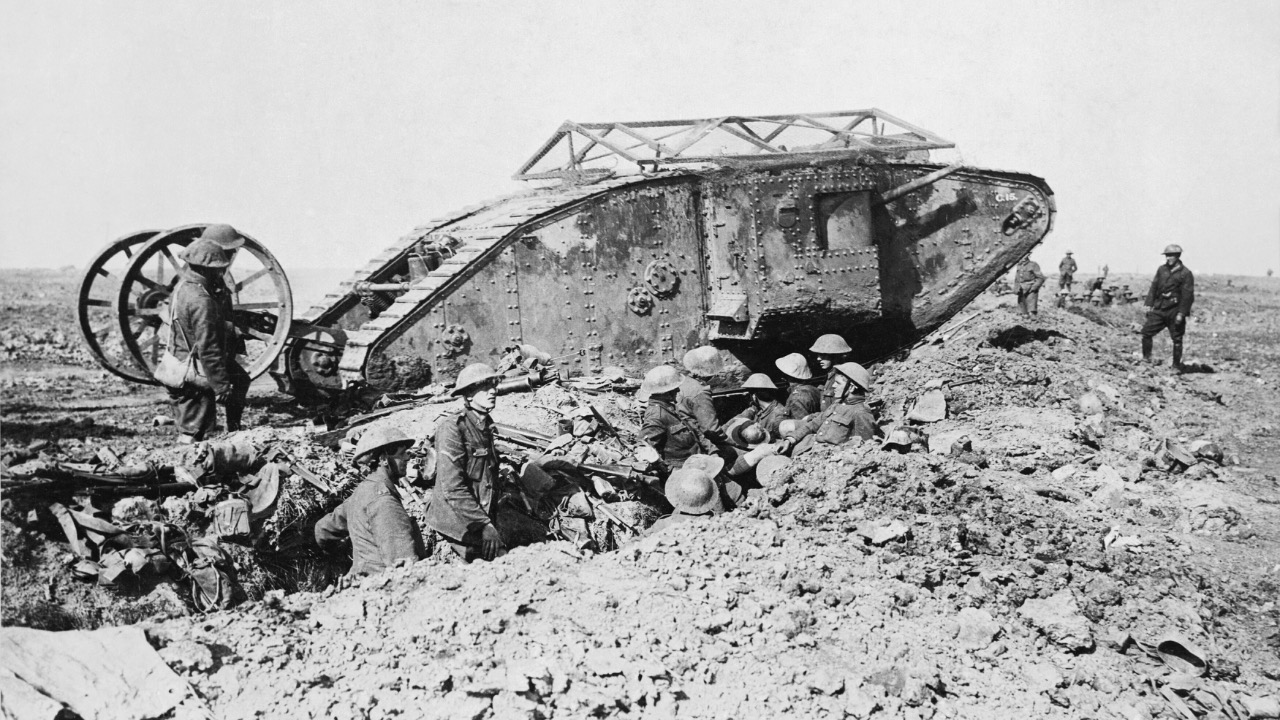
The Mark I Tank was the first combat tank to reach the front, and it was explicitly Introduced in World War I to break trench deadlock. Its armored hull and caterpillar tracks let it cross shell craters and barbed wire that had stalled infantry assaults. Even with mechanical failures and slow speed, it proved that armor, not massed infantry alone, could punch through fortified lines.
That breakthrough changed how planners thought about offensive operations. Later designs like the MKIV and British Centurion refined the concept, but the Mark I Tank created the template for mechanized breakthroughs that still underpins modern armored doctrine.
2. MKIV Tank
The MKIV followed the Mark I and turned an experimental idea into a practical assault tool. As later analysis of the MKIV notes, incremental improvements in armor layout and fuel capacity made it more reliable for sustained offensives. The MKIV’s ability to support infantry over longer distances helped turn isolated tank raids into coordinated combined-arms attacks.
By proving that armored spearheads could be massed and supplied, the MKIV pushed doctrine toward large-scale armored formations. That shift laid the groundwork for later blitz-style operations, even if the vehicle itself faded from public memory once sleeker interwar tanks appeared.
3. British Centurion
The British Centurion emerged from World War II but came to define the early Cold War battlefield. Described among influential designs that changed armored warfare, the British Centurion combined strong armor, a powerful gun, and good mobility in a way earlier heavy tanks could not. A Dutch Army Centurion Tank providing security in postwar deployments illustrated how it could dominate both open terrain and urban approaches.
Strategically, the Centurion helped crystallize the “main battle tank” idea, replacing the split between light, medium, and heavy types. That consolidation simplified logistics and training, and it influenced how NATO forces planned to counter massed armor in Europe for decades.
4. The Tiger
The Tiger was designed, as one detailed history puts it, at least partially as a direct counter to the T-34. The Tiger’s thick armor and high-velocity gun made it one of the most feared tanks of World War II, forcing opponents to adapt with new tactics and better anti-tank weapons. Even when outnumbered, it could dominate long-range duels.
However, its complexity and cost limited production, highlighting a trade-off between battlefield overmatch and industrial sustainability. That lesson pushed postwar designers toward more balanced vehicles like the M1 Abrams and British Centurion rather than chasing ever-heavier monsters.
5. NSU Kettenkrad HK101
The NSU Kettenkrad HK101 looked like a motorcycle fused with a tracked tractor, and Germany used the Kettenkrad extensively during WWII. As a light, tracked carrier, it hauled cables, ammunition, and even small guns across mud and snow where wheeled vehicles bogged down. Its compact size also made it useful for towing aircraft and moving supplies along narrow forest tracks.
By blending motorcycle agility with tracked mobility, the Kettenkrad previewed modern all-terrain utility vehicles. It showed commanders that logistics platforms could be as specialized and terrain-focused as frontline armor, a principle that still shapes off-road support fleets.
6. Vespa 150 TAP
The Vespa 150 TAP was an airborne scooter fitted with a recoilless rifle, and it appears among the Vespa 150 TAP as a particularly odd anti-tank solution. Representing motorbikes in that lineup, it allowed small teams to move quickly after parachute insertion, then assemble the 150 millimeter-class weapon to ambush armor or fortified positions.
While the scooter itself was fragile, the concept of highly mobile, lightweight anti-armor teams anticipated later missile-armed infantry. It pushed doctrine toward dispersing firepower across many small units instead of concentrating it only in heavy vehicles.
7. Jeffery Quad (Nash Quad)
One of the first successful four-wheel-drive vehicles, the Jeffery Quad, also known as the Nash Quad, introduced four-wheel steering and powered axles that let it tackle rough terrain. As a visual history of off-roaders notes, One of the its key roles was hauling guns and supplies as armies entered the first World War with motor transport.
By proving that trucks could replace horses even in mud and ruts, the Jeffery Quad shifted logistics planning toward mechanization. Its influence can be seen in every modern 4×4 tactical truck that treats off-road mobility as a baseline requirement rather than a luxury.
8. GMC Model 15 Truck
The GMC Model 15 truck is thought to be the first land vehicle deployed on a large scale for military logistics. Reporting on early supply innovations highlights how the GMC Model 15, Introduced in World War I, allowed armies to move ammunition and rations far more efficiently than wagon trains. The GMC name quickly became synonymous with standardized, rugged trucks.
This shift in logistics changed battlefield tactics by extending operational reach. Commanders could plan offensives that depended on continuous resupply over poor roads, a capability that underpins modern maneuver warfare even though the specific Model 15 has long since disappeared from service.

Asher was raised in the woods and on the water, and it shows. He’s logged more hours behind a rifle and under a heavy pack than most men twice his age.