Why bear spray outperforms firearms in many real-world encounters
When biologist Tom S. Smith and colleagues at Brigham Young University examined real attacks in Alaska, they found that people who pulled a gun on a charging bear were not statistically safer than those who did not. Wildlife agencies from the U.S. National Park Service to Montana Fish, Wildlife & Parks have since leaned on that kind of data to argue that bear spray, not a handgun or rifle, should be the first line of defense in bear country. The evidence points in the same direction: in many real encounters, a cloud of capsaicin stops an aggressive bear more reliably, more quickly, and with less collateral damage than a bullet.
That conclusion cuts against the popular image of the heroic last‑second shot. But when you look at how bears actually move, how people actually shoot under pressure, and how both tools work in the field, a pattern emerges. Bear spray gives ordinary hikers, hunters, and researchers a wider margin for error, while firearms demand near‑perfect performance in the worst seconds of their lives.
Why the data favors spray over bullets
The numbers matter because they strip away a lot of mythology. Analyses of hundreds of bear encounters in Alaska and the Northern Rockies consistently show that bear spray stops aggressive behavior in the vast majority of cases, while firearms produce more mixed results. One synthesis of field incidents found that bear spray was between 92 to 100%effective at stopping aggressive bears, with very low injury rates for both people and animals. In contrast, guns could stop a bear, but success depended heavily on the shooter’s skill, the weapon, and the circumstances.
Researchers at Brigham Young University dug into this gap by comparing incidents where people used firearms against bears with those where they did not. Their work found that using a gun did not make people safer in a statistically clear way, which is why the study is often cited as evidence that gun in bear does not automatically translate into better outcomes. People often miss, wound the animal without stopping it, or injure themselves or companions. Bear spray, by contrast, covers a wider area, does not require pinpoint accuracy, and is designed specifically to create a window for retreat rather than a lethal confrontation.
What bear spray actually does to a charging bear
Bear spray is essentially a high‑volume, high‑pressure version of pepper spray formulated for large wildlife. It uses capsaicin and related compounds to inflame the bear’s eyes, nose, and lungs, creating intense but temporary pain that overwhelms the animal’s drive to continue the charge. Guidance from safety trainers explains that a proper canister projects a dense orange cloud for several seconds, creating a barrier that a bear must pass through to reach a person. Once the spray hits, most bears veer off, stop, or retreat, buying precious seconds for a safe withdrawal.
Manufacturers and safety educators emphasize that this is a non‑lethal deterrent, not a weapon meant to injure permanently. One major safety guide describes bear spray as a powerful, non‑lethal tool that lets people create distance and then leave the area rather than escalate the conflict, which is why it is framed as a way to allow for a. The physical effects on the bear usually subside within tens of minutes, and there is no need to track a wounded animal or risk a second confrontation. That temporary but overwhelming discomfort is exactly what tips the balance in favor of spray in so many real attacks.
Why firearms are so hard to use well under attack
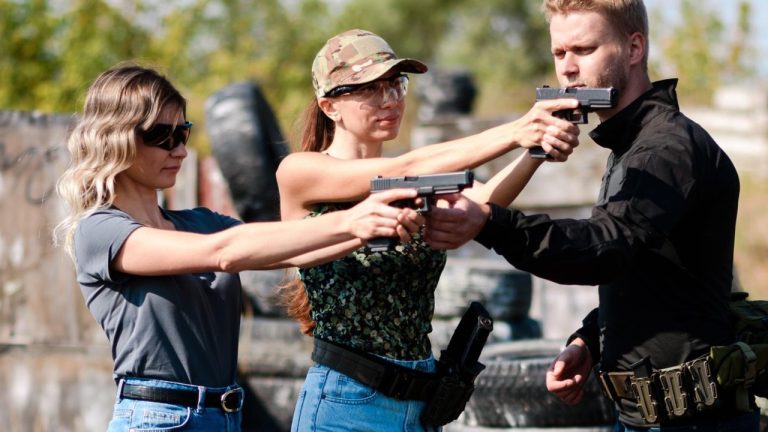
Firearms can absolutely kill a bear, but the question that matters in an attack is whether they can stop it fast enough. Bears can cover 40 feet in roughly a second and a half, and they rarely run straight at a stationary target on a shooting range. To end a charge immediately, a shooter typically needs a spine or brain shot on a moving animal, often in low light and with adrenaline surging. George Hyde, General Manager at Counter Assault Bear Spray, has put it bluntly, explaining that you have to make a spine or brain shot to stop that bear, a standard that even experienced hunters struggle to meet under calm conditions, let alone in a surprise encounter.
Field data back up how unforgiving that reality is. In one widely cited analysis of defensive shootings, firearms were reported as 84% effective but also associated with people shooting themselves during an attack, an outcome highlighted in discussions about bear spray vs performance. The Brigham Young University research similarly stressed that people should carefully consider their ability to be accurate under duress before relying on a gun for protection from bears. A handgun on a hip can feel reassuring, but in the tight time window of a real charge, it often demands more precision and composure than most people can deliver.
What government safety guidance actually says
Federal land managers have moved steadily toward a clear message: carry bear spray and know how to use it. The U.S. National Park Service explains that bear spray is a highly effective deterrent and that visitors in areas with bears should keep it accessible, practice removing the safety clip, and know the recommended firing distance. That same guidance notes that the goal is to end the encounter with everyone walking away, and that a cloud of spray is more likely to achieve that than a rushed shot.
On firearms, the language is pointed. In an official advisory, the agency states that Firearms are not for stopping a bear attack and warns that using a firearm during a bear attack may only worsen the attack. The broader guidance on bear spray and lays out a hierarchy: make noise, secure food, avoid surprising animals, and carry spray as the primary defensive tool. Firearms, where legal, are treated as a last resort for people who are both highly trained and fully aware of the legal and safety risks.
Lessons from the Northern Rockies and Alaska
The debate about spray and guns is not academic in places like Montana, Wyoming, and Alaska, where people share trails and river bottoms with grizzlies and black bears. Across the Northern Rockies, both bear and human populations are on the rise, which means more encounters in campgrounds, on hiking trails, and during hunting seasons. A safety brochure from Montana Fish, Wildlife & Parks notes that bear encounters are increasing and that carrying spray has become a standard recommendation for hunters, anglers, and hikers who spend time in dense brush or near carcasses.
That regional experience has fed into broader safety campaigns. A technical briefing used in outdoor and aviation safety training compares bear spray and bullets directly, highlighting that spray is easier to deploy effectively and less likely to cause unintended injuries. In one such document, trainers summarize field reports to show that bear spray vs is not a close contest in most surprise encounters. The data from Alaska that informed the Brigham Young University work tell a similar story: people who had spray and knew how to use it walked away from charges that could easily have turned fatal.
How real users and hunters think about the tradeoffs
Beyond formal studies, the way experienced hikers and hunters talk about bear spray is telling. In one discussion among backcountry campers, a user posting as wildlife_is_neat responded to a question about Yellowstone by saying, “Yes, bear spray is a sufficiently reliable tool,” adding that they highly recommend it for anyone traveling in that ecosystem. The same thread emphasized that bear spray is not banned in Yellowstone and that rangers there routinely carry and endorse it, a practical endorsement that aligns with official policy and the underlying science.
Hunters often bring a more firearm‑centric mindset, but even there, many have shifted toward a belt holster that holds spray alongside a rifle. One detailed comparison written for hunters opens with “Here are some thoughts on whether you should carry bear spray or a firearm as protection” and concludes that, statistically, bear spray is more effective at reducing injuries, citing the same research that found spray to be highly reliable in close encounters. That piece labels its core section “The Stats” and notes that Statistically, bear spray outperforms firearms when measured by human injury rates, even though many contributors to the debate are lifelong gun owners.
What the BYU research really adds to the picture
The Brigham Young University study has become a reference point because it did not simply tally success stories; it compared outcomes across many types of encounters. The researchers looked at incidents where people used guns, where they had guns but did not fire, and where they had no firearm at all. The surprising result was that the presence or use of a gun did not clearly reduce the chance of injury. People were sometimes injured while trying to deploy a firearm, including from misfires and ricochets, and in other cases they wounded bears without stopping the attack.
In a summary of the work, the authors stressed that people should carefully consider their ability to be accurate under duress before carrying a firearm for protection from bears, because the data show that simply having a gun is not enough. The study argued that People should carefully whether they can shoot quickly and accurately enough to frighten away or stop a charging bear. That conclusion dovetails with the broader message from wildlife agencies: for most visitors and even many hunters, bear spray is the more forgiving, higher‑percentage option.
Training, tactics, and the human factor
One reason spray performs so well is that it is relatively easy to learn and remember under stress. Standard advice is to carry the canister on a belt or chest harness, practice pulling it out and flipping off the safety, and visualize aiming slightly downward so the cloud rises into the bear’s face. In aviation and field safety briefings, instructors emphasize that even a partial hit with spray can turn a bear, while a missed shot with a firearm does nothing. A training document used in safety programs compares how quickly people can deploy bear spray vs under simulated pressure, and spray usually wins.
Firearms training, by contrast, needs to be deeper and more continuous to be reliable in a crisis. A long gun slung over a shoulder or a pistol under a jacket takes extra seconds to access, and the user has to manage recoil, sight picture, and trigger control while a large animal closes the distance. In one video breakdown, a backcountry expert in EP. 25 SURVIVING A GRIZZLY ATTACK on YouTube spends several minutes walking through the pros and cons of each method, noting that even expert hunters and frequent hikers can struggle with accuracy when surprised. That analysis of EP. 25 SURVIVING aligns with the broader research: human factors like panic, poor grip, or a snagged holster often matter more than caliber on paper.
Ethics, law, and the future of bear conflict prevention
There is also an ethical and legal dimension to choosing spray over bullets. Non‑lethal deterrents reduce the number of bears that must be destroyed after conflicts, which matters for threatened populations and for public tolerance of predators near communities. Agencies that manage grizzlies and black bears repeatedly highlight that when people use spray effectively, the bear usually survives and avoids people in the future, while a wounded bear from a poorly placed shot may suffer, disappear into cover, and later pose a greater risk. That is part of why safety campaigns in places like Montana and Wyoming pair spray training with strict rules on food storage and carcass handling.

Leo’s been tracking game and tuning gear since he could stand upright. He’s sharp, driven, and knows how to keep things running when conditions turn.