The Elite Military Firearms That Quietly Changed Modern Warfare
You tend to hear about the standard-issue rifles and machine guns. They get the headlines, the recruiting posters, and the documentaries. But modern warfare has often shifted because of tools used by smaller groups—special operations units, counterterror teams, and reconnaissance elements who needed something different from the average infantry rifle.
These firearms didn’t always dominate news cycles. Some were fielded in limited numbers. Others evolved behind closed doors before their influence spread across NATO and beyond. What they share is this: they altered tactics, forced adversaries to adjust, and reshaped how professionals think about range, mobility, suppression, and precision. Here are the elite firearms that quietly moved the needle.
Heckler & Koch HK416
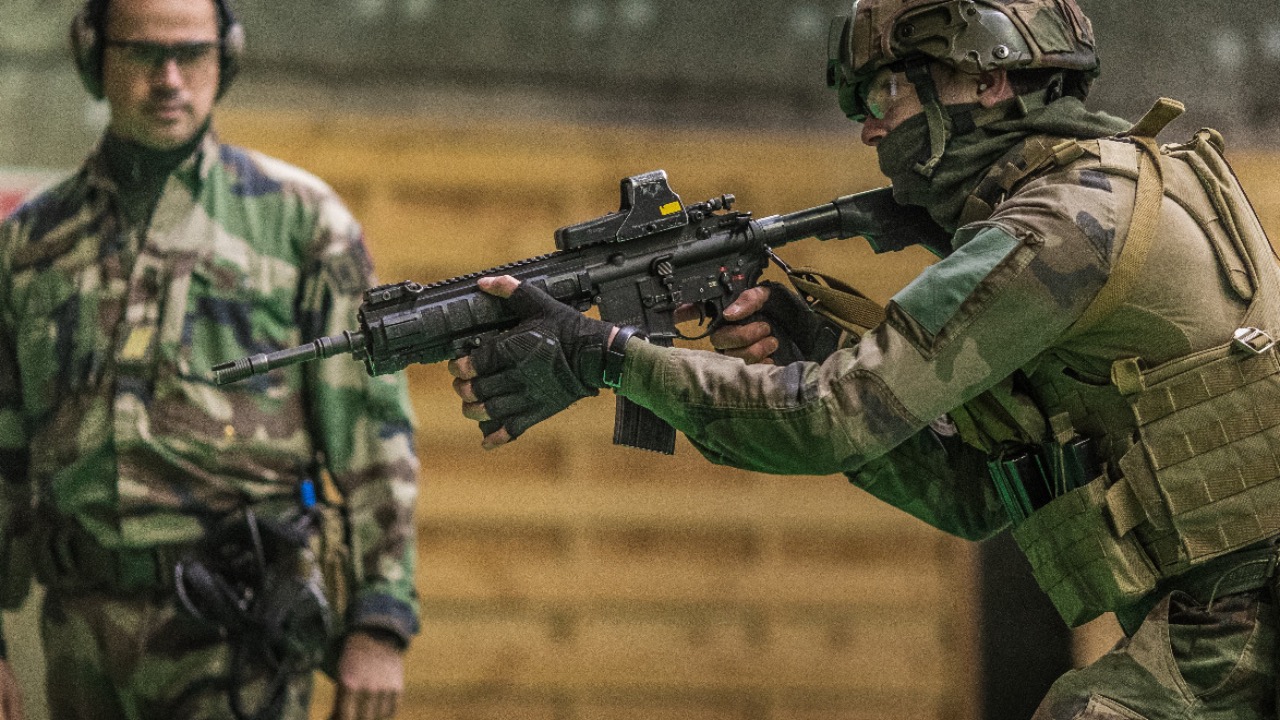
When you look at the HK416, you see a familiar silhouette. Internally, though, its short-stroke gas piston system addressed reliability concerns that surfaced in harsh environments during the early years of the Global War on Terror. Special operations units wanted AR ergonomics with improved durability under sustained fire and suppressed use.
You saw it gain prominence with U.S. special mission units before it was adopted more broadly, including by the U.S. Marine Corps as the M27 Infantry Automatic Rifle. Its influence went far beyond its own production numbers. The piston-driven AR concept gained credibility worldwide, and reliability under adverse conditions became a renewed focus for modern service rifles.
FN SCAR
The FN SCAR program came out of U.S. Special Operations Command’s desire for modularity. Instead of one rifle doing one job, operators could configure the platform for different barrel lengths and calibers. That flexibility changed how units approached deployment planning.
The 7.62 NATO SCAR-H in particular gave special operations teams a lightweight battle rifle with improved ergonomics and accessory compatibility. It filled the gap between carbines and traditional sniper rifles. While not universally adopted across conventional forces, the SCAR proved that modular battle rifles could be practical tools, not range curiosities.
Accuracy International AX Series
Long before precision rifle competitions became mainstream, Accuracy International rifles were setting standards in military sniper circles. The AX series built on that reputation with improved chassis systems, folding stocks, and multi-caliber capability.
For you as a student of military evolution, what matters is how these rifles supported extended-range engagements in Afghanistan and Iraq. Consistency, durability, and quick barrel swaps made them adaptable in unpredictable terrain. The AX platform reinforced the idea that sniper systems had to be rugged field tools first, precision instruments second.
Barrett M107
The Barrett M107 didn’t invent the anti-materiel rifle, but it made the concept operationally widespread. Chambered in .50 BMG and semi-automatic, it allowed engagement of equipment, fortified positions, and distant threats without relying on crew-served weapons.
You saw it used to disable vehicles, disrupt supply points, and counter enemy snipers at extreme ranges. Its presence altered battlefield calculus. Adversaries had to assume that hard cover at long distances was no longer safe. The psychological and tactical impact went well beyond the number of rifles fielded.
Heckler & Koch MP7
The MP7 emerged from NATO’s search for a Personal Defense Weapon capable of defeating soft body armor. Chambered in 4.6×30mm, it offered high velocity in a compact platform suited for vehicle crews and special units.
For close protection details and counterterror teams, the MP7 provided controllable automatic fire with better armor penetration than traditional submachine guns. Its development signaled a shift in thinking about compact firearms. Pistols and 9mm subguns were no longer assumed adequate for every rear-echelon or protective role.
Mk 12 Special Purpose Rifle
The Mk 12 SPR grew out of a practical need: bridging the gap between standard carbines and bolt-action sniper rifles. Built around a precision 5.56 platform with a free-floated barrel and quality optics, it gave designated marksmen extended reach without sacrificing mobility.
You can trace much of today’s designated marksman rifle concept back to its field use. It proved that precision didn’t always require a heavier caliber. With proper ammunition and training, a tuned 5.56 rifle could reliably engage targets beyond typical carbine distances, reshaping squad-level firepower.
SIG Sauer MCX
The SIG MCX platform gained attention in special operations circles for its short-stroke piston system and adaptability, particularly with .300 AAC Blackout. Suppressed fire in confined spaces became more practical and reliable.
For units conducting urban raids, maritime operations, and low-visibility missions, the MCX provided compact dimensions with rifle-caliber effectiveness. Its folding stock and quick-change barrel system supported transport and mission-specific setups. The broader industry followed, and you now see compact, suppressor-optimized rifles treated as standard rather than niche tools.
Knight’s Armament M110
The M110 Semi-Automatic Sniper System gave U.S. forces a reliable 7.62 NATO platform capable of precision fire with faster follow-up shots than traditional bolt guns. It wasn’t flashy, but it addressed real-world combat needs.
Urban and mountainous environments demanded rapid engagement of multiple targets at varied distances. The M110 delivered that capability with modern optics and suppressor integration. It helped normalize the semi-automatic precision rifle as a primary sniper tool rather than a backup, influencing procurement decisions across allied militaries.
FN Minimi / M249 Improvements
While the Minimi design dates back decades, elite units refined how it was employed. Shorter barrels, improved stocks, optics integration, and suppressor use changed the way light machine guns supported small teams.
You began to see automatic riflemen operating with greater mobility, treating the gun as an integrated part of a maneuver element rather than a static base-of-fire asset. That evolution influenced later automatic rifle concepts and reinforced the importance of lightweight sustained fire in fast-moving operations.
Glock 19 (Special Operations Use)
The Glock 19 didn’t enter service with dramatic fanfare, but its adoption by elite units signaled a shift in sidearm philosophy. Compact, reliable, and consistent in trigger pull, it replaced larger, heavier pistols in many roles.
For you looking at modern doctrine, that matters. Special operations units prioritized reliability, magazine capacity, and commonality of parts. The Glock 19’s quiet spread through military and law enforcement circles helped standardize striker-fired pistols worldwide, influencing procurement trends far beyond its original contracts.
These firearms weren’t always the loudest stories in defense media. But they changed how professionals fight—how they plan, move, and engage. And when you step back, you can see their fingerprints on nearly every modern service weapon fielded today.

Asher was raised in the woods and on the water, and it shows. He’s logged more hours behind a rifle and under a heavy pack than most men twice his age.