Historic warship movements signal rising tensions overseas
From the Persian Gulf to the Baltic Sea, warships are maneuvering in ways that look less like routine presence and more like an ongoing test of wills. Carrier strike groups, missile destroyers, and gray zone fleets are converging near flashpoints where a misread signal at sea could quickly escalate into something far more dangerous.
Recent deployments around Iran, Taiwan, and contested European waters suggest that naval power is again becoming the preferred language of great power competition. Each movement carries its own logic, yet together they sketch a picture of rising tension that is reshaping global trade routes, alliance politics, and the risk calculations of every state that depends on open seas.
Epic Fury and the new Iran front line at sea
The most dramatic signal of the current moment came when the United States and Israel launched the Epic Fury operation against Iran, striking at least nine targets across the country in the early hours of a Saturday. Analysts describe the strikes as a turning point because they involved both the United States and Israel hitting Iranian assets directly, rather than operating through proxies, which sharply raises the chance that any follow-on confrontation will spill into the surrounding waters of the Persian Gulf and the Arabian Sea. Expert commentary on the Epic Fury attack stresses that Tehran is likely to respond asymmetrically, and its navy and allied militias have long treated commercial shipping as a pressure point.
Those same assessments emphasize that the Epic Fury strikes did not occur in isolation, but against a backdrop of years of tense encounters between U.S. and Iranian forces at sea. In the Persian Gulf, Iranian units have repeatedly challenged Western vessels, and international monitors note that these incidents often unfold in crowded shipping lanes where 30 per cent of the world’s seaborne oil trade passes. That history means any new clash tied to Epic Fury would instantly carry energy market implications, since the maritime front line around Iran is also one of the world’s most important arteries for crude and liquefied natural gas.
Carrier strike groups reposition around Iran
Well before Epic Fury, Washington had already been moving major naval assets closer to Iran, a sign that planners anticipated a sharper confrontation. Earlier this year the Pentagon ordered a carrier strike group toward the Middle East as tensions with Iran rose, with briefings describing the deployment as a way to bolster deterrence and give commanders more options if regional partners came under attack. Reporting on the Pentagon move noted that decision makers were acutely aware that the presence of a carrier and its escorts can both reassure allies and inflame Iranian rhetoric, especially when framed as preparation for potential intervention.
Separate coverage of U.S. posture toward Iran underlined that Washington had already redeployed another carrier strike group near the country during a period of internal unrest. The decision to shift such a large formation was interpreted as a signal not only to Tehran’s leadership, but also to protesters challenging Iran’s clerical establishment, suggesting that outside powers were watching events closely. Analysts writing on Iran unrest argued that this kind of naval repositioning is meant to influence calculations in multiple capitals at once, from Gulf monarchies worried about spillover violence to European states focused on keeping energy supplies stable.
Hormuz on edge as Iran threatens closure
As the air and missile exchanges intensified, Iran shifted its messaging toward one of its most powerful levers: the Strait of Hormuz. Iranian officials and aligned media warned ships as the country moved to close the waterway, citing recent missile strikes and framing a possible closure as a defensive response to foreign aggression. One widely shared alert stressed what is at stake by pointing out that the Strait of Hormuz handles approximately 20 to 25 per cent of the world’s oil trade, and explicitly labeled that volume as the Global Oil Supply that could be disrupted if tensions spiral further.
International analysts have long warned that any attempt to close Hormuz would be extremely risky, both for Iran and for the global economy. The narrow channel is the route for tankers serving energy importers across Asia and Europe, and previous crises have already shown how quickly insurance premiums and spot prices react to even minor incidents. The International Crisis Group has documented how U.S. and Iranian navies have had repeated tense encounters in the Persian Gulf, with each side accusing the other of unsafe maneuvers and harassment of forces operating in international waters, and that record makes today’s threats more credible than simple bluster. If Iran were to move from signaling to action, even partial interference with shipping would reverberate through supply chains that depend on predictable transit times through the chokepoint.
Regional navies warn merchants away from the Gulf
As Iranian rhetoric hardened, regional navies began issuing their own warnings to civilian mariners. The Thai Navy publicly advised commercial ships to avoid the Strait of Hormuz amid rising Middle East tensions, framing the situation as a direct risk to seafarers who might be caught between hostile forces. A social media alert amplified by Thai commentators used urgent language about a potential closure threat in the Gulf, with the Mar warning urging shipowners and captains to reroute where possible to protect crews and cargo.
Such advisories reflect more than simple caution. They signal that governments far from the immediate conflict zone see a real possibility of miscalculation at sea, whether in the form of mistaken identity, stray missiles, or aggressive boarding attempts by local forces. For countries like Thailand, whose economies rely heavily on oil imports that transit Hormuz, the choice to warn away traffic is a trade-off between short-term safety and higher costs from longer voyages. The alerts also add diplomatic pressure on Iran, since each diverted ship becomes a visible reminder that its threats are already imposing economic pain beyond its borders.
USS Gerald R. Ford’s Mediterranean positioning
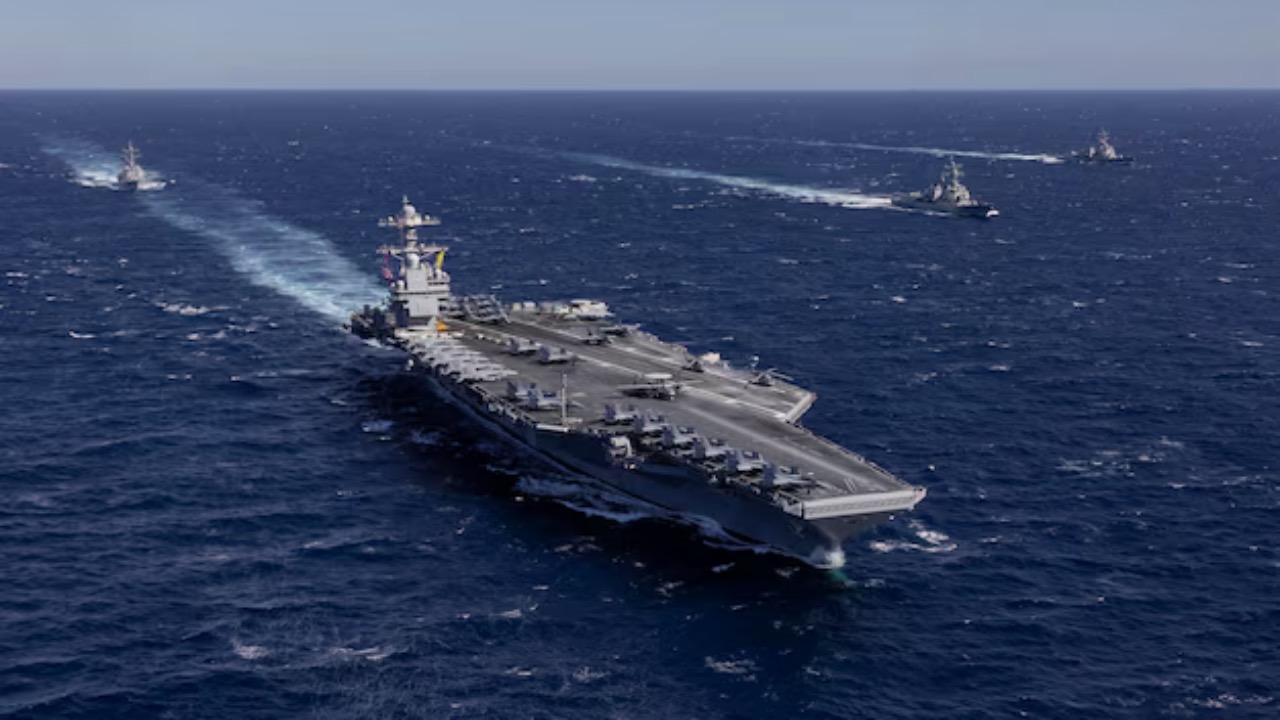
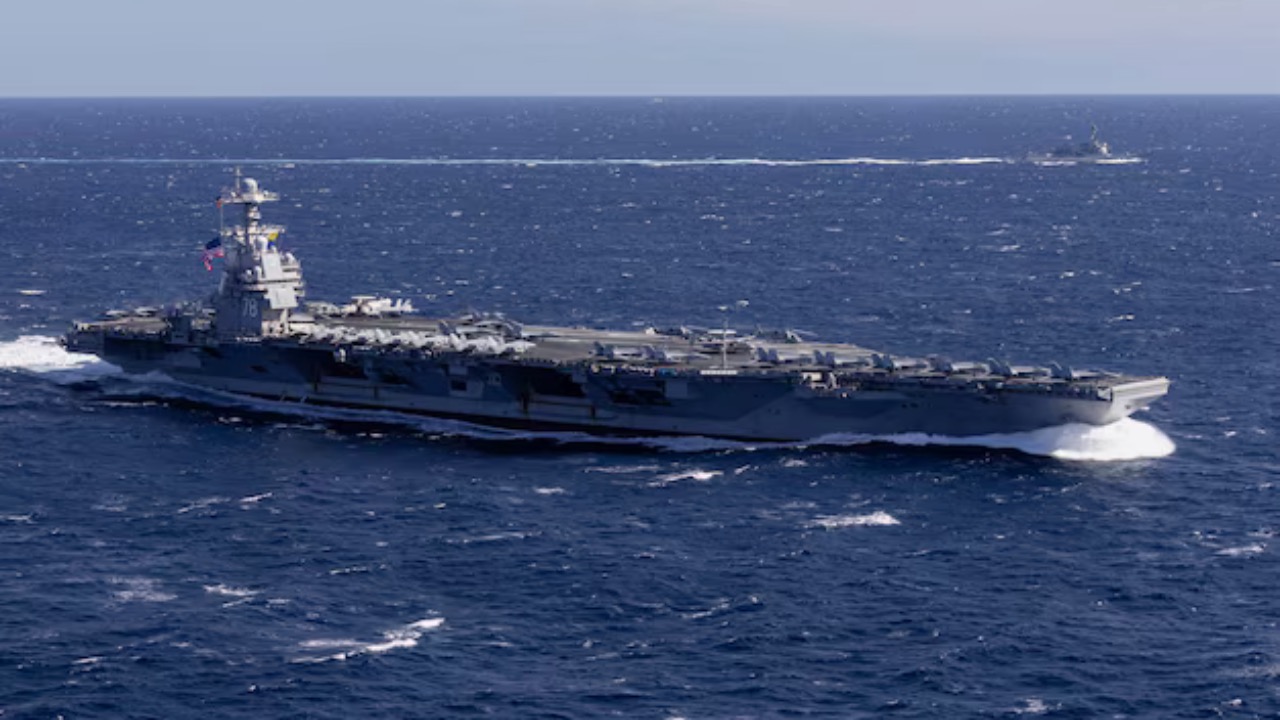
While attention has focused on the Gulf, the world’s largest aircraft carrier has been maneuvering in the eastern Mediterranean in ways that connect directly back to Iran. The USS Gerald R Ford recently arrived at the U.S. naval base of Souda Bay on Crete, pausing there en route to join operations linked to rising tensions between Washington and Tehran. Coverage of the port call described how the USS Gerald Ford used the stop at Souda Bay on Crete for refueling and resupply, but also noted that the visit was read by regional observers as a reminder that American air power can reach the Gulf and Levant quickly from multiple directions.
Official statements have also highlighted the endurance of the carrier and its crew. The U.S. Navy reported that more than eight months into an extended deployment, the Sailors of USS Gerald R. Ford (CVN 78) continued to demonstrate resilience and readiness while operating away from their homeport in NORFOLK. The announcement praised the work of the Sailors of USS Gerald R. Ford, emphasizing that CVN 78 had maintained high operational tempo since departing Norfolk on June 24, 2025, and stressing that this kind of long deployment shows how the Ford and its escorts can sustain pressure in multiple theaters at once. By keeping such a large platform in motion near Europe, the United States signals to both Iran and Russia that it can reinforce or shift focus rapidly if conditions change.
China’s gray zone fleets and the Taiwan Strait
Far from the Gulf, another set of warship movements is reshaping the balance of risk, this time around Taiwan. Chinese naval and coast guard units have been pushing into contested waters, using what analysts describe as a maritime gray zone campaign that blurs the line between civilian and military activity. Detailed data on these operations show how Chinese vessels swarm near Taiwan under the cover of commercial activity, using large numbers of ships to normalize their presence and test responses without crossing clear thresholds that would trigger open conflict. One assessment of the gray zone campaign argues that this pattern is now a constant feature of great power competition in East Asia, with authoritarian states relying on indirect methods to advance their claims.
Western navies have responded by stepping up transits through the Taiwan Strait, presenting them as routine freedom of navigation operations. China has reacted sharply to these sailings, particularly when they involve U.S. and British warships operating together. In one recent incident, Chinese officials condemned the passage of American and Royal Navy vessels through the strait, even as British commanders insisted that wherever the Royal Navy operates, it does so in full compliance with international law and norms and that navigation in the Strait should not be limited. Chinese forces shadowed the transit and staged war games nearby, underlining how each such passage has become a choreographed confrontation in a narrow body of water that Beijing regards as highly sensitive.
Global reactions to Chinese and U.S. carriers in contested seas
The contest around Taiwan is no longer limited to destroyers and frigates. Reports from earlier this year indicated that China has deployed advanced warships, including new carrier groups, farther from its shores amid rising tensions in the region. Commentary on these moves described them as China’s loudest signal yet that it is preparing to operate far beyond its own coastline, a step that would have been unthinkable for the People’s Liberation Army Navy a generation ago. Social media analysis of these Reports China deployments framed them as part of a broader effort to build a true blue water navy that can escort Chinese trade and project influence across the Indo Pacific.
At the same time, the presence of U.S. carriers near contested Asian waters has split opinion worldwide. Detailed reporting on a recent standoff described how a Chinese fleet pushed into disputed areas while a U.S. carrier steamed closer, creating what observers called a dangerous test of nerves. In some countries, especially those wary of China, the U.S. carrier presence is seen as a stabilizing shadow that deters unilateral moves by Beijing. Other states, particularly those that rely heavily on Chinese trade, worry that such deployments risk provoking a clash that would disrupt the very sea lanes they have relied on for generations. The debate captures a central tension of modern naval strategy: the same warship that reassures one audience can alarm another.
Baltic Sea friction and Russia’s northern rhetoric
Europe’s northern waters have not escaped the pattern of sharpened signaling at sea. Analysts tracking Russia’s posture in the Baltic Sea have warned that Moscow’s northern war rhetoric has grown more aggressive, accompanied by increasingly assertive maneuvers by its navy. One notable incident involved NATO member Estonia’s military command and the flagship Jaguar, a vessel linked to Britain, in a confrontation that raised questions about how Russian forces might test alliance resolve. A detailed account of the NATO Estonia Jaguar episode described how a vessel refused to cooperate when asked to stop, feeding fears that similar incidents could be used to probe weaknesses along the alliance’s maritime flank.
These Baltic tensions unfold alongside Russia’s broader confrontation with the West, but they also have their own dynamics. The sea is crowded with commercial traffic, energy infrastructure, and undersea cables, making it an attractive arena for signaling and covert action. When Russian officials speak of northern war scenarios, they are not only invoking nuclear or land based threats, but also hinting at the possibility of disrupting shipping or infrastructure that passes through narrow straits and shallow waters. For NATO planners, the challenge is to maintain a visible presence that deters such moves without creating the impression of preparing for offensive operations, a balance that becomes harder as rhetoric on both sides hardens.

Asher was raised in the woods and on the water, and it shows. He’s logged more hours behind a rifle and under a heavy pack than most men twice his age.