Michigan’s 30-Year Decline in Hunters Raises Policy Questions
Michigan has quietly undergone a profound shift in its hunting culture. Over roughly three decades, the state has seen a steep drop in licensed hunters, a trend that now shapes everything from deer collisions on rural roads to who pays for conservation. The decline is no longer a niche concern for outdoors enthusiasts; it is a policy problem that touches budgets, public safety and how wildlife decisions are made.
With hunting participation down roughly 30 percent over 30 years, lawmakers, biologists and local communities are scrambling for answers. Some see a looming funding crisis, others worry about a deer population that is already straining farm fields and suburban neighborhoods, and many argue that the institutions managing wildlife have not kept pace with a changing public.
Three decades of shrinking license sales
Officials with The Michigan Department of Natural Resources have watched the trend unfold in real time. In FLINT, Mich, they have described how the state has lost roughly 200,000 deer hunters over about 25 years, a drop of around 30 percent that tracks with broader participation declines across the Midwest. That loss of 200,000 hunters is not an abstract statistic; it represents fewer people buying licenses, fewer families heading to deer camp and fewer residents directly engaged with the state’s game management system.
The agency’s own data, available through the Michigan DNR, show that hunting participation has been on a long downward slide even as deer numbers remain strong. A report highlighted by mid-Michigan broadcasters notes that Michigan has lost 200,000 deer hunters in the last 25 years, and that drop is now widely cited by policymakers as they debate how to sustain wildlife programs that were built on a much larger base of license buyers. In that same coverage, leaders in Michigan stressed that the decline has been steady rather than sudden, which complicates efforts to reverse it quickly.
Ecological fallout and a deer management squeeze
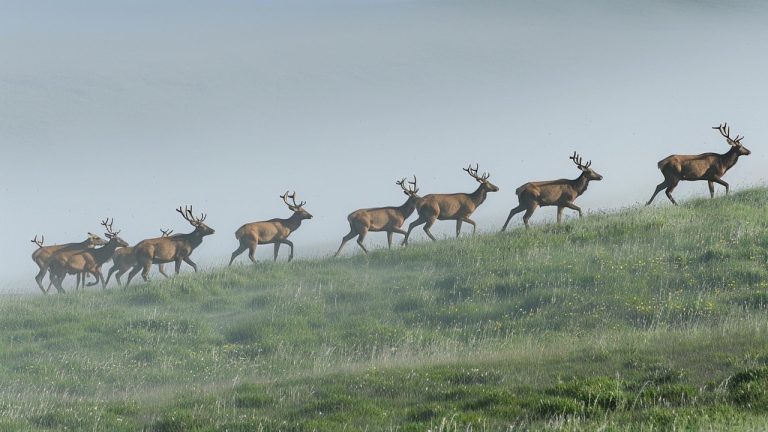
The shrinking pool of hunters arrives at the same time as a growing deer management challenge, particularly in the Lower Peninsula. A detailed account of a recent deer overpopulation emergency in the Lower Peninsula described a cascade of events that began with fewer hunters in the field and ended with farmers watching crops get stripped and motorists facing more collisions. As hunting pressure eased, deer numbers climbed, and local officials started to talk about a crisis rather than a seasonal nuisance.
Those concerns have pushed hunters and farmers into closer partnership. In one initiative, Michigan Hunters and Farmers Team to Address Deer Overpopulation Crisis, advocates described how landowners and sportsmen are coordinating access and harvest goals to bring numbers down, especially in areas where herds are damaging fields or invading suburbs. That collaboration reflects a broader recognition that traditional deer seasons alone may no longer be enough. When fewer people take to the woods, managers must lean on targeted efforts and community-based programs to deal with the biological and economic fallout of too many deer concentrated in the wrong places, as outlined in the Lower Peninsulacoverage.
Money, licenses and the conservation funding gap
Behind the ecological story sits a financial one. Funding for wildlife work in Michigan still leans heavily on hunting license revenue and related federal excise taxes. In statewide coverage that has alarmed conservation planners, officials pointed out that deer licenses play an outsized role in bankrolling the Michigan DNR, with one report noting that 47% of their Wildlife budget comes from those permits. As the number of deer hunters shrinks, that 47% share is exposed, and program managers are forced to consider either cutting services or finding new revenue streams.
Retailers feel the trend too. In one account, store owner Knutson explained that the federal government takes 10% of all wholesale sales on hunting and fishing merchandise, a tax that flows back into conservation programs, and that his business has seen a decline of 2% each year as fewer customers gear up for hunting seasons. That erosion in gear sales chips away at the federal funding that supplements state license dollars. For lawmakers who grew up assuming that hunters would always carry the bulk of conservation costs, the current trajectory raises a hard question: how to maintain fish and wildlife programs when the traditional payers are aging out and not being replaced.
Policy responses and the fight over who decides
The policy response has been uneven, and it has increasingly spilled into public debate. Earlier this year, a televised segment titled Michigan hunting numbers down 30% in 30 years, lawmakers push NRC reforms showed legislators arguing that the state really needs to get broken up into districts where local voices can shape regulations. In that discussion, one lawmaker said the state really needs to get broken up in the districts where those decisions can be made either by hometown means where local residents get a say, reflecting frustration that the current Natural Resources Commission structure feels too centralized for a changing hunting base.
Another report on the same issue, shared through Feb hearings, framed the 30 percent decline over three decades as a direct challenge to how state wildlife policies are shaped, not just a matter of fewer people in the woods. The Michigan-focused newsletter coverage of those hearings emphasized that Michigan hunting numbers down 30 in 30 years, lawmakers push NRC reforms, and that reform push has become a proxy fight over who should have the final word on season structures, bag limits and predator rules. As participation wanes, non-hunters make up a larger share of the electorate, and the political calculus around wildlife decisions becomes more complex.
Changing hunter behavior, new rules and future options
Even with fewer license buyers, those who still hunt remain highly effective. During a recent firearms season, Michigan hunters reported nearly 252,000 deer killed, a figure that illustrates how modern equipment and concentrated effort can still produce high harvest numbers. That same season also brought new rules that some hunters chafed at, including changes to reporting and antler restrictions, which fed into the broader debate about whether regulations are helping or hurting efforts to keep people engaged.
State leaders have already started tweaking policy levers in response. The State of Michigan previously removed the minimum age to hunt, which had been 12 years old, in an attempt to get children into the field earlier and build long-term participation. Last year, the DNR began requiring hunters to report their deer harvests online in order to gather more efficient and effective data and make more informed resource management decisions, a move that modernizes the system but also adds one more obligation for hunters who may already feel burdened by rules. At the same time, coverage of Michigan sees significant decline in hunters over past few decades highlighted biologist Stewert warning that younger hunters are simply not replacing older ones and that they are just simply not being replaced, while he argued that They need to get more kids involved and that kids is the key.
Other policy experiments are emerging around the edges. A new coyote management approach from The Michigan Natural Resources Commission, described by reporter Dan Basso of the Lansing State Journal, shows how predator regulations are being adjusted as deer and small game dynamics shift. Nationally, research on youth recruitment summarized in a Families Afield NM presentation pointed out that Barriers cause many youth to lose interest in hunting and they too often settle for other activities like video games or organized sports, raising concerns that the cultural pipeline into hunting is narrowing. Academic work on western states, such as a study of Big Sky politics and license allocation, has warned that conflicts over access and privatization can further erode public hunting participation. For Michigan, where the decline of 200,000 deer hunters has already been Discovered through multiple reporting trails, the policy question is no longer whether the trend is real, but how quickly leaders can retool a system that still assumes hunters will always be there to carry the load.

Leo’s been tracking game and tuning gear since he could stand upright. He’s sharp, driven, and knows how to keep things running when conditions turn.