Why the minigun looks unstoppable on screen but raises real-world concerns
The minigun has become one of Hollywood’s favorite visual shortcuts for unstoppable firepower, a spinning wall of lead that turns action heroes into one-man armies. On screen it looks almost supernatural, a gun that never runs dry and barely kicks while chewing through anything in its path. In the real world, though, the same traits that make it so cinematic create serious practical and ethical problems once you step away from the movie set and into an actual fight.
To understand why the minigun looks unbeatable on film but is so rarely seen in human hands outside of fantasy, you have to look at the mechanics, the logistics, and the way pop culture has trained audiences to think about automatic weapons. When you line up what the weapon really is against what the camera says it is, the gap is wide enough to matter for anyone who cares about how guns, games, and movies shape public ideas about violence.
The real minigun behind the movie myth
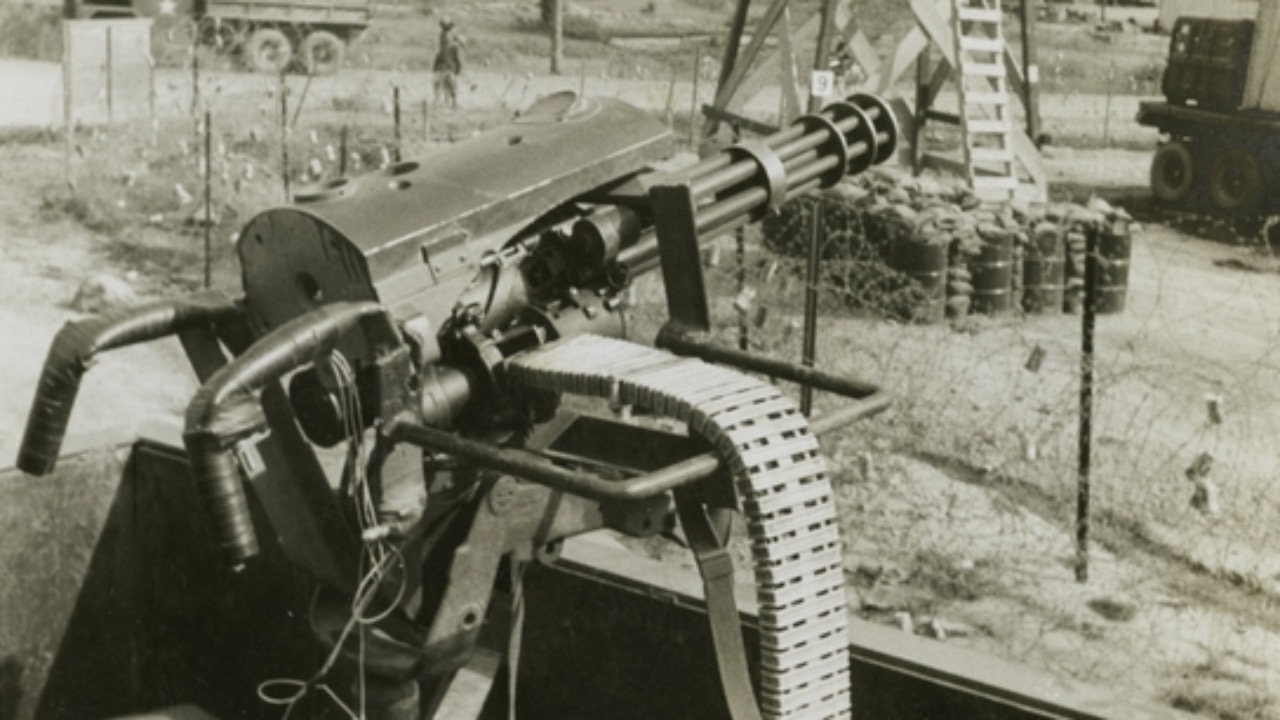
At its core, the minigun is a mechanically clever answer to a simple problem: how do you fire a lot of rifle rounds very fast without melting a barrel. Instead of a single tube, the classic M134 uses multiple rotating barrels driven by an external electric motor, which lets it spit out a stream of bullets at a rate that would destroy a conventional machine gun. A single barrel with a traditional action would overheat and fail at those speeds, but the rotating cluster spreads the heat and wear across several tubes, which is why a true Minigun can sustain rates of fire that look unreal to anyone used to belt‑fed infantry guns.
That external power source is the first big clue that this is not a normal shoulder weapon. The gun does not cycle itself like an M240 or PKM, it relies on electric motors to spin the barrels and feed ammunition, which means you need a serious power supply along with the gun and its belts. One detailed breakdown of the system points out that this reliance on motors is exactly why the platform cannot be treated like a regular machine gun and why the “mini” label is misleading compared with older, slower designs that run off recoil or gas alone. As one analysis of the platform’s myths puts it, the idea that it can be fired like a standard infantry gun is a Myth, because the whole system is built around powered rotation rather than a self‑contained action.
Why “handheld” miniguns stay on the big screen
Most people’s mental picture of a minigun is not a helicopter door gun or a vehicle mount, it is Jesse “the Body” Ventura in Predator hosing down a jungle while standing upright. That image has been so widely copied that it feels plausible, but the physics are brutal once you start adding up the numbers. An M134 on its own weighs in the neighborhood of 85 pounds before you even think about ammunition, and a belt of several hundred rounds adds a heavy, shifting load that has to be supported and controlled while the barrels spin up and the recoil starts to bite. One worldbuilding discussion that walks through the math notes that an M134 mini gun without ammo, and that is before you strap on batteries or power cables.
Even if you imagine a superhumanly strong operator, you still have to feed the thing. A company called Empty Shell tried to bring a compact, man‑portable version to market, and the result was a system that looked impressive on video but still needed a backpack full of linked cartridges and power gear to run. That project, which was built around the same basic rotating‑barrel idea, highlighted why a shoulder‑fired version is not great for an infantry weapon: the weight, the bulk, and the support equipment all pile up fast once you move away from a fixed mount. One technical write‑up on that effort points out that Empty Shell could make it work as a demonstration piece, but the compromises made it a poor fit for real squads that already carry radios, armor, and everything else needed to fight.
Predator’s “Old Painless” and the ammo problem
Predator’s “Old Painless” is the purest version of the handheld fantasy, a character dragging a spinning cannon through the jungle as if it were a tricked‑out AR. The prop itself was built around a genuine minigun mechanism, but the way it is used on screen ignores almost every real constraint that comes with that kind of firepower. Fans have picked apart the scenes for years, and even the lore around the prop admits that the handheld portrayal is completely unrealistic, with one behind‑the‑scenes account noting that the Old Painless setup is beset by continuity and factual mistakes because the character is shown firing far longer and more accurately than the hardware would allow.
Once you start timing the bursts, the numbers get even sillier. One detailed fan breakdown points out that the ammo boxes used for the prop held about 550 rounds, which at the gun’s rate of fire would give you roughly 26.4 seconds of continuous shooting before you were dry. That same analysis notes that the rate works out to about 20.83 rounds per second, which means every second of screen time is burning through a shocking amount of linked cartridges. The discussion that lays out those figures, introduced with a blunt “However, the wiki also says that the ammo boxes only had about 550 rounds which would give you 26.4 seconds of fire as opposed to … of 20.83 rounds per second,” has become a touchstone for anyone trying to square the movie with reality, and it lives on in a long Jan thread where fans and gun people meet in the middle.
What the gun actually weighs and kicks like
Weight is only half the story, because a gun that heavy, firing that fast, also pushes back hard. Recoil from a minigun is spread across multiple barrels and a high rate of fire, which smooths the impulse compared with a slow, heavy single‑shot, but the total force is still significant. Holding 85 pounds of steel and spinning parts out in front of your body while it shoves you backward is a different problem than bracing a 20 pound machine gun on a bipod. One detailed Oct discussion about fictional strongmen points out that even if you had a character who could deadlift the weight, keeping the muzzle on target while the barrels spin and the belt feeds would be a full‑body wrestling match, not the casual hip‑fire we see in games.
On top of that, the gun is not a self‑contained package. You have to hang belts or drums of ammunition somewhere, and you have to power the electric motor that keeps the barrels turning. That means backpacks, cables, or rigid mounts that tie the shooter to a larger system, which is why real miniguns live on helicopters, boats, and vehicles where the platform can soak up the recoil and carry the extra gear. The official technical overview of the M134 makes the point bluntly, noting that in actuality a man‑portable M134 minigun would be near impossible and highly impractical for a human being to either carry or operate, which is why the weapon has never entered production status as a shoulder gun and remains a vehicle‑mounted system in real arsenals.
Why militaries keep miniguns on mounts
Professional militaries are not shy about heavy weapons, so if a portable minigun really gave a squad a decisive edge, you would see them in every infantry platoon. Instead, the pattern is clear: miniguns show up on helicopters, armored trucks, and fixed emplacements, where crews can feed them from large boxes and power them from the vehicle’s electrical system. That is not an accident, it is the result of decades of hard lessons about what is worth carrying on a human back. One long WarCollege discussion about portable, crew‑served miniguns points out that every extra box, cable, and component is another thing to lug, another thing to fail, and another thing to feed, which is a poor trade when you are already hauling water, armor, and medical gear.
Even if you accept the extra weight, the payoff is not as dramatic as the movies suggest. A minigun might be substantially more effective than a standard machine gun in very specific scenarios, but one detailed logistics comparison notes that it is not 20 times as effective and probably is 20 times as logistically demanding once you factor in ammunition, maintenance, and power. That same analysis, which has become a reference point in debates about crew‑served weapons, argues that the marginal gain in firepower does not justify the huge increase in complexity, a point summed up in the line that minigun might be but is vastly more demanding to keep running in the field.
Games and movies that crank the fantasy to eleven
Pop culture has leaned hard into the visual drama of spinning barrels, and that has shaped how a whole generation thinks about the weapon. Whenever a game or movie needs to dial up the action, the roar of the minigun is there, whether it is mounted to a Battlefield helicopter or slung under the arm of a larger‑than‑life hero who barely seems to notice the weight. One detailed video breakdown of how entertainment handles the platform opens with the observation that Whenever a director wants instant spectacle, they reach for a spinning‑barrel gun, because the sound and motion sell power even if the physics do not.
Games follow the same script, often giving miniguns bottomless belts, perfect reliability, and recoil that feels more like a leaf blower than a weapon that can chew through concrete. One long Sep thread about their portrayal in shooters notes that They are not always stationary in real life, pointing to rare examples like the XM214 in 5.56 mm, but even those niche systems are usually tied to mounts and power supplies rather than being carried like assault rifles. When players see a character sprinting with a minigun, spinning it up instantly, and firing for minutes at a time, they are watching a fantasy that has been tuned for fun, not a training film.
Rate of fire, armor myths, and what the gun is actually for
One reason the minigun looks so unstoppable on screen is the raw rate of fire. When you see a wall of tracers pouring out of a helicopter door, it is easy to assume that anything in that cone is doomed. In reality, the high cyclic rate is a tool for very specific jobs, like saturating an area to keep heads down or shredding light vehicles, not a magic beam that ignores cover and armor. The rotating barrels let the system maintain that rate without cooking itself, but they do not change the basic ballistics of the cartridge, which is why a 7.62 mm round from a minigun behaves like any other 7.62 mm round once it leaves the muzzle.
Gamers often assume that miniguns should punch through armor more easily than slower guns, but that is not how penetration works. One detailed discussion of their performance points out that miniguns in general should have the advantage of armor penetration only in the sense that more hits in a short window raise the odds of finding a weak spot, not because each bullet is magically stronger. That same thread notes that real systems can dial their speed down to around 1,250 rpm for better control, which undercuts the idea that they always run flat out. The comment that speed down to is an option shows how operators trade raw volume for accuracy and ammo conservation, a nuance that rarely survives the jump to the big screen.

Asher was raised in the woods and on the water, and it shows. He’s logged more hours behind a rifle and under a heavy pack than most men twice his age.