8 Hunting rifles that don’t need replacing
Some hunting rifles are fads, and some are tools you can run for a lifetime without feeling undergunned or out of date. When I talk about rifles that do not need replacing, I mean guns with proven actions, sane chamberings, and parts support that will outlast most of us. The eight rifles below have earned that kind of trust in deer camps, elk basins, and truck racks across the country.
1. Remington Model 700

The Remington Model 700 is the classic “buy it once” bolt gun. Its twin locking lugs, recessed bolt face, and tubular receiver give it the kind of out-of-the-box accuracy that made it a favorite with hunters and law enforcement. Decades of production mean you can find a 700 in almost any practical chambering, from .243 Winchester to .300 Winchester Magnum, and parts are everywhere. Stocks, triggers, bottom metal, and barrels are all easy upgrades if you ever feel like tinkering.
What keeps the 700 from needing replacement is how well it scales with your skills. A basic ADL in .270 Winchester will kill whitetails for a lifetime, while a trued action and quality barrel can hang in precision matches. If a scope fails or a stock cracks, you fix the component and keep the rifle. That long-term support, plus a track record of accuracy, makes the 700 a rifle you can hand down instead of trade in.
2. Winchester Model 70

The Winchester Model 70, especially the controlled-round-feed versions, is the rifle many hunters still measure others against. Its large claw extractor, three-position safety, and smooth feeding have earned it a place in elk camps and on African plains. The action handles cartridges like .30-06 Springfield, .270 Winchester, and .300 Winchester Magnum with ease, and the geometry of the stock on classic models manages recoil without beating you up. Even current production rifles keep that familiar feel while tightening tolerances.
What makes the Model 70 hard to replace is its reliability in rough country. The controlled-round-feed system keeps cartridges under control from magazine to chamber, which matters when you are cycling the bolt at odd angles or in bad weather. Aftermarket stocks, triggers, and bottom metal are widely available, but many hunters never bother, because the rifle already does what they need. When a gun shoulders naturally, feeds every time, and holds zero season after season, there is little reason to move on.
3. Ruger American Rifle
The Ruger American Rifle proved that an affordable hunting gun does not have to feel cheap in the field. Its three-lug bolt, bedding system, and cold-hammer-forged barrel give it accuracy that often rivals rifles costing much more. Chamberings like 6.5 Creedmoor, .308 Winchester, and .30-06 Springfield cover everything from pronghorn to moose, and the detachable rotary magazines are reliable and easy to replace. The synthetic stocks shrug off rain, snow, and truck abuse that would make you baby a walnut rifle.
For a hunter who wants one rifle to do nearly everything, the American is tough to beat. You can mount a solid 3-9x or 4-12x scope, confirm a good zero, and hunt for years with nothing more than routine cleaning. If you later decide to stretch your range, the Predator and Hunter variants accept heavier barrels and better optics without changing the basic platform. That ability to start modest and grow into more demanding hunts keeps the Ruger American from feeling like a “starter gun” you outgrow.
4. Tikka T3x
The Tikka T3x has earned a reputation for out-of-the-box accuracy that borders on boring. The slick two-lug bolt, crisp trigger, and quality barrels give most T3x rifles sub-MOA potential with factory ammunition. Chamberings like 6.5 Creedmoor, .308 Winchester, and .300 Winchester Magnum are common, and the lightweight synthetic stocks keep overall weight manageable for mountain hunts. The detachable magazines are tough and feed smoothly, which matters when you are working the bolt with cold hands or gloves.
What keeps a T3x from needing replacement is how well it balances weight, accuracy, and reliability. You can carry it all day in steep country without feeling punished, yet it still has enough barrel to make confident shots across canyons. Aftermarket stocks, bottom metal, and barrels are available if you want to customize, but the factory configuration is already a capable hunting tool. Many hunters who buy a T3x for one specific hunt end up using it for nearly everything afterward.
5. Savage Model 110
The Savage Model 110 has been around long enough to prove that smart engineering can outshoot price tags. Its barrel nut system allows precise headspacing at the factory, which is a big reason so many 110s shoot well with factory ammo. The AccuTrigger, with its user-adjustable pull weight, lets you tune the trigger safely without a gunsmith. You can find 110 variants in cartridges from .243 Winchester to .338 Winchester Magnum, and the line includes lightweight, heavy-barrel, and left-handed models.
For hunters who care about accuracy but do not want to chase custom builds, the 110 is a practical answer. If you ever burn out a barrel or want a different chambering, the design makes rebarreling more straightforward than many actions. Stocks and bottom metal upgrades are widely available, yet plenty of older wood-stocked rifles are still stacking deer every fall. When a rifle keeps printing tight groups after decades of use, there is little incentive to replace it with something trendier.
6. Browning X-Bolt

The Browning X-Bolt is a modern hunting rifle that manages to feel refined without being fragile. Its three-lug bolt gives a short lift, which helps when cycling quickly from field positions, and the rotary magazine feeds cartridges smoothly. The adjustable Feather Trigger breaks cleanly, and the Inflex recoil pad tames cartridges like .300 Winchester Magnum and 7mm Remington Magnum. Many X-Bolt models ship with threaded muzzles, so adding a brake or suppressor is straightforward if your state allows it.
What keeps the X-Bolt relevant long term is how well it pairs classic hunting roles with current features. Lightweight versions carry well in the mountains, while heavier-barreled models handle longer shots on open-country mule deer or pronghorn. The fit and finish tend to hold up, so you are not fighting rust or loose hardware after a few hard seasons. When a rifle feels good in the hand, shoots accurately, and already has the features hunters are adding to older guns, there is little reason to trade it away.
7. Weatherby Vanguard
The Weatherby Vanguard gives hunters a strong, accurate push-feed action without the premium price of the company’s flagship rifles. Built around a two-lug bolt with a one-piece machined body, the Vanguard is known for solid lockup and consistent headspacing. Many models carry a sub-MOA accuracy guarantee with quality ammunition, and chamberings range from .243 Winchester and 6.5 Creedmoor up through .300 Winchester Magnum and Weatherby’s own cartridges. The stocks, whether synthetic or wood, are shaped for real field positions rather than benchrest shooting.
For someone who wants one rifle to cover deer, elk, and black bear, the Vanguard is a logical choice. It is heavy enough to soak up recoil but not so heavy that it feels like a burden on long hikes. The action has enough aftermarket support for stock and trigger upgrades, yet the factory configuration is already a capable hunting setup. When a rifle delivers that mix of accuracy, durability, and sane pricing, it tends to stay in the safe for decades instead of getting traded off.
8. Marlin 336
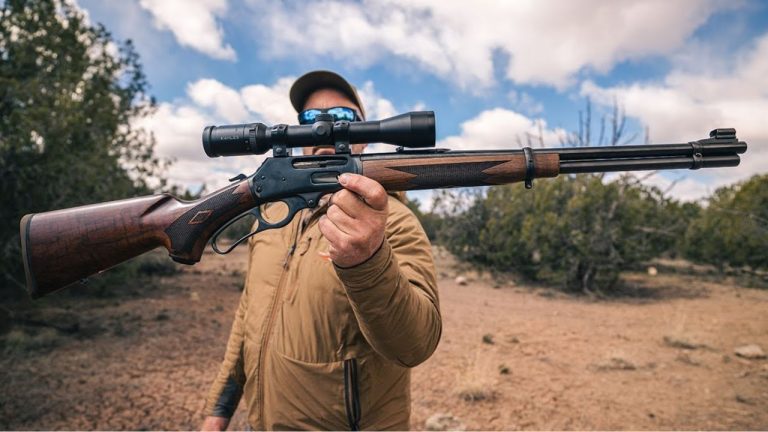
The Marlin 336 is the lever gun many whitetail hunters grew up with, and there is a reason so many of those rifles are still in the woods. Chambered mainly in .30-30 Winchester and .35 Remington, the 336 carries easily, points fast in timber, and hits hard inside typical woods ranges. Its side-eject design makes mounting a scope straightforward, which helped it stay relevant as optics became standard. The solid-top receiver and half-cock safety give hunters confidence when climbing stands or slipping through brush.
What keeps the 336 from feeling outdated is how well it fits real whitetail hunting. In thick cover, a fast-handling lever gun that you know inside and out often beats a heavier bolt rifle built for long-range work. Parts and support remain available for older rifles, and current production models keep the same basic layout. When a rifle has already proven itself across generations of deer seasons, there is little pressure to replace it with something newer that does not actually do the job any better.

Asher was raised in the woods and on the water, and it shows. He’s logged more hours behind a rifle and under a heavy pack than most men twice his age.