Landowner Says Hunters Started Arguing Over a Trophy Buck Right in the Middle of His Property
A landowner in the rural West says a pair of hunters started shouting at each other over who had rights to a trophy-class buck, all while standing in the middle of his private pasture. What began as a dispute over who fired first quickly turned into a confrontation over property lines, permission and who actually owns the wildlife that moves across those boundaries. The scene captures a growing tension in big-game country, where public hunting opportunity, private land control and record-book animals increasingly collide.
What happened
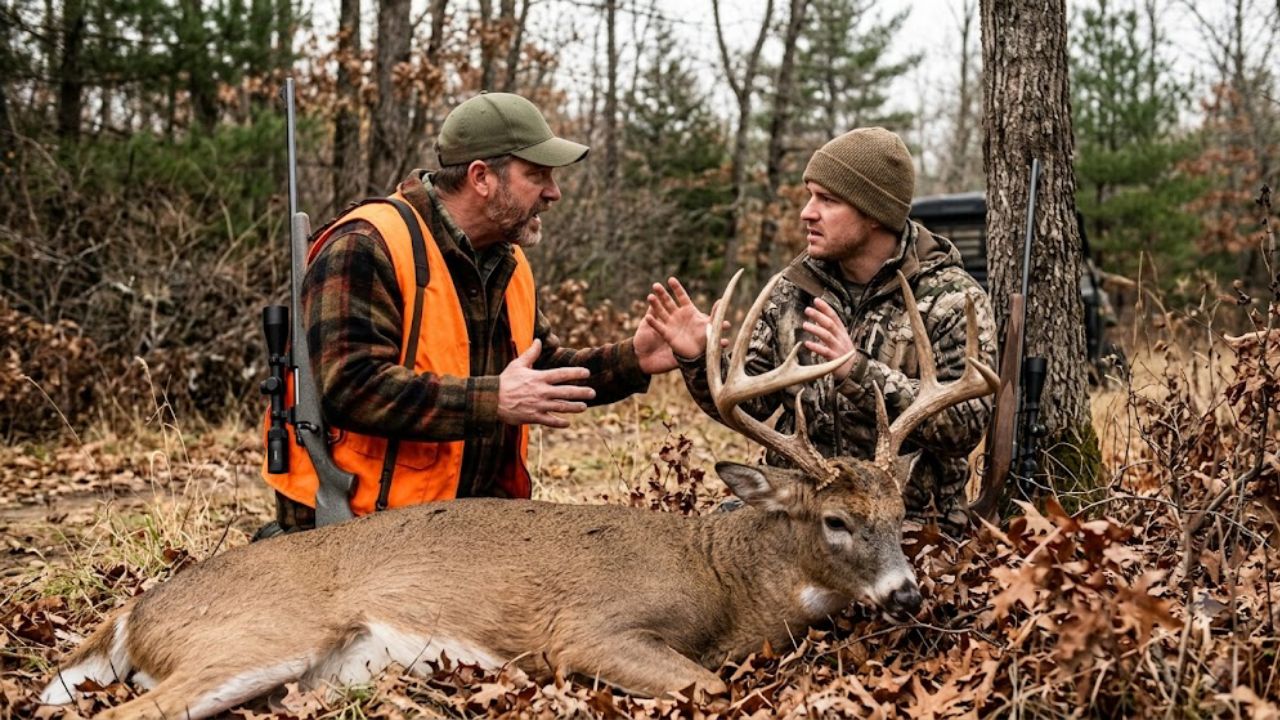
The landowner describes the morning as typical peak-rut chaos: trucks easing along gravel roads before daylight, headlamps sweeping fence corners, and distant rifle shots echoing off nearby ridges. He says two hunters, who had been glassing the same whitetail buck from different angles, converged on the animal after it dropped near the center of his property. Each insisted his shot had made the kill, and the argument spilled out in raised voices that carried back to the ranch house.
According to the landowner, neither hunter had explicit permission to be inside his fences. One claimed he had followed the wounded buck from adjacent public land and believed he was legally tracking game he had already shot. The other insisted he had taken the only lethal shot from a different direction and that the deer had fallen where he stood. The landowner says he arrived to find both men standing over the buck, phones out, trying to document bullet entry angles and hoofprints in the frosted grass.
The dispute did not involve physical violence, but it did expose how fragile etiquette can become when a large-antlered deer is on the ground. Arguments over who pulled the trigger first are not new in hunting culture, yet they take on sharper edges when layered over access battles and property rights. In Montana, for example, tensions around private ground and big-game opportunity have grown intense enough that one agricultural producer recently launched a public license giveaway to reward respectful hunters and highlight what he saw as a breakdown in trust.
Similar friction has surfaced in other Western states where checkerboard ownership and tight access funnel hunters into contested spaces. A high-profile corner-crossing case in Wyoming, which centered on whether stepping from one public parcel to another at a shared corner violated the airspace of private land, showed how quickly a disagreement about a few feet of ground can escalate into a years-long legal fight. The landowner in this latest incident did not call law enforcement, but he says the argument felt like a smaller version of that broader conflict, played out over a single buck.
Why it matters
At the heart of the confrontation is a basic question: who gets to enjoy and benefit from wildlife that moves freely across property lines. State law in most places treats deer, elk and other game as a public resource, managed in trust by agencies for all residents. Yet the animals live on a patchwork of private and public ground, and access to that habitat is often controlled by individuals who pay the taxes, fix the fences and absorb crop and pasture damage.
Those competing interests are already visible in policy fights. In Montana, debates over how many landowner-sponsored tags should exist and who can use them have shaped programs that tie private access to public hunting opportunity. The rancher who organized the license giveaway framed his effort as a way to encourage ethical behavior and show that good relationships can still open gates. His message echoed a common refrain among landowners who say they feel squeezed between public demand for access and the practical realities of running a business.
Lawmakers have also wrestled with what happens when more than one hunter claims the same animal. In Kansas, a dispute over who owned a set of antlers from a trophy whitetail that had been found dead prompted legislators to introduce a resolution that tried to clarify how such disputed antlers should be handled. The case involved questions about salvage rights, prior hunting activity and the role of wildlife officers in assigning ownership. That debate, while specific to one state, reflected a broader unease about how to divide a finite resource that carries both cultural and financial value.
Conflicts are not limited to rifle hunters on open pasture. In the Southeast, long-running friction between still hunters, dog hunters and nearby landowners has led to lawsuits and calls for tighter regulation. In Florida, for instance, the state was sued over deer dog hunts in the Blackwater River State Forest, with plaintiffs arguing that hounds regularly crossed onto private land and created safety concerns. That case highlighted how even traditional methods can become flashpoints when property boundaries and perceptions of respect collide.
For the landowner who found two strangers arguing over a dead buck in his pasture, the stakes feel less abstract. He worries that repeated incidents will push more property owners to close access entirely, especially if they feel that hunters are willing to ignore fences when a big animal is at stake. That concern is echoed across the region, where some ranchers have already locked gates or enrolled in programs that limit who can enter their land with a firearm.
Hunters, on the other hand, often point to shrinking public access, rising lease prices and crowded trailheads as pressures that make every opportunity feel more precious. In parts of Montana and Wyoming, for example, access to certain mule deer and elk units is increasingly mediated by outfitters and long-term leases, which can leave do-it-yourself hunters feeling pushed to the margins. Stories of landowners using game animals as leverage for high-dollar clients circulate through campfire conversations and online forums, feeding resentment that can flare when a giant buck crosses a fence at the wrong moment.
Those dynamics complicate what used to be handled with a handshake. A generation ago, many rural landowners simply expected that neighbors or local hunters might cross a line to retrieve a wounded animal, so long as they asked permission afterward and did not cause damage. Today, with more nonresident pressure, social media attention on record antlers and a legal environment shaped by cases like the corner-crossing dispute, both sides are quicker to reach for statutory language instead of community norms.
What to watch next
Incidents like the pasture argument over a trophy buck are likely to become more common as hunting seasons grow busier and access patterns shift. Several trends bear watching. One is how states refine landowner tag programs and public access agreements. In Montana, experiments such as the license giveaway have sparked conversations about incentives that reward respectful behavior rather than simply expanding private control over tags. If more landowners adopt similar approaches, they could help rebuild trust that has eroded in some communities.
Another area to monitor is legislative interest in clarifying who owns antlers, capes and meat when multiple hunters or landowners are involved. The Kansas fight over disputed antlers showed that even a single high-profile deer can prompt formal resolutions. Other states may consider rules that spell out how officers should assign possession when more than one person claims a kill, or when an animal dies on property where the hunter did not have permission.
Access law will remain a flashpoint. The Wyoming corner-crossing case has already encouraged both landowners and hunters to scrutinize maps, airspace arguments and the definition of trespass. Any future appeals or copycat cases could reshape how people move across checkerboarded country, which in turn affects where confrontations over animals like the landowner’s buck are most likely to occur.
In the Southeast, the outcome of disputes over deer dog hunts will signal how far regulators are willing to go in balancing tradition against neighboring property concerns. If courts or commissions tighten rules on where and how dogs can be released, that may reduce some conflicts but also fuel resentment among hunters who view hound hunting as central to their identity.

Leo’s been tracking game and tuning gear since he could stand upright. He’s sharp, driven, and knows how to keep things running when conditions turn.