Medieval weapons and armor that remain unsettling today
Medieval warfare was built on tools that were not only efficient at killing but also calculated to terrify. Even in an age of drones and precision-guided weapons, some of those blades, bludgeons, and armored masks still feel disturbingly personal, as if they were designed to erase any distance between attacker and victim. I find that the most unsettling examples are not always the largest or the most famous, but the ones that reveal how carefully people in the Middle Ages studied the human body and mind in order to break both.
Looking closely at these weapons and armor, it becomes clear that brutality was not an accident of a “primitive” era but a deliberate choice. From heavy swords that could shear through bone to grotesque helmets that turned soldiers into walking demons, the surviving artifacts show a culture that understood fear as a battlefield resource. The result is a material record of violence that still has the power to unsettle anyone who imagines what it was like to face these objects in use.
The brutal reality behind the myth of chivalry
Popular culture often wraps the Middle Ages in a haze of honor and courtly love, but the hardware of war tells a different story. When I look at surviving accounts and equipment, what stands out is how thoroughly combat was organized around maiming and killing, not ritualized duels. Descriptions of Medieval warfare emphasize that it was “brutal and incredibly violent,” and that the men best suited to this work were those willing to inflict that violence without hesitation. The weapons that survive, from crushing maces to armor-piercing spikes, were engineered to exploit weak points in the human body, not to stage romantic contests.
Firsthand reflections on combat reinforce that image. Modern historians and enthusiasts who sift through chronicles and archaeological finds stress that Medieval battles, like all battles, were very brutal, with chaos, close-quarters killing, and little mercy for the wounded. That context matters when we look at specific weapons and armor. A great sword or a grotesque helmet was not a theatrical prop. It was part of a system in which fear, pain, and psychological shock were as valuable as any tactical formation, and that is what makes these objects feel so chilling today.
Great swords and the cult of overwhelming force
Few objects capture the raw intimidation of medieval combat like the massive two-handed blades often called great swords. These weapons, sometimes taller than the people who carried them, were built to deliver crushing cuts and thrusts that could break through mail and split unarmored opponents outright. One famous example is associated with Pier Gerlofs Donia, a Frisian rebel leader whose legendary “Great Sword” is cited among Amazing and Deadly. Whether every story about Pier Gerlofs Donia is literally true is less important than what his sword represents: a belief that sheer size and power could dominate a battlefield and a psyche.
Handling replicas of such blades today, I am struck by how they collapse the distance between myth and anatomy. A great sword is not a delicate dueling weapon; it is a tool for sweeping arcs that can hit multiple bodies, for driving a long point into gaps in armor, and for finishing fallen enemies who are still moving. The fact that these weapons were celebrated in their own time, and that figures like Pier Gerlofs Donia became folk heroes around them, underlines how normalized overwhelming, visible force was in late Medieval and early modern warfare. The unsettling part is not only what the sword could do, but how proudly societies displayed that capability.
Flails and the chaos of uncontrolled impact
If the great sword embodies controlled power, the flail represents something closer to weaponized chaos. The image is familiar: a wooden haft, a length of chain, and a spiked metal ball swinging at the end. Enthusiasts discussing obscure arms often single out the chain-and-ball type as particularly disturbing, noting that a flail, particularly this design, looks impressive in games and films but is terrifying to imagine in real combat. The physics are unforgiving: once the head is in motion, it is difficult to control, and any solid contact can crush bone, cave in helmets, or wrap around shields to strike the person behind.
What unsettles me most about the flail is how it blurs the line between weapon and accident. Unlike a sword or spear, which follows the user’s arm, the flail’s chain introduces a delay and a whip-like snap that can surprise even the wielder. That unpredictability would have been horrifying for anyone on the receiving end, who could not easily read the angle of attack. It also hints at a battlefield culture willing to accept risk to its own fighters in exchange for the chance to inflict catastrophic, demoralizing injuries on the enemy. The very idea of swinging “that thing near their faces,” as one commentator put it, captures why this weapon still feels so viscerally wrong.
Crossbows and the quiet terror of the unseen shot
Not every disturbing medieval weapon was loud or theatrical. The crossbow, a compact machine of wood, horn, and steel, brought a different kind of dread to the battlefield. Unlike a longbow, which demanded years of training, a crossbow allowed relatively unskilled soldiers to launch powerful bolts with lethal accuracy. Accounts of Crossbow use emphasize that its projectiles could punch through armor at ranges that made hand-to-hand skill irrelevant. For heavily armored elites who had invested fortunes in plate and mail, the idea that a peasant could kill them with a trigger pull was deeply unsettling.
From a modern perspective, the crossbow’s psychological impact is easy to understand. It turned parts of the battlefield into killing zones where death arrived without warning, often silently, and from beyond the range where a victim could strike back. The Church’s attempts to restrict crossbow use against Christians hint at how disruptive this technology was to existing ideas of “honorable” combat. In practice, though, commanders embraced it, because fear of the unseen shot could pin enemies in place or break their formations. That cold calculation, valuing the terror of being hunted at a distance as much as the wounds themselves, is what lingers when I think about these weapons today.
Greek Fire and the nightmare of inextinguishable flames
Some of the most frightening technologies associated with the medieval world attacked not just the body but the basic human fear of burning alive. Greek Fire, a liquid incendiary used in the eastern Mediterranean, became infamous because it continued to burn even on water. Later writers describe how this substance clung to ships and men, turning the sea itself into a trap. Modern discussions of ancient and medieval warfare note that Greek Fire ranks among history’s most feared weapons, precisely because its victims could not easily escape it.
Even centuries later, the details remain chilling. Reports on ancient military technology point out that Perhaps the Romans most well-known military invention in this category, also called “liquid fire,” was so persistent that sand was required to extinguish it. The exact recipe is still debated, which only adds to its aura. For sailors and soldiers who saw it in action, the horror was very concrete: a weapon that turned ordinary elements like wind and water into accomplices, and that made survival feel like a matter of luck rather than skill. That sense of helplessness in the face of an uncontrollable force is what makes Greek Fire feel disturbingly modern, a medieval precursor to chemical and incendiary weapons that still haunt international law.
Grotesque helmets and the weaponization of the human face
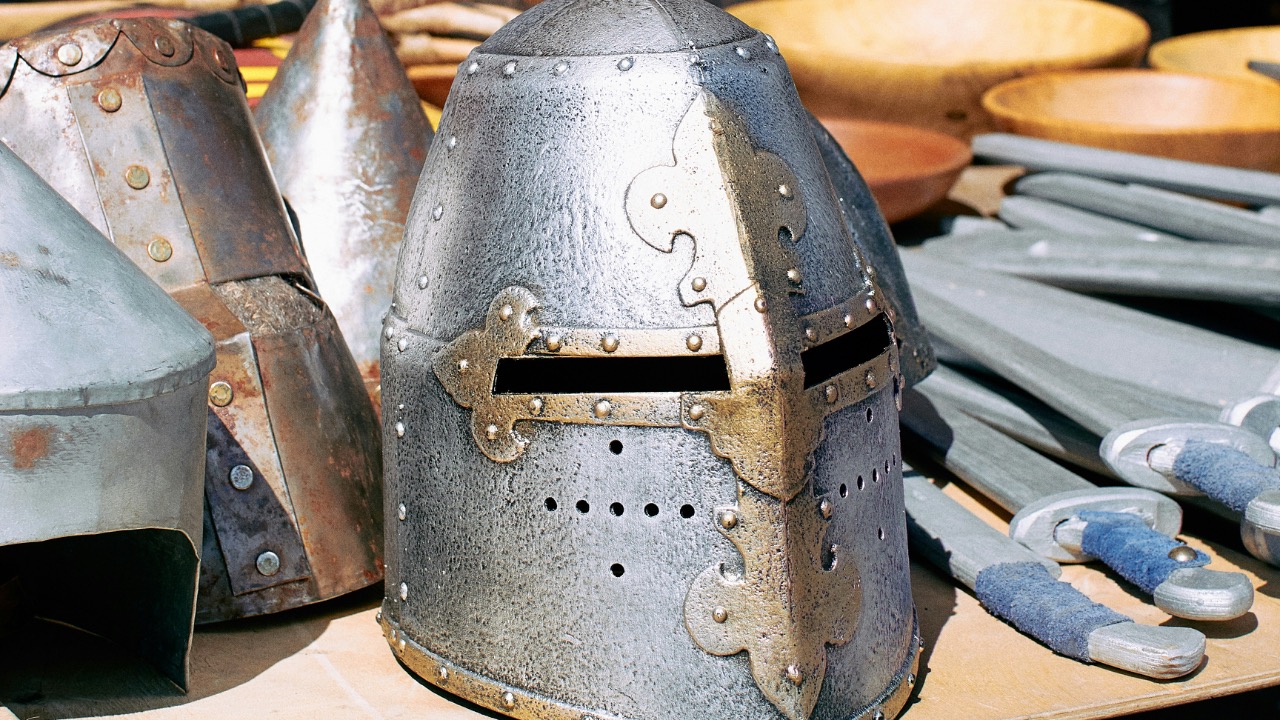
Not all unsettling medieval artifacts are blades or projectiles. Some of the most disturbing are pieces of armor that turned the wearer into something inhuman. A striking example is a 16th Century Superb Grotesque Helmet described as an imposing headpiece with a demonic face, wide eyes, a moustache, a goatee, and pointed teeth. The description notes that This imposing helmet belongs to a tradition of impressive gothic helmets in grotesque form. Looking at such a piece, I am struck by how deliberately it distorts the human face into a mask of predatory calm, as if the wearer had shed any trace of vulnerability.
Contemporary commentary on Eastern European warfare reinforces that this was not an isolated fashion choice. In Moscow and among the Golden Horde, armorers used embossing to create helmets with masked visors and sinister human features. A historical segment on these designs notes that Among the armies of Moscow and the Golden Horde, grotesque faces on helmets were meant to strike terror into enemy soldiers. When I imagine a line of cavalry advancing with metal faces frozen in sneers or grimaces, it is clear that the helmet itself became a psychological weapon. The unsettling part is how effectively these artisans understood the power of eye contact and facial expression, then twisted those instincts into tools for intimidation.
Composed armor sets and the quiet menace of full plate
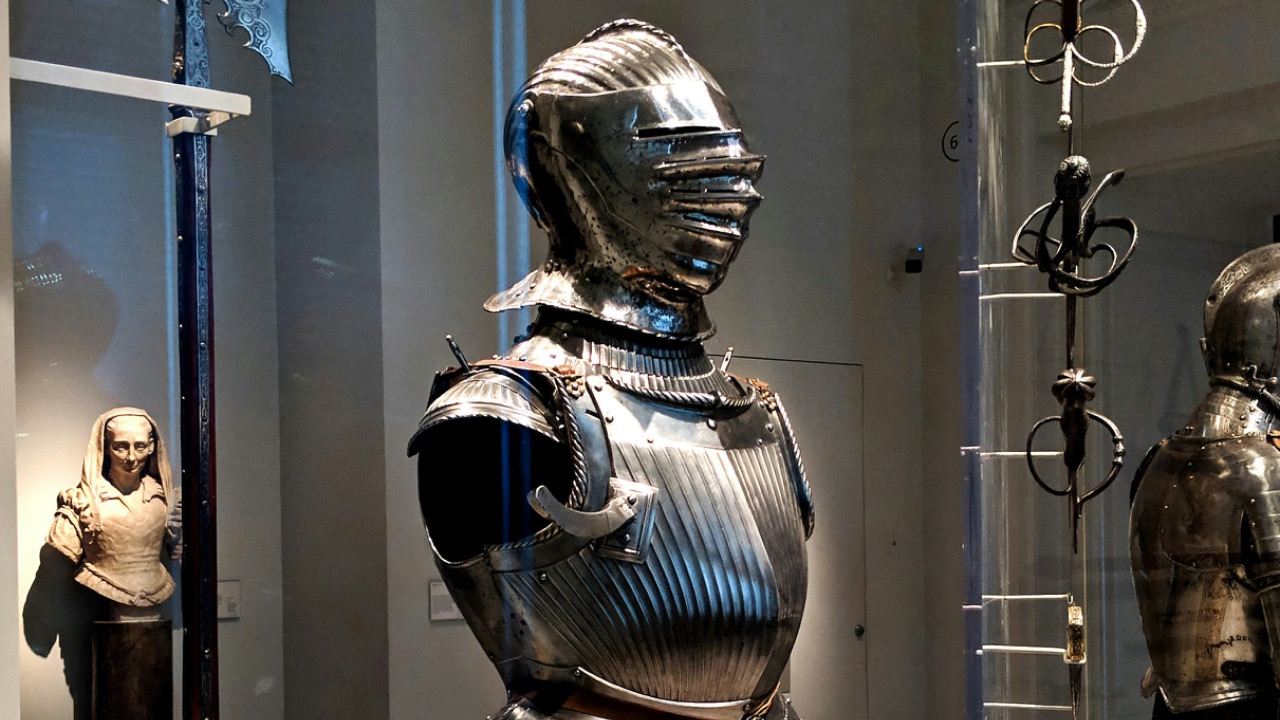
At first glance, a full suit of plate armor in a museum can seem almost reassuring, a polished shell that turns a knight into a walking statue. Yet the more closely I look, the more menacing it becomes. A study of a composed harness at the Metropolitan Museum of Art in New York City, described in a project titled History Unfolding, explains how curators assembled pieces from different origins into a coherent Composed Armor Set The Metropolitan Museum of Art, New York City. Even though the result is not incredibly flashy, it is rather fascinating in how it demonstrates the logic of full-body protection: overlapping plates, articulated joints, and narrow vision slits that turn the wearer into a kind of armored machine.
What unsettles me is how completely such armor erases the individual. Once the visor is down, there is no visible face, no expression, only a metal surface that reflects the chaos around it. Combined with the brutal tools these soldiers carried, from swords to maces, the armor suggests a person who has been reshaped into a weapon system, optimized for killing and survival rather than for any recognizable human interaction. In that sense, even a relatively plain harness can feel as disturbing as a grotesque helmet, because it embodies a world in which entire social classes were trained and equipped to live inside steel shells built for violence.
Traps, locks, and the invisible weapons of castle defense
When people imagine medieval warfare, they often picture open-field battles, but some of the most unsettling technologies were hidden inside walls and gates. Research into fortification security stresses that Medieval defense was not primitive. It was thoughtful, functional, and often surprisingly effective, using locks, murder holes, and traps that stopped the enemy and often broke them psychologically. Boiling liquids, concealed pits, and collapsing stairways turned the very architecture into a weapon, punishing intruders in ways that were as much about fear as about physical harm.
What I find particularly disturbing is the premeditation involved. A sword or spear is reactive, used in the moment, but a trap is designed long before any specific victim appears. Engineers and lords sat together to imagine how an attacker might move, where they might place their feet, and how best to injure or kill them without exposing defenders to risk. That kind of planning, in which the castle itself becomes a silent accomplice, reveals a mindset that treated human bodies as predictable objects in a lethal puzzle. It is a reminder that medieval warfare extended far beyond the clash of armies, into a world of hidden mechanisms waiting patiently for someone to make a fatal mistake.
Why these medieval tools still disturb us
Looking across these examples, from Pier Gerlofs Donia’s Great Sword to Greek Fire and grotesque helmets, a pattern emerges. Medieval societies invested enormous creativity in finding new ways to break the human body and mind, and they celebrated the people who wielded those tools effectively. Modern observers sometimes romanticize this period, but the surviving weapons and armor insist on a more uncomfortable truth: violence was not a side effect of chivalry, it was its core. The fact that so many of these objects were also works of art, from embossed visors to carefully balanced blades, only deepens the unease.

Leo’s been tracking game and tuning gear since he could stand upright. He’s sharp, driven, and knows how to keep things running when conditions turn.