U.S. uses bunker-buster bombs near the Strait of Hormuz
The United States has entered a new phase of its confrontation with Iran along one of the world’s most sensitive waterways, using 5,000-pound bunker-buster bombs against fortified missile sites near the Strait of Hormuz. The strikes are intended to blunt Iranian threats to commercial shipping and energy flows, but they also deepen a conflict that is already shaking global markets and drawing in regional powers.
By choosing to employ some of its heaviest precision munitions against underground positions on Iran’s coastline, the US signaled that it is prepared to accept higher military and political risks to keep the Strait of Hormuz open. The question now is whether this show of force will deter further escalation or harden Iranian resolve to retaliate across the Gulf and beyond.
What the bunker-buster strikes targeted
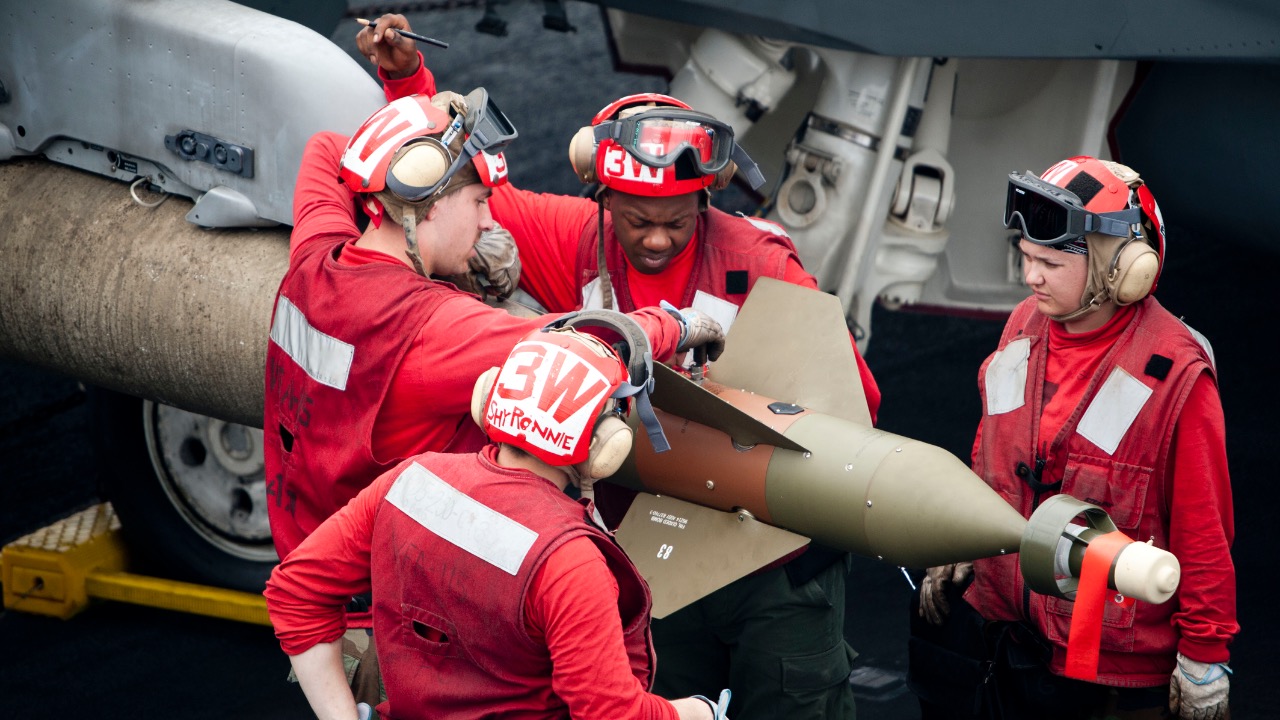
MC3 Paul Kelly/U.S. Navy – Public domain/Wiki Commons
The US operation focused on hardened Iranian missile sites dug into terrain along the approaches to the Strait of Hormuz. According to reporting on the strikes, American aircraft dropped multiple 5,000-pound deep penetrator weapons on underground missile facilities that had been used to threaten shipping lanes.
These targets were not improvised launch pads but hardened Iranian positions designed to protect anti-ship and ballistic missiles from conventional airstrikes. Separate coverage described how the US military struck Iranian missile sites near the Strait of Hormuz that were assessed as capable of disrupting global oil flows.
Video briefings on the operation described US aircraft dropping “multiple 5000-pound deep penetrator munitions” on hardened Iranian missile sites along Iran’s coastline near the Strait of Hormuz, with US Central Command presenting the strikes as a direct response to recent attacks on shipping and energy infrastructure. The same coverage emphasized that these were not symbolic warning shots but a coordinated effort to degrade launch complexes that had survived earlier, lighter strikes.
Why the US turned to heavy bunker-buster bombs
The decision to employ very large bunker-buster munitions reflects both the resilience of Iran’s missile network and the strategic value of the Strait of Hormuz. One detailed account stated that the US used new 5,000-pound GBU-72 bunker busters against Iran missile sites near the Strait of Hormuz, identifying the GBU 72 as the model used.
Built to penetrate reinforced concrete and rock before detonating, these weapons can collapse tunnels, bunkers, and deeply buried storage sites. Earlier reporting on the same series of strikes noted that the bombs were used on underground missile sites that had been hardened since previous attacks by US aircraft in 2021, a sign that Iranian planners had anticipated renewed air operations and invested in deeper fortifications.
Analysts quoted in coverage of the operation argued that conventional precision-guided bombs would struggle against such targets, especially when launchers and command nodes are buried under layers of soil and concrete. The shift to heavy bunker-buster weapons therefore indicates that Washington judged the threat to shipping to be severe enough to justify using some of its most advanced and destructive air-delivered munitions.
How the strikes fit into the wider Iran conflict
The bunker-buster strikes are part of a broader confrontation that has turned the Strait of Hormuz and the surrounding region into an active war zone. One analysis described how the US and Israeli war with Iran has spread into the Indian Ocean, with major maritime confrontations now stretching well beyond the narrow Strait itself.
Live updates from the Gulf region have tracked a pattern of escalation. One feed of Key Headlines reported that Iran hit the world’s largest liquefied natural gas export terminal in Qatar, and that the IRGC later ordered the evacuation of energy assets in Qatar, Saudi Arabia, and the UAE as the conflict intensified. That same stream detailed how Iran’s missile activity and drone attacks have targeted both energy infrastructure and naval assets, prompting calls from Washington for other countries to help secure the Strait of Hormuz.
Within this context, the US decision to attack Iranian coastal missile sites with bunker-buster munitions looks less like an isolated event and more like one step in a rolling campaign. Another report on the operation highlighted that US forces hit Iranian coastal missile sites with bunker-buster bombs that were assessed as threats to commercial shipping, with bunkerbuster munitions specifically chosen to target coastal launch complexes that had previously survived lighter strikes.
The Strait of Hormuz and global supply chains
The stakes around the Strait of Hormuz are not just military. They are also deeply economic. A detailed business analysis warned that by blocking the Strait of Hormuz, global supply chains are at risk, and that for every day the war drags on the list of product shortages and price spikes grows longer.
The Strait of Hormuz is the chokepoint for a significant share of the world’s seaborne oil and liquefied natural gas exports. Tankers leaving terminals in Qatar and Saudi Arabia must pass through this narrow corridor before heading to markets in Europe and Asia. When Iran threatens to fire on these vessels from coastal missile sites, or when it hits facilities such as the LNG export terminal in Qatar, the immediate effect is higher shipping insurance costs and rerouted cargoes. Over time, the result is a drag on global growth and persistent inflationary pressure.
The same analysis pointed out that the cascading effects of a partially blocked Strait of Hormuz are already being felt around the world, from fuel prices in North America to manufacturing inputs in East Asia. That reality helps explain why the US is willing to accept the risks of using heavy bunker-buster bombs on Iranian territory, despite the obvious danger of further escalation.
Details from live conflict reporting
Live-blogs tracking the Iran conflict have provided a granular view of how the bunker-buster strikes unfolded alongside other events. One such feed, labeled as Key Headlines, reported that on Mar 18 at 12:55 PM PDT, US aircraft dropped 5,000-pound bunker-buster bombs at targets around the Strait of Hormuz, shortly after Iran hit the LNG export terminal in Qatar. The same updates noted that Iran’s actions were framed by its leadership as retaliation for earlier strikes on its own territory.
Another live update stream recorded that the IRGC ordered the evacuation of Gulf energy assets in Qatar and Saudi Arabia, as well as in the UAE, after the US strikes. The wording stressed that the IRGC directive was a response to what it described as an expanded US-Israeli campaign, and that it was intended to reduce casualties at facilities that might be targeted in future rounds of the conflict.
Across these feeds, references to Mar timestamps and PDT time zones highlight how quickly events have been unfolding, with new attacks and counterattacks often separated by only hours. The same coverage documented how Iran has tried to leverage its missile arsenal to pressure both regional rivals and the global economy, while the US has sought to use air power to degrade that arsenal before it can be fully brought to bear against shipping.
Technical profile of the GBU 72 bunker buster
At the center of the operation is a specific weapon: the GBU 72, a 5,000-pound bunker-buster bomb designed to attack deeply buried and hardened targets. According to technical summaries referenced in coverage of the strikes, the GBU 72 is guided by precision systems that allow it to home in on coordinates with high accuracy, then use its mass and hardened casing to punch through concrete and rock before detonation.
One report explained that the GBU 72 was dropped on Iran missile sites near the Strait of Hormuz, with targets that included hardened pads used to fire anti-ship missiles. The description emphasized that these pads and associated bunkers were built to survive conventional attacks, which is why the US opted for a munition specifically engineered for deep penetration.
Separate analysis of the strikes noted that the GBU 72 represents an evolution in US bunker-buster technology, with improvements over earlier models in both guidance and penetration capability. Regardless of the specific munitions used, another report stressed that the US strikes targeted Iranian anti-ship cruise missile sites on the edge of the Strait of Hormu, with the goal of reducing the immediate threat to commercial vessels that are often hard to distinguish from civilian types in a crowded shipping lane.
How the operation was framed by US officials
Public statements and background briefings around the strikes have framed the operation as a defensive move designed to protect international shipping and energy infrastructure. One account quoted US officials who argued that the attacks were focused on sites that had directly threatened international shipping, and that they were calibrated to reduce Iran’s ability to close the Strait of Hormuz without broadening the war unnecessarily.
Reporting on the strikes also referenced internal US assessments that previous, smaller-scale attacks on Iranian positions had failed to achieve lasting deterrence. Iranian forces had rebuilt launch sites, dug deeper bunkers, and continued to move missiles and drones into positions along the coastline. The use of 5,000-pound bunker-buster bombs was therefore presented as a necessary step to impose higher costs on Iran’s military planners.
In one detailed story, journalist Zoe Hussain described how the US dropped 5,000-pound bunker busters on underground missile sites near the Strait of Hormuz, and highlighted that this was part of a broader campaign to prevent Iran from leveraging its geography to strangle global energy flows. The same report noted that the sites hit had been hardened since prior attacks by US aircraft in 2021, a point that underlines the iterative nature of the conflict.
Iran’s response and regional reactions
Iran has not treated the bunker-buster strikes as a contained incident. According to live updates, Iran hit Qatar’s LNG export terminal and signaled that it would expand its response if the US and Israel continued their operations. Iranian officials have framed the attacks on their missile sites as acts of aggression that justify further strikes on energy infrastructure and potentially on naval assets in the Gulf.
Regional governments in Qatar and Saudi Arabia have reacted with a mix of alarm and caution. The IRGC’s order to evacuate energy assets in Qatar, Saudi Arabia, and the UAE suggests that Iranian planners anticipate further exchanges and want to limit civilian and contractor casualties at high-value sites. At the same time, these evacuations disrupt production and shipping schedules, which feeds back into the global supply chain stress already described by business analysts.
Other states that rely on the Strait of Hormuz for energy imports, including large Asian economies, have reportedly pressed for de-escalation while also exploring alternative routes and stockpiling strategies. However, the geography of the Gulf means that there is no true substitute for the Strait, and any long-term closure or serious disruption would require a fundamental reordering of global energy trade.
Implications for shipping and maritime security
The direct military effect of the bunker-buster strikes is still being assessed, but their impact on maritime security perceptions is immediate. Reports focused on the shipping sector noted that bunker-buster munitions were used to hit Iranian coastal missile sites that had been identified as threats to commercial shipping, with the goal of reducing the risk of further attacks on tankers and container vessels.

Leo’s been tracking game and tuning gear since he could stand upright. He’s sharp, driven, and knows how to keep things running when conditions turn.