After once facing jail time, Maynard Harrison Smith went on to receive the Medal of Honor
War has a way of reshaping men. Some rise to the occasion early. Others take a harder road before they ever prove what they’re made of.
Maynard Harrison Smith wasn’t the model airman when he first put on the uniform. He clashed with authority. He skirted discipline. At one point, his behavior nearly landed him in serious trouble that could have ended his military career altogether. Yet within a year, he would stand inside a burning bomber over Europe and refuse to give up his post.
If you want to understand how complicated courage can be, you need to understand the full arc of Smith’s story.
A Rough Start in Uniform
When you look at Smith’s early military record, you don’t see a polished career airman. You see a man who struggled with discipline and authority.
He enlisted in the Army before the United States entered the war, but his time in service wasn’t smooth. Smith reportedly clashed with superiors and accumulated disciplinary problems. At one point, his conduct nearly led to serious punishment that could have meant jail time or discharge.
You don’t often hear that part of the story. It’s easier to focus on medals and ceremony. But Smith’s path wasn’t clean or linear. He was stubborn, outspoken, and not always inclined to follow orders quietly. That rough edge, though, would later show up in a very different way.
Assigned to the Eighth Air Force
By 1943, Smith found himself serving as a ball turret gunner in the Eighth Air Force, flying out of England.
If you know anything about daylight bombing missions over occupied Europe, you understand what that meant. Crews faced concentrated anti-aircraft fire and relentless fighter attacks. Casualty rates were staggering.
Smith flew aboard a B-17 Flying Fortress during one of these missions over France. The job of a ball turret gunner placed you in a cramped plexiglass sphere under the bomber’s belly. You had limited protection and almost no room to move. When things went wrong, you were often the most exposed man in the aircraft.
The Mission Over France
On May 1, 1943, Smith’s B-17 joined a formation attacking German submarine pens at Saint-Nazaire, France. The target was heavily defended.
German flak tore into the bomber. The aircraft suffered severe damage, and fires broke out inside the fuselage. Crew members were wounded. Smoke filled compartments. The plane was barely holding together.
When the B-17 limped away from the target, the danger wasn’t over. Flames continued to spread. Ammunition cooked off. Explosions ripped through the interior. It would have been understandable—human even—for a man to focus only on his own survival at that point. Smith did the opposite.
Fighting Fire in a Burning Bomber
Despite being wounded himself, Smith refused medical attention. Instead, you would have seen him moving through the damaged aircraft with a fire extinguisher in hand.
For nearly 90 minutes, he fought flames that threatened to destroy the bomber midair. He kicked burning ammunition out of the waist positions. He administered first aid to injured crewmen. He manned defensive guns when enemy fighters approached again.
All of this happened in a crippled aircraft, leaking fuel and trailing smoke across the sky. He was operating in heat, chaos, and constant danger. There was no dramatic speech. No cinematic moment. There was simply a man who decided that quitting wasn’t an option.
Refusing to Be Relieved
At one point during the return flight to England, a superior officer suggested that Smith be relieved of duty because of his wounds. He refused.
You can picture the scene: a battered bomber, injured crew, nerves stretched thin. Smith insisted on staying at his position and continuing to defend the aircraft. He believed the crew still needed him.
That decision mattered. In a damaged bomber limping home, every gun counted. Every pair of steady hands mattered. Smith’s stubborn streak—once a liability—had transformed into resolve. The same defiance that once got him into trouble now kept him locked in place when others might have stepped back.
The Medal of Honor Ceremony
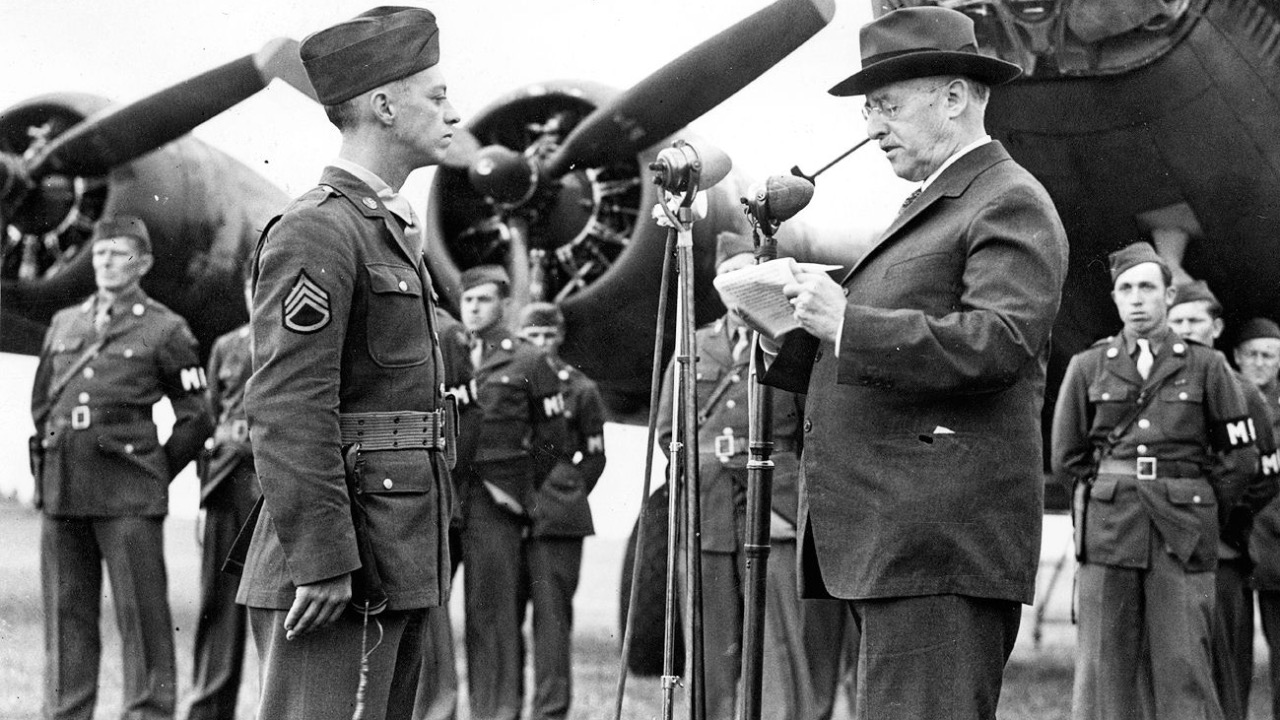
For his actions that day, Smith became the first enlisted airman in the European Theater to receive the Medal of Honorduring World War II.
On July 16, 1943, Franklin D. Roosevelt personally presented the medal at the White House. That’s the image most people remember: a decorated airman standing before the president, recognized for extraordinary bravery.
What you don’t see in that moment is the earlier version of Smith—the man who nearly lost his place in uniform. His story forces you to reconsider how growth happens. A troubled record didn’t define him. When it counted, under fire and in a burning aircraft, he showed exactly who he was.

Asher was raised in the woods and on the water, and it shows. He’s logged more hours behind a rifle and under a heavy pack than most men twice his age.